
Key Takeaways
-
1Neither Model Wins Universally: The right choice depends on your budget, complexity, and how much control you need.
-
2In-House Hiring Skews Toward Larger Companies: Most open SEO roles sit at companies with 250+ employees.
-
3Speed Favours Outsourcing: Agencies start delivering in weeks. In-house hires take months to ramp up.
-
4Contract Talent Is on the Rise: Most marketing leaders are increasing their use of contractors, not reducing it.
-
5The Right Model Changes Over Time: What works today may not work in eighteen months.
The debate around SEO in-house vs outsourcing rarely gets a straight answer.
Agencies will tell you outsourcing wins. In-house advocates will tell you control is everything.
The honest answer is that neither model is universally better. What matters is whether the model you choose matches your business’s current stage and budget.
This guide isn’t a pros and cons list. It’s a decision framework built to help you identify which model fits your business right now, and when that answer might change.
What We Mean by In-House SEO vs Outsourced SEO
Before comparing the two, it’s worth being precise about what each actually involves.
In-house SEO means building an internal team dedicated to managing your search engine optimisation. This could be a single specialist, a small team, or a full department.
Outsourced SEO means contracting an external agency, consultant, or white label provider to manage some or all of your SEO activity. You’re buying their expertise and time rather than hiring it directly.
The hybrid model combines both. Many businesses keep strategy and brand-specific content in-house while outsourcing execution-heavy work like technical audits or content production. This is increasingly common, and often the most practical choice.
What In-House SEO Actually Costs
Cost is the first thing most people look at, and the area most often misrepresented. Building even a modest in-house function involves more than a salary.
Source: Search Enigne Land
Add the full cost of employment on top of that. Benefits, payroll taxes, and paid time off typically add 25 to 30 percent to the base salary figure.
Then factor in tools. A functional SEO stack, keyword research, technical crawling, rank tracking, and reporting, runs $500 to $1,500 a month depending on the tier.
Training adds another $2,000 to $5,000 annually per team member. Recruitment costs average 15 to 20 percent of the first year’s salary.
| Cost Component | Annual Estimate |
|---|---|
| SEO Specialist Salary | $68,000 - $100,000 |
| Benefits and Payroll Taxes (28%) | $19,000 - $28,000 |
| SEO Tools and Software | $6,000 - $18,000 |
| Training and Development | $2,000 - $5,000 |
| Recruitment (first year) | $10,000 - $20,000 |
| Total Year One Cost | $105,000 - $171,000 |
This is the cost of a single specialist. A functional team covering content, technical SEO, and link building needs three to five people minimum, which multiplies these figu
⚠️ Warning
This is the cost of one hire, not one team. Most businesses underestimate this because they price out a single salary and stop there.
What Outsourced SEO Actually Costs
Outsourced pricing varies by scope, market, and provider quality.
Source: Ahrefs
| Service Type | Monthly Cost Range |
|---|---|
| Freelance SEO Consultant | $500 - $3,000 |
| Small to Mid-Size Agency | $1,500 - $5,000 |
| Established Full-Service Agency | $5,000 - $15,000 |
| Enterprise Agency | $15,000+ |
These fees typically bundle strategy, execution, tools, and reporting together, something a freelancer’s hourly rate alone doesn’t include.
The cost advantage reverses at scale. A large business generating significant organic revenue can justify investing in a full in-house team that compounds its knowledge over time.
6 Signals to Choose In-House vs Agency SEO
Rather than asking which model is better in general, ask which signals in your current situation point toward one model or the other.
Signal 1: Your Budget
Source: Ahrefs
This is a useful reality check. If you’re a small or mid-size business, you’re not the typical in-house hirer, and that’s fine. The market data itself suggests outsourcing is the more common path at your size.
Under $60,000 a year, outsourcing is almost always the rational choice. That budget won’t cover one competent in-house hire with tools included.
Over $150,000 annually, with SEO as a primary revenue driver, in-house starts making financial sense.
Between $60,000 and $150,000, the hybrid model is usually the most efficient use of resources.
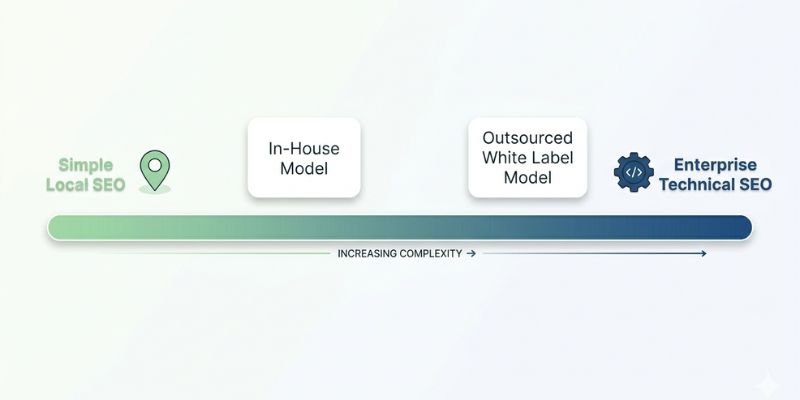
Signal 2: The Complexity of Your SEO Needs
Simple local or content-led SEO can often be managed in-house by a generalist with the right guidance.
Complex technical SEO, enterprise architecture, or aggressive link acquisition genuinely benefit from specialists whose entire practice is built around that discipline.
Signal 3: How Quickly You Need Results
Recruiting a qualified in-house specialist typically takes two to four months. Ramping to full productivity takes another two to three months.
Outsourced agencies typically begin execution within two to four weeks. If you’re under competitive pressure or recovering from a penalty, that speed advantage matters.
Signal 4: How Much Brand Knowledge Matters
This is the strongest argument for in-house SEO, and it’s often underweighted in cost-focused comparisons.
An in-house team lives inside your product and customer conversations every day. That contextual knowledge produces content an external agency can’t easily replicate.
For businesses where content depth is the primary SEO lever, publishing, SaaS, professional services, in-house brand knowledge is a genuine advantage.
Signal 5: How Stable Your SEO Strategy Is
A well-defined strategy with sound site architecture suits in-house execution well.
A forming strategy, significant technical debt, or unclear ranking issues need diagnostic expertise most in-house hires can’t provide at the level an experienced agency can.
Signal 6: How Much Control You Need
Businesses with strict compliance requirements, financial services, healthcare, legal, often need in-house SEO for tight control over every piece of content before publication.
If outcome quality matters more than day-to-day control, outsourcing is operationally practical.
The Hybrid Model in Practice
The hybrid model isn’t a compromise. For many businesses, it’s the most strategically intelligent choice, and the data backs this up.
Source: Robert Half
In-house responsibilities: strategy oversight, brand voice, product knowledge, content briefs, cross-functional collaboration, reporting to leadership.
Outsourced responsibilities: technical audits, link acquisition, content production at scale, keyword research, local SEO across multiple locations, reporting infrastructure.
The key is clear ownership of the division between what’s managed internally and what’s delegated externally.

When to Switch Models
The right model for your business today may not be right in two years. Here are the specific triggers worth watching for.
Move from outsourced to in-house when:
- Your organic channel represents 30% or more of total revenue
- Your agency doesn’t understand your product well enough to produce useful content
- You consistently need to move faster than your agency’s workflow allows
- You have the budget to hire and retain a strong team
Move from in-house to outsourced when:
- Your team is struggling to keep pace with algorithm or technical changes
- You’re in rapid growth or a site migration requiring specialist capability
- A key team member has left and you need continuity while rehiring
- Your cost per result is increasing rather than improving
Add outsourcing to an existing in-house function when:
- You need to scale content production beyond your team’s capacity
- You’re expanding into a new market or region
- You need link building at a scale your team can’t produce internally
The Agency-Specific Version of This Decision
Marketing agencies face a variation of this same question, but on behalf of their clients, not just themselves.
Agencies that resell SEO services are effectively choosing an outsourced model for their clients. Working with a white label SEO company in Sydney lets an agency offer SEO without building an internal delivery function, using a fulfilment partner’s team under the agency’s own brand.
If you’re an agency trying to grow your client base specifically without adding headcount, this decision has its own dedicated considerations, provider vetting, contractual protections, and capacity planning that go beyond the general in-house-versus-outsourcing framework covered here.
Practical Decision Scorecard
Score each factor 1 to 3 based on where your business actually stands right now, then add up your total.
| Factor | 1 Point | 2 Points | 3 Points |
|---|---|---|---|
| Annual SEO Budget | Under $60K | $60K to $150K | Over $150K |
| SEO Complexity | Simple local or content | Mixed technical and content | Complex technical or enterprise |
| Speed of Results Needed | 6 to 12 months | 3 to 6 months | Under 3 months |
| Brand Knowledge Importance | Low | Medium | Critical |
| Internal Control Requirements | Flexible | Moderate | Strict |
| Current Team SEO Capability | Strong | Moderate | Limited |
6–10: Outsourcing or hybrid model is the strongest fit right now.
11–14: Hybrid model with strong internal oversight is the most practical choice.
15–18: In-house SEO is viable and worth investing in, though a hybrid may still be more efficient during a build phase.
Common Mistakes Regardless of Model
- Treating SEO as a one-time project – it requires consistent execution over months to produce compounding results
- Choosing based on cost alone – the cheapest hire and the cheapest agency both carry the same risk: insufficient expertise
- Skipping clear performance benchmarks – without them, there’s no reliable way to evaluate whether the model is working
- Switching models too early – SEO typically needs three to six months to show meaningful movement, switching before that resets the clock
⚠️ Warning
Unclear expectations around ranking timeframes are one of the most commonly cited frustrations agencies hear from clients. Setting realistic timelines upfront, regardless of which model you choose, prevents most of this friction before it starts.
Conclusion
SEO in-house vs outsourcing is not a question with a single right answer. It is a question with a right answer for your specific business at its current stage.
Outsourcing makes the most sense when your budget is limited, your needs are technically complex, you need results quickly, or your strategy is still forming. In-house makes the most sense when SEO is a primary revenue driver, brand knowledge is a critical differentiator, your budget supports a strong team, and you need tight operational control.
The hybrid model is not a fallback position. It is often the most strategically sound choice for businesses that need both expert execution and internal alignment.
The most important thing is to make the decision deliberately, with clear performance benchmarks, and to revisit it as your business grows. The right model today is not necessarily the right model in eighteen months.
FAQs
Is outsourcing SEO more cost-effective than hiring in-house?
For most small to mid-size businesses, yes. An agency at $2,000 to $5,000 a month covers a team of specialists and tools that would cost over $100,000 to replicate in-house. This shifts at scale, once SEO is a primary revenue driver.
Can I do both in-house and outsourced SEO at the same time?
Yes. The hybrid model is increasingly common, and most marketing leaders are actively increasing their use of contract talent rather than moving away from it.
How long does it take to see results from outsourced SEO?
Most reputable agencies show early traction within three to six months. Any provider guaranteeing first-page rankings within a specific timeframe should be treated with caution, no one can guarantee rankings.
What are the biggest risks of outsourcing SEO?
Provider quality, lack of brand alignment in content, and ethical practice concerns around link building. Thorough vetting and clear contractual obligations mitigate these substantially.
When should I stop outsourcing and build in-house?
When organic SEO represents a significant share of revenue, when your agency struggles to capture your brand voice, or when your budget supports hiring and retaining strong talent long-term.
Conclusion
SEO in-house vs outsourcing isn’t a question with one right answer. It’s a question with a right answer for your business at its current stage.
Outsourcing makes sense when your budget is limited, your needs are technically complex, or your strategy is still forming. In-house makes sense when SEO is a primary revenue driver and you need tight operational control.
The hybrid model isn’t a fallback. For many businesses, it’s the most strategically sound choice of all, and the market is clearly moving in that direction.
The most important thing is making this decision deliberately, and revisiting it as your business grows.
Not Sure Which Model Fits Your Business?
Our team helps businesses build the right SEO delivery model, whether that's fully outsourced, in-house support, or a hybrid built around your budget and goals.
👉 Talk to Our SEO Team