
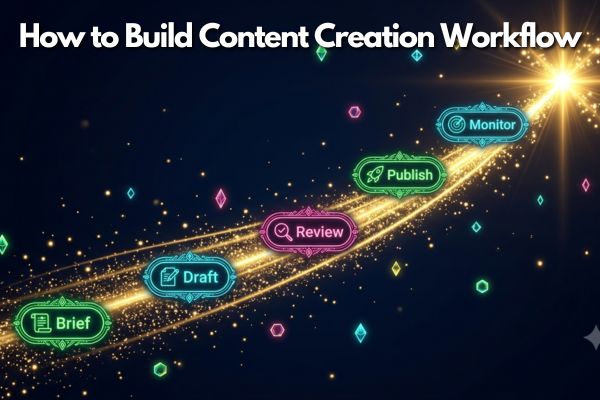
A content creation workflow is the infrastructure that separates content teams that consistently publish high-quality work from those that scramble to meet deadlines, chase approvals, and wonder why their content never quite performs the way it should.
Most businesses understand that content matters. Far fewer have built the systems that make producing it reliably possible without burning out the people responsible for it.
The uncomfortable reality is that a brilliant content strategy executed through a broken workflow produces mediocre results. A good content strategy executed through a disciplined, well-documented workflow compounds in value over time, building organic reach, brand authority, and conversion performance that a chaotic production process never could.
This guide covers every dimension of a high-performing content creation workflow, from what it actually is and why it matters to a step-by-step production framework, ready-to-use templates, and the most common mistakes that derail even experienced content teams.
Why Your Content Workflow Is the Key to Consistency
A content creation workflow determines not just what gets published but how reliably it gets published, at what quality level, and at what cost to the team producing it.
Content chaos takes many forms: missed deadlines, duplicated effort, unclear ownership, and brand voice inconsistency. It is not a volume problem. It is a workflow problem. And it compounds as content output scales.
Research from the Content Marketing Institute consistently finds that the most effective content marketing teams operate with documented strategies and defined workflows, while the least effective teams tend to work without either.
The gap between those two groups is not creative talent or budget. It is the presence or absence of a system. For businesses investing in SEO content writing to drive organic traffic, the stakes are particularly high.
A workflow that introduces errors, delays publication, or allows brand voice inconsistencies to slip through does not just hurt internal efficiency. It directly undermines the ranking signals and reader trust that SEO-driven content depends on.
What Is a Content Creation Workflow and What Does It Actually Cover
A content creation workflow is the complete system through which a piece of content moves from initial idea to published asset and beyond. It encompasses every person, task, tool, approval gate, and timeline involved in that journey.
It is not a single checklist but a living operational framework that defines how content gets made in a specific organisation with specific people and specific goals.
Understanding what a workflow covers is equally important as understanding what it does not. A workflow is not a content strategy. It does not decide what topics to cover or which audiences to target. A workflow is the engine that executes whatever the strategy prescribes.
The Three Core Elements — Process, Tasks and People
Every effective content creation workflow rests on three pillars that must all function well for the workflow to succeed:
| Pillar | What It Defines | What Happens Without It |
|---|---|---|
| Process | How content travels through the organisation, hand-off points, and approval gates | Content gets stuck, delayed, or skips quality checks |
| Tasks | Specific actions at each stage, who performs them, and how long each takes | Effort is duplicated, timelines are missed, briefs are ignored |
| People | Whether tasks are completed on time, at quality, with the right skills applied | Even perfect processes collapse without the right people owning them |
Weakness in any one of these three pillars degrades the entire workflow. A well-defined process with unclear task ownership fails. Clear tasks assigned to the wrong people fail. The right people with no documented process improvise, and improvisation at scale produces inconsistency.
How a Workflow Differs From a Content Strategy
A content strategy answers the questions of what to create, for whom, and why. It defines audience personas, content pillars, channel priorities, and success metrics.
A content creation workflow answers the questions of how content gets made, by whom, in what sequence, and to what standard.
Strategy without workflow is a plan with no execution mechanism. Workflow without strategy is a production machine pointed in no particular direction.
Why Every Content Type Needs Its Own Workflow Variation
A blog post workflow and a video production workflow share some structural similarities. Both require ideation, production, review, and publication.
But their task sequences, time requirements, approval processes, and tool dependencies are fundamentally different. A 1,500-word blog post moves from brief to publication in a few days.
A three-minute brand video may require storyboarding, scripting, filming, editing, colour grading, audio mixing, and legal review before it is ready to publish.
Applying a single generic workflow to every content type creates friction, missed steps, and unrealistic deadlines. The investment in building type-specific workflow variations pays back in faster production cycles and fewer quality problems at the publication stage.
The Risks of Creating Content Without a Defined Workflow
Operating without a documented content creation workflow is not a neutral choice. It actively introduces risks that compound as content volume grows.
Teams that manage these risks informally through individual effort and goodwill find that the system breaks down precisely when it matters most: during high-volume periods, team transitions, or when scaling production for growth.
Missed Deadlines and Content Stuck in Approval Limbo
The most visible symptom of a broken workflow is content that gets stuck. A copywriter finishes a draft and does not know who to send it to next. An editor waits for subject matter expert sign-off from someone who was never formally notified.
A piece that should have published on Tuesday sits in a shared folder on Friday because no one has defined who is responsible for the final upload.
These delays are not caused by laziness or incompetence. They are caused by a workflow that has no defined hand-off points, no named owners for each stage, and no deadlines attached to individual tasks.
Documenting those three elements for every stage of production eliminates the vast majority of deadline failures.
Brand Voice Fragmentation Across Channels
When multiple writers, editors, and content contributors work without a shared, documented workflow that includes brand voice guidelines and editorial standards, the result is content that sounds different across channels.
A LinkedIn post sounds formal and corporate. A blog reads conversational and casual. An email sequence uses different terminology than the website it is driving traffic to.
Brand voice fragmentation erodes the trust that consistent content builds over time. For local SEO content strategies where brand familiarity is a key trust signal in a defined geographic market, this inconsistency can directly affect conversion rates.
Wasted Time, Budget and Talent on Avoidable Bottlenecks
Content production without a workflow tends to involve significant duplication of effort. Writers research topics that have already been covered. Designers create assets that do not match the brief because the brief was not shared in time.
Editors receive drafts that were not reviewed by the subject matter expert first, requiring revision after the editorial pass rather than before it.
Each of these inefficiencies represents a direct cost in time, in budget, and in the opportunity cost of talent that could be applied to higher-value tasks.
A well-documented workflow eliminates most of these bottlenecks not by making people work harder but by ensuring that the right work happens in the right sequence by the right person.
The Content Creation Workflow Step by Step
A robust content creation workflow follows a consistent sequence regardless of content type, though the depth and duration of each stage varies significantly depending on what is being produced.
The seven stages below represent the complete production lifecycle of a piece of content from idea to ongoing performance management.
Step 1 — Ideation and Strategy:
Every piece of content should begin with a defined goal, not a topic, but a goal. What should this content achieve? Drive organic traffic to a specific keyword cluster? Nurture leads who have downloaded a guide? Support a product launch?
The goal determines the topic, the format, the channel, the call to action, and the success metric. A brief that starts with a topic and never defines a goal produces content that is technically complete and strategically purposeless.
Step 2 — Research:
Research in a content workflow is not something that happens only at the ideation stage. It is an active part of the production process that the writer undertakes before drafting begins. The research stage is also where the content brief is finalised. A complete brief should include:
- Target keyword and secondary keywords
- Intended audience and their assumed knowledge level
- Content goal and success metric
- Required word count or duration
- Tone and style guidelines
- Mandatory inclusions such as specific products, data points, or calls to action
Step 3 — Production:
Production is the stage where the content is actually created. For written content, this means drafting the piece according to the brief. For visual or video content, it means designing, filming, illustrating, or animating the asset.
The most important production rule in any workflow is that the creator should focus exclusively on creation during this stage and resist the impulse to self-edit in real time.
Self-editing during production slows the process, introduces over-caution, and produces drafts that are technically polished but often structurally weak because the writer never fully committed to a clear argument before starting to refine one.
Step 4 — Editing and SME Review:
The editing stage encompasses two distinct activities that must happen in the correct sequence. Subject matter expert review should happen before the editorial review.
Editing a piece that later requires significant factual corrections wastes the editor’s time and introduces the risk that corrected content does not receive a second editorial pass.
Editorial review then addresses structure, clarity, tone, brand voice, readability, and compliance with the style guide. The editor’s job is not to rewrite.
It is to strengthen what the writer produced while maintaining their voice and ensuring the piece meets the standards the workflow has defined.
Step 5 — Testing and Experimentation:
Not every piece of content requires a formal testing stage, but high-stakes content including landing pages, campaign emails, product category pages, and cornerstone articles benefits significantly from comparing alternative versions before committing to the final one.
The testing stage is consistently underinvested in content workflows and consistently overperforms when it is included. A headline change that improves click-through rate by 15% on a high-traffic page compounds in value every day that page remains live.
Step 6 — Publication:
The publication stage should be accessible to non-technical team members including content managers, editors, and marketers, without requiring developer intervention for every upload.
Modern content management systems make this possible, but only when the workflow includes clear publication standards covering how to format content in the CMS, how to add metadata, how to optimise images, and how to set up internal links.
For e-commerce seo content operations where product descriptions, category pages, and campaign content need to be published quickly and accurately at scale, a publication stage without developer dependency is not a convenience. It is a competitive requirement.
Step 7 — Performance Monitoring:
Performance monitoring is the step that most content creation workflows either omit entirely or treat as an afterthought. Publishing a piece of content and moving immediately to the next one without reviewing how the previous piece performed is equivalent to running a business without looking at the accounts. At a minimum, monitoring should track:
- Organic traffic and keyword rankings
- Time on page and scroll depth
- Conversion rate from the content piece
- Backlinks earned over time
How to Build Your Own Content Creation Workflow From Scratch
Building a workflow from scratch is significantly more effective when it starts with an honest audit of what currently exists rather than with a blank template.
Most organisations already have an informal workflow. The problem is that it exists only in the heads of the people who have been doing the work, making it fragile, inconsistent, and impossible to scale.
Map Your Current Process Before You Redesign It
Before redesigning or formalising a content workflow, document what actually happens today. Track a recent piece of content from its original idea to its published state and note every step, every person involved, every tool used, every delay experienced, and every rework required.
This process map will reveal the actual workflow rather than the intended one, and the gap between those two is where most workflow improvement opportunities live.
Define Roles and Responsibilities Using a RACI Framework
The RACI framework is one of the most practical tools available for defining who does what in a content workflow:
| Letter | Stands For | Meaning in a Content Workflow |
|---|---|---|
| R | Responsible | The person who does the work at this stage |
| A | Accountable | The person who owns the outcome and approves it |
| C | Consulted | Those whose input is needed before the stage is complete |
| I | Informed | Those who need to know the status but do not take action |
Ambiguity about accountability is the most common cause of approval bottlenecks in content workflows. When two people believe they are both accountable for a stage, neither moves decisively. The RACI framework eliminates that ambiguity by making ownership explicit for every stage.
Set Time Estimates for Every Stage to Make Deadlines Realistic
A workflow without time estimates is a workflow that will routinely produce unrealistic deadlines. Setting time estimates for every stage makes it possible to work backwards from a publication date to determine when each stage must begin.
A 1,500-word blog post that requires keyword research, a detailed brief, writing, SME review, editorial review, and publication setup might require ten to twelve hours of elapsed time across three to five days, not the two-day turnaround that gets promised without checking the numbers.
Build Workflow Variations for Different Content Types
Once the core workflow is documented, build variations for each content type the team regularly produces. A blog post variation, a social media variation, a video production variation, and an email sequence variation will share structural similarities but differ in task specifics, time estimates, approval requirements, and tool dependencies.
A Ready-to-Use Content Creation Workflow Template
The templates below represent a practical starting point. Adjust the time estimates, responsible parties, and specific tasks to reflect your organisation’s actual structure and content types.
Blog Post Workflow Template
| Stage | Task | Owner | Time Estimate |
|---|---|---|---|
| Strategy | Define goal and target keyword | Content Strategist | 15 minutes |
| Strategy | Complete content brief | Content Strategist | 30 minutes |
| Research | Keyword and competitor research | SEO or Writer | 45 minutes |
| Research | Audience and topic research | Writer | 60 minutes |
| Production | Write first draft | Writer | 3 to 4 hours |
| Review | SME accuracy review | Subject Matter Expert | 60 minutes |
| Review | Editorial review and revisions | Editor | 90 minutes |
| Production | Add images, metadata, internal links | Content Manager | 30 minutes |
| Publication | Final approval and publish | Head of Content | 20 minutes |
| Monitoring | Review performance at 30 days | Content Strategist | 20 minutes |
Social Media Content Workflow Template
| Stage | Task | Owner | Time Estimate |
|---|---|---|---|
| Strategy | Define platform, goal and audience | Social Media Manager | 15 minutes |
| Production | Draft copy variations | Copywriter | 30 minutes |
| Production | Design accompanying visuals | Graphic Designer | 45 minutes |
| Review | Editorial and brand review | Editor | 20 minutes |
| Publication | Schedule via platform tool | Social Media Manager | 10 minutes |
| Monitoring | Review engagement at 48 hours | Social Media Manager | 15 minutes |
Video Content Workflow Template
| Stage | Task | Owner | Time Estimate |
|---|---|---|---|
| Strategy | Define goal, format and script brief | Content Strategist | 30 minutes |
| Production | Write and approve script | Copywriter and Editor | 2 hours |
| Production | Storyboard and shot list | Creative Director | 60 minutes |
| Production | Film or animate content | Video Producer | Variable |
| Review | Edit and colour grade footage | Video Editor | Variable |
| Review | SME and legal review if required | SME and Legal | Variable |
| Production | Add captions, thumbnails and metadata | Video Manager | 45 minutes |
| Publication | Upload and schedule | Content Manager | 20 minutes |
| Monitoring | Review watch time and completion rate at 7 days | Content Strategist | 20 minutes |
Most Common Content Workflow Mistakes and How to Fix Them
Even teams with documented workflows make predictable mistakes that erode the efficiency and quality gains those workflows were designed to deliver. Naming these mistakes explicitly is more useful than pretending that documentation alone solves everything.
Manual Copy-Paste Processes That Introduce Errors and Slow Teams Down
Workflows that require content to be manually copied from one tool to another introduce two problems simultaneously. They create opportunities for human error at every transfer point, and they consume time that could be invested in higher-value tasks. Over a high volume of content, these manual steps add up to significant lost productivity.
The fix is integration. Modern content tools can connect via API or native integrations, reducing or eliminating manual transfers.
⚠️ Warning
-
The most dangerous manual process in any content workflow is an approval chain conducted entirely via email. Email approvals have no audit trail, no deadline enforcement, and no visibility for the team waiting on sign-off. Replacing email approvals with a dedicated workflow tool or project management platform is one of the highest-impact changes a content team can make.
Content Silos That Kill Collaboration and Brand Consistency
Content silos occur when different teams, departments, or channels manage their content in separate tools, separate databases, or separate processes that do not connect.
A website team, a social media team, and an email marketing team all producing content for the same brand without access to each other’s work creates duplication, inconsistency, and missed opportunities to repurpose high-performing assets across channels.
At a minimum, a shared content calendar visible to all producing teams and a shared asset library accessible across channels creates enough coordination to reduce the most damaging silo effects.
Approval Stages With No Defined Owner or Deadline
An approval stage in a workflow without a named owner and a defined deadline is not an approval stage. It is a place where content goes to wait indefinitely.
Every approval gate must name the specific person responsible for providing sign-off, the deadline by which sign-off must be provided, and the escalation path if that deadline is not met.
This is especially important in organisations where subject matter experts are senior people with competing priorities. Building the SME review stage into their calendar at the briefing stage transforms approval from an interruption into a scheduled commitment.
Treating the Workflow as a One-Time Setup
A content workflow documented once and never reviewed becomes outdated faster than most teams expect. Team members change. Tools change. Content types are added. Audience platforms shift.
A workflow optimised for a team of three people producing two blog posts per week will not serve a team of eight people producing fifteen pieces per month across five formats.
Scheduling a quarterly workflow review keeps the workflow aligned with the reality of current operations rather than the reality it was designed for.
Content Creation Workflow Quick Reference Checklist
Use this checklist when building or auditing your content creation workflow:
Foundation
- Have you documented the workflow rather than relying on institutional knowledge?
- Does the workflow cover all content types your team regularly produces?
- Have you built type-specific workflow variations rather than a single generic process?
Roles and Responsibilities
- Does every stage have a named owner using the RACI framework?
- Are approval stages assigned to specific people with defined deadlines?
- Is there a documented escalation path when deadlines are missed?
Process
- Have you mapped your current informal workflow before redesigning it?
- Does the workflow include time estimates for every stage?
- Are approval stages sequenced correctly with SME review before editorial review?
Tools
- Does your CMS allow non-technical team members to publish without developer support?
- Is there a shared content calendar visible to all producing teams?
- Are approvals handled in a tool that provides audit trail and deadline enforcement?
Performance
- Does the workflow include a defined performance monitoring stage after publication?
- Are underperforming pieces reviewed and updated rather than simply replaced?
- Is the workflow itself reviewed quarterly to stay aligned with current operations?
A content creation workflow is not a constraint on creativity. It is what makes creativity sustainable at scale. Without one, the most talented content team in the world will eventually produce inconsistent work under unsustainable pressure.
With one, an average team can produce consistently excellent content because the system removes the variables that cause quality to fluctuate.
FAQs
Q1: What is a content creation workflow?
A content creation workflow is a documented system that moves content from initial idea to published asset through defined stages, tasks, approvals, and people. It covers ideation, research, production, editing, publication, and performance monitoring. It ensures content is produced consistently, on time, and to a defined quality standard.
Q2: What are the steps in a content creation workflow?
A complete content creation workflow follows seven steps: ideation and strategy, research, production, editing and SME review, testing, publication, and performance monitoring. Each step has a specific job and builds on the one before it. Skipping any stage introduces quality problems or delays that compound over time.
Q3: What is the difference between a content workflow and a content strategy?
A content strategy defines what to create, for whom, and why. A content workflow defines how content gets made, by whom, in what sequence, and to what standard. Strategy decides direction and workflow executes it. Both are necessary and neither replaces the other.
Q4: What should a content workflow template include?
A content workflow template should include every production stage from brief to monitoring, the specific task and named owner at each stage, and a realistic time estimate for each task. It should also include a defined approval gate before content moves to the next stage. Templates should be adapted separately for each content type.
Q5: How do you scale content production without losing quality?
Scaling content production without losing quality requires a documented workflow every team member follows regardless of volume. Type-specific workflow variations ensure blog posts, videos, and social content each follow the right process. A performance monitoring stage after publication catches quality issues before they compound.
Q6: How do you handle content approvals without causing delays?
Approval delays are caused by three missing elements: a named owner for each approval stage, a defined deadline for sign-off, and a documented escalation path when that deadline is not met. Moving approvals out of email and into a dedicated workflow tool with deadline enforcement eliminates most bottlenecks. Building SME review into their calendar at the briefing stage also prevents last minute delays.
Q7: How often should you review and update your content workflow?
A content workflow should be reviewed quarterly at a minimum as teams, tools, and content types change over time. A workflow built for a small team producing two posts per week will not serve a larger team producing fifteen pieces per month. A quarterly review keeps the workflow aligned with current operations rather than outdated ones.
Conclusion
Most content problems are workflow problems in disguise. Inconsistent quality, missed deadlines, brand voice fragmentation, and content that never quite performs the way it should are not signs of a team that does not care. They are signs of a team operating without a system that sets them up to succeed.
A documented content creation workflow solves all of these problems at once by making the right process the default process rather than the exception. It removes the variables that cause quality to fluctuate, eliminates the ambiguity that causes deadlines to slip, and creates the consistency that turns content from a cost centre into a compounding business asset.
The good news is that building a workflow does not require expensive tools, a large team, or months of planning. It requires an honest audit of what currently happens, clear ownership assigned to every stage, realistic time estimates built into every template, and a quarterly commitment to reviewing and improving the system as the team evolves.
Start with the content type you produce most frequently. Document every step from brief to publication. Assign a named owner to every task and every approval gate. Then publish the workflow where every team member can find and follow it.
Do that once, and the difference in output quality, publication consistency, and team morale will be visible within weeks. Do it consistently across every content type you produce, and your content operation will compound in value every single month that passes.
The teams producing the best content consistently are not necessarily the most talented. They are the most systematic. Build the system and the results will follow.
Ready to Build a Content Workflow That Actually Scales?
The content and SEO specialists at OmniSEO Agency build workflows and content strategies tailored to your specific team, content types, and growth goals at a budget that makes sense for your business.
Get in Touch Today