

Key Takeaways
-
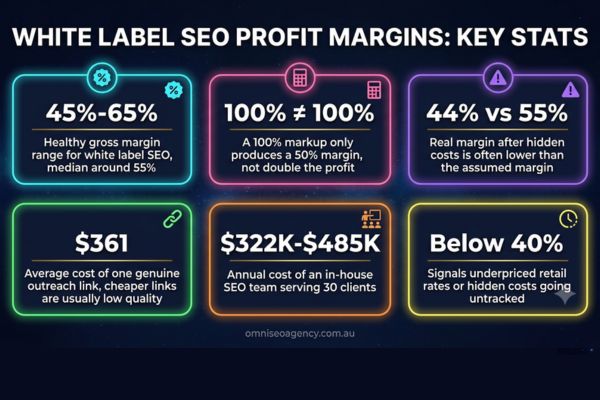
1Margin and Markup Are Not the Same Thing: Markup is calculated on cost, margin is calculated on revenue, a 100% markup only produces a 50% margin, mixing these up leads to overestimating real profitability.
-
2Real Cost Goes Beyond the Wholesale Invoice: Payment processing fees, account management time, software costs, and client revisions all quietly reduce margin, and most agencies never track them.
-
3Healthy Margins Sit Between 45% and 65%: Margins below 40% usually mean underpriced retail rates, while margins above 70% often signal a scope mismatch that can lead to client churn later.
-
4Provider Pricing Varies for Real Reasons: Team seniority, scope depth, link sourcing quality, and reporting depth all explain why wholesale SEO pricing differs so much between providers.
-
5Client Churn Can Erase Paper Profit: Onboarding costs are higher than ongoing months, so a client who leaves early can turn a seemingly profitable retainer into a net loss.
Running a white label SEO partnership can be profitable. But most agencies never actually sit down and calculate their real margin.
They see the wholesale invoice. They see what the client pays. They assume the gap between the two is profit.
It is not that simple. Account management time, software costs, payment processing fees, and the occasional client revision all quietly chip away at that number before it ever reaches the bottom line.
This matters more than it might seem. An agency that thinks it is earning 55% margin, when the real number is closer to 40%, is making pricing decisions, hiring decisions, and growth decisions based on numbers that do not reflect reality. Over a year, that gap adds up to real money left on the table, or worse, quietly lost.
This guide walks through exactly how white label SEO margins work in 2026. It covers the difference between margin and markup, how to calculate your true cost per client, what typical margins look like across service tiers, and where agencies most often lose profit without realizing it.
What Are White Label SEO Profit Margins?
A white label SEO profit margin is the percentage of revenue an agency keeps after paying its fulfillment partner and covering the internal costs of managing that client.
It is not just “what the client pays” minus “what the provider charges.” Real margin also has to account for account management time, software costs, payment processing fees, and the occasional client revision that eats into billable hours.
Most agencies only calculate the first part. That is why so many think they are earning 50% margin when they are actually closer to 30%.
Source: Nico Digital
Recommendation
Before you price anything, write down every cost involved in serving one client from start to finish. Not just the invoice from your provider. Everything.
Margin vs Markup: Getting Your Pricing Math Right
These two terms get mixed up constantly, and the confusion costs agencies real money.
Markup is calculated on your cost. It answers the question: how much more am I charging compared to what I paid?
Margin is calculated on your revenue. It answers a different question: how much of what the client pays do I actually keep?
Here is the difference in practice:
| Term | Formula | Example (Cost: $500, Price: $1,000) |
|---|---|---|
| Markup | (Price - Cost) / Cost | ($1,000 - $500) / $500 = 100% markup |
| Margin | (Price - Cost) / Price | ($1,000 - $500) / $1,000 = 50% margin |
Notice that a 100% markup only produces a 50% margin, not 100%. This trips up a lot of agency owners.
⚠️ Warning
-
If you set your prices using markup percentages but report your profitability using margin percentages, you will consistently overestimate how much money you are actually keeping.
How to Calculate Your White Label SEO Profit Margin
The basic formula looks simple:
Profit Margin = (Retail Price – Total Cost) / Retail Price x 100
The part agencies get wrong is “Total Cost.” It is never just the wholesale invoice.
Real Agency Example
Let’s walk through one client, month by month.
An agency pays a white label provider $800 per month for a mid-tier local SEO package. They charge the client $1,800 per month.
At first glance, that looks like a 55% margin. But add in the real costs:
- Payment processing fees (around 3%): roughly $54
- Account manager time (2 hours at $40/hour): $80
- Reporting software allocation: $25
- Occasional client revisions or rewrites: $50
Total real cost: $800 + $54 + $80 + $25 + $50 = $1,009
Real margin: ($1,800 – $1,009) / $1,800 = 44%, not 55%.
Different Types of Profit Margins and What Each Reveals
Not all margin numbers tell you the same thing. Agencies typically track three types:
| Margin Type | What It Measures |
|---|---|
| Gross Margin | Revenue minus direct fulfillment cost (the wholesale fee) |
| Contribution Margin | Gross margin minus variable costs like software and payment fees |
| Net Margin | Contribution margin minus all fixed overhead, including salaries and rent |
Gross margin looks the healthiest on paper. Net margin tells you what you actually take home. Both numbers matter, but they answer different questions.
What Are Typical White Label SEO Profit Margins?
Based on 2026 industry data, wholesale white label SEO pricing generally falls into three bands:
| Service Tier | Typical Wholesale Cost | Typical Retail Price | Typical Gross Margin |
|---|---|---|---|
| Basic Local SEO | $300 to $900/month | $700 to $1,500/month | 45% to 55% |
| Mid-Market SEO | $900 to $2,500/month | $1,500 to $3,500/month | 50% to 60% |
| Enterprise/Ecommerce | $2,500 to $6,000+/month | $5,000+/month | 55% to 65% |
The standard markup across the industry sits between 2x and 2.5x the wholesale cost, which is what produces that 45% to 65% margin range.
By Client Size
Smaller clients often produce thinner margins in dollar terms but can still hit strong percentages, since basic packages are simpler to fulfill.
Enterprise clients produce larger dollar profit but require more account management time, more revisions, and more custom reporting, which can quietly erode the higher percentage margin if it is not tracked carefully.
⚠️ Warning
-
Wholesale pricing below $300 per month for a full-scope SEO package is a red flag. At that price point, providers are usually cutting corners with AI-only content, low-quality directory links, or no real account management. Cheap fulfillment often costs more later in client churn.
How Do White Label SEO Costs Compare Across Providers?
Pricing varies a lot between providers, and not always for good reasons. Four factors drive most of the difference:
- Seniority of the delivery team. Junior-heavy content teams price much lower than senior-led teams, but the output quality difference shows up fast.
- Scope depth. “SEO” can mean a templated monthly checklist, or it can mean full technical, content, and link-building programs. These are not the same product even if both are called “SEO.”
- Link sourcing. Editorial link placements cost several times more than marketplace or directory links. This is one of the biggest hidden cost differences between providers.
- Reporting depth. Basic monthly reports cost less than detailed, client-ready dashboards with KPI tracking.
Source: Outreach Desk
What Pricing Strategies Maximize Agency Margins?
There are a few pricing approaches agencies commonly use, and they are not equally effective.
Flat-rate reselling means charging a fixed markup on whatever the provider charges. It is simple to manage, but it ignores what the client is actually willing to pay, which can leave money on the table in premium markets.
Value-based pricing ties your price to the outcome for the client rather than your own cost. A law firm where one new case is worth $50,000 can justify a much higher SEO retainer than a small local business, even if the fulfillment cost behind the scenes is identical.
Tiered packaging (commonly Foundation, Growth, and Authority-style tiers) tends to guide clients toward a mid-tier option, since the higher tier makes the middle price look more reasonable by comparison.
How Outsourcing SEO Fulfillment Improves Your Margins
The main financial argument for white label SEO comes down to cost structure, not just convenience. The general mechanics of how white label SEO services are structured (who handles fulfillment, reporting, and client communication) directly shape how much of the retainer actually turns into margin
Fixed vs Variable Cost Structure
An in-house SEO hire is a fixed cost. You pay their salary whether you have five clients or fifty, and whether business is slow or booming.
White label costs are variable. If you lose a client, that specific cost drops immediately. There is no unused salary sitting on your books.
Beyond Salary: The Real Cost of an In-House Hire
Salary is only part of what an in-house SEO specialist actually costs. The fuller picture includes:
- Base salary, typically $60,000 to $120,000+ depending on seniority and region
- Benefits and payroll taxes, often adding 20% to 30% on top of salary
- Software subscriptions like Ahrefs, Semrush, or Screaming Frog, which can run $1,000+ per month
- Recruitment and onboarding costs if the hire does not work out
- Training time before they are fully productive
For the full cost breakdown behind these figures, including a complete year-one cost table and the six signals that determine whether in-house or outsourced makes sense for your specific situation, see our guide on SEO in-house vs outsourcing.
Source: Almcorp
Quality and Specialization Benefits
A white label partner often has more specialized skill depth than a single in-house generalist, simply because they work across many clients and industries.
This can mean better content, stronger technical audits, and higher-quality link building than one internal hire could realistically deliver alone.
The tradeoff is less direct control and a dependency on the provider’s communication and turnaround speed.
How Do Agencies Increase Margins Without Raising Client Prices?
Raising prices is not the only lever available. A few other approaches work well:
- Negotiate volume pricing. Agencies that place multiple client campaigns with the same provider often move from a single-client rate to a meaningfully lower per-client rate at volume.
- Set clear scope boundaries. Many agencies quietly absorb extra revisions, audits, or content rewrites that were never part of the original scope. Defining what is and is not included protects margin without touching the client’s price.
- Reduce time spent editing provider deliverables. If a provider’s reports or content routinely need heavy internal editing before they reach the client, that editing time is a real cost. Choosing a provider with client-ready output protects margin just as much as a lower invoice does.
- Bundle complementary services. Adding a related service, like content or local SEO, to an existing client can increase the total contract value without a proportional increase in account management effort.
⚠️ Warning
-
Pricing tied to a percentage of the client's ad spend is common in PPC, but it does not translate well to SEO. SEO delivery costs stay largely fixed regardless of the client's revenue, so percentage-of-spend pricing can create pricing that does not match the actual work involved.
What Margins Should Your Agency Target?
Based on 2026 benchmark data, a gross margin between 45% and 65% is considered healthy for white label SEO, with the median sitting closer to 55%.
Margins consistently below 40% usually signal an underpriced retail rate rather than an expensive provider. Margins above 70% are worth double-checking too, since unusually high margins can point to a scope mismatch, where the client is not getting enough value for their price, which often shows up later as churn.
| Margin Range | What It Usually Means |
|---|---|
| Below 40% | Retail price is likely too low, or hidden costs are not being tracked |
| 45% to 65% | Healthy, sustainable range for most white label SEO retainers |
| Above 70% | Possible scope mismatch, worth reviewing for long-term client fit |
How Does Churn Affect Profitability?
A high margin on paper means little if clients do not stay long enough to make the relationship profitable.
First-month costs are almost always higher than ongoing months, because of onboarding work like audits and strategy planning. If a client churns within the first two or three months, the agency may never fully recover that upfront cost, regardless of what the monthly margin looked like on paper.
Consistent delivery quality, clear reporting, and realistic expectations set early in the relationship all reduce churn, which protects the long-term margin far more than any single pricing decision.
Much of this comes down to how well you’re actually managing your portfolio day to day. Agencies juggling many accounts without proper systems tend to see quality slip first, and margin erode right behind it. Our guide on managing multiple white label SEO clients efficiently covers exactly how to protect both.
FAQs
What profit margin should I expect starting out with white label SEO?
Most new resellers should aim for at least 40% to 45% gross margin in the first few clients, since account management time is often underestimated early on. As processes get more efficient, margins in the 50% to 60% range become realistic.
How do I price white label SEO services competitively?
Start with your total real cost, including software, payment fees, and management time, not just the wholesale invoice. Then research what competitors charge for similar scope in your market before setting a final retail price.
What hidden costs should I watch for in a white label partnership?
Payment processing fees, time spent editing provider deliverables before sending them to clients, unbilled revisions, and onboarding work that is heavier than ongoing monthly work are the most commonly missed costs.
How do I handle clients who want lower prices?
Consider offering a lower-scope tier rather than discounting your standard package. This protects your margin on the core offering while still giving price-sensitive clients an option.
Is white label SEO more profitable than hiring in-house?
For most agencies below roughly 25 active SEO clients, white label is generally more cost-effective, since it avoids the fixed cost of a full-time salary, benefits, and software subscriptions. Above that volume, some agencies find it makes sense to bring certain functions in-house.
Conclusion
White label SEO margins look straightforward from a distance. Pay a wholesale fee, charge a retail price, keep the difference.
In practice, the real number depends on account management time, software costs, payment fees, scope creep, and how long the client actually stays. None of these show up on the provider’s invoice, which is exactly why they get missed.
The agencies that protect their margins over time are the ones that track the full cost picture from the start, not just after a client relationship goes sideways. That means logging real hours spent on account management, watching for scope creep before it becomes the norm, and reviewing margin per client every few months rather than assuming last quarter’s numbers still hold.
None of this requires complex tools or a finance background. It mostly requires the discipline to write down real costs instead of estimating them. Agencies that do this consistently tend to price more accurately, catch unprofitable clients earlier, and grow with a much clearer sense of what their business actually earns.