Key Takeaways
-
1A Website Is Still Essential, Even With Social Media: Businesses with a website grow roughly twice as fast, and most people specifically check for a website before deciding whether to trust a business at all.
-
2Plan Before You Build: Your target customer, page list, and keyword research all need to be decided upfront, fixing this after launch usually means rebuilding pages and changing URLs, not just editing text.
-
3Design Decides Whether Anyone Sticks Around: With 94% of first impressions tied to design, a slow or confusing homepage loses visitors before your words or offer ever get seen.
-
4SEO Has to Be Set Up Before Launch, Not After: Since around 63% of web traffic comes through Google, skipping keyword research and basic setup at launch means starting invisible to your biggest source of potential visitors.
-
5Launching and Announcing Are Two Separate Steps: Test everything, mobile, forms, links, before telling anyone the site exists, since a broken page during your big announcement rarely gets a second chance with that same visitor.
Most people think launching a new website is just “build it, then put it online.” But a website that actually brings in customers needs more thought than that. Here’s why this matters: your website is often the first real impression someone gets of your business.
Studies show 94% of first impressions are tied to website design, according to recent small business website research. If that first impression is confusing, slow, or unclear, most visitors won’t stick around long enough to find out if you’re actually a good fit for them.
Source: Network Solutions
This guide explains:
- Whether you actually need a website right now
- How to build it, step by step, in the right order
- How to launch and promote it properly, so people actually find it
Most of these steps don’t require technical skill. They just require doing things in the right order, planning before building, not building and hoping it works out afterward.
Do You Actually Need a Website Right Now?
Not every business needs a website on day one. But most do, and waiting too long usually costs more than starting simple.
Signs you’re ready to launch:
- You have a clear offer (a product, a service, something people can act on)
- People already ask you “do you have a website?” and you say no
- You’re relying only on social media, and posts get buried within a day or two
- You’re losing potential customers to competitors who show up first in a Google search
Signs you might want to wait:
- You’re still testing whether your business idea works at all, and don’t have paying customers yet
- You don’t yet have a clear description of what you offer or who it’s for
- You’re mid-rebrand and your name, logo, or offer is about to change anyway
What You Need to Have Ready Before You Start Building
Before touching any tool or platform, get these basics sorted. Skipping this step is the single most common reason website projects drag on for months.
- A domain name. Keep it short, easy to spell out loud, and as close to your business name as possible. Avoid hyphens and numbers if you can, they’re easy to mistype and hard to say aloud.
- Your business name and branding decided. Logo, colors, and basic visual identity should exist before you start designing pages, not be figured out mid-build.
- A clear idea of who your target customer is. A site trying to speak to everyone usually connects with no one.
- A rough list of pages you’ll need. Most small business sites need: home, about, services or products, and contact, at minimum.
- A budget range in mind. This shapes almost every decision that follows, from which platform you choose to whether you hire help.
⚠️ Warning
-
Skipping keyword research before development is a costly shortcut. It determines what pages you need and how your URLs should be structured, fixing it after launch usually means rebuilding pages and changing URLs, not just editing text, which can hurt rankings if done carelessly.
How Much Does It Actually Cost to Launch a Website?
This is one of the most common questions, and one of the hardest to answer with a single number, because the range is genuinely huge.
| Approach | Typical Cost Range | What You Get |
|---|---|---|
| DIY website builder | $0 to $30/month | Templates, drag-and-drop editing, hosting included |
| AI website/app builder | $0 to $50/month | AI-generated design and structure from a text description |
| WordPress (self-managed) | $100 to $2,000 setup, plus hosting | More control, requires some learning |
| Freelance developer | $500 to $5,000 | Custom build, moderate flexibility |
| Digital agency | $3,000 to $50,000+ | Fully custom design, strategy, and ongoing support |
Website costs can range from under $100 to more than $100,000, depending on whether you use a website builder or hire a professional design and development team, according to recent small business website data.
Step 1: Choose How You'll Build Your Website
There’s no single right answer here. It depends on your budget, your timeline, and how hands-on you want to be.
- Option A: Website builders (Squarespace, Wix). Best for non-technical users who want to launch fast. Templates handle most of the design decisions for you.
- Option B: AI website or app builders (Lovable, v0, Bolt, Replit). Describe your site in plain language and get a working build generated for you. This is the fastest-growing option in 2026, especially strong if you need functionality beyond a static site, booking flows, simple dashboards, or custom forms.
- Option C: CMS platforms (WordPress, Webflow). More flexible than builders, but with a steeper learning curve. Good if you expect to add a lot of content over time, like a blog.
- Option D: Hire a digital agency or developer. Hands-off for you, but vet carefully. Ask specifically who owns the final code and design files, what ongoing maintenance costs after launch, and what happens if the timeline slips.
- Option E: DIY custom code. For the technically inclined. Full control, but the slowest option unless you already know how to build websites from scratch.
Source: Marketing LTB
Step 2: Structure Your Site Before You Build Anything
This step gets skipped more than any other, and it’s usually why a website feels confusing later, even when the design looks fine.
- Map out a simple sitemap. List every page you actually need, and be honest about whether each one earns its place. A page nobody will ever click on is just clutter.
- Plan your navigation so the most important pages are never more than one or two clicks away from the homepage. If a visitor has to hunt for your contact page, you’ve already lost some of them.
- Think through the visitor’s journey. What should someone do first when they land on your homepage? What should they do second? Third? Every page should have one clear next step, not five competing options.
Step 3: Write Your Website Copy
Good design can’t fix confusing words. This is where most sites lose potential customers without the business owner ever realizing it.
- Homepage: Say clearly what you do and who it’s for, in the first few seconds a visitor sees the page. If someone has to scroll and read three paragraphs to understand what your business actually does, most won’t bother.
- About page: Include real context, why you started, who you help, what makes your approach different. Not just a list of credentials or a generic mission statement.
- Service or product pages: Explain the benefit, not just the feature. “We use the latest equipment” tells a visitor nothing about what’s in it for them. “You’ll get your results back in half the usual time” does.
- Contact page: Make it stupidly easy to find your phone number, email, and location. Don’t hide contact details behind a form only.
Writing for yourself instead of the visitor. “We offer premium solutions” tells a visitor nothing.
“We help small clinics fill more appointments” tells them exactly what to expect, and whether it’s relevant to them at all.
Writing clear, conversion-focused copy for every page takes time, and getting it wrong is one of the most costly launch mistakes.
If you’d rather have this handled professionally, our SEO content writing services cover homepage, about, service, and product copy, written to convert and rank from day one.
Step 4: Make Your Design Decisions
- Choosing a template vs. custom design vs. AI-generated design
- Brand consistency across colors, fonts, and imagery, so every page feels like it belongs to the same business
- Mobile responsiveness, tested on an actual phone, not just assumed
- Adding your own photos and content vs. relying on generic stock imagery
Small things like color choice, visual hierarchy, and how much white space you leave actually shape whether visitors trust you and stick around, not just how the site looks.
Source: Reboot Online
⚠️ Warning
-
Avoid generic stock photos of people shaking hands or smiling at laptops. Visitors have seen these images a thousand times, and they tend to signal "this business didn't invest much effort," even if that's not actually true.
Step 5: Set Up Your SEO Foundations Before Launch
- Keyword research done before development starts. This determines which pages you actually need to build and how your URL structure should be organized, not something to retrofit after the site exists.
- Title tags and meta descriptions for every single page, not just the homepage.
- Image alt text, describing what’s in each image, both for accessibility and for search engines that can’t “see” images.
- Setting up Google Search Console and Google Analytics before launch, so you have data from day one instead of a blank slate months in.
- Submitting your sitemap to Google as soon as the site goes live, so it can start crawling and indexing your pages right away.
Source: Spark Toro
Step 6: Build in Ways to Keep Visitors on Your Site Longer
- Internal linking, so one page leads naturally to the next instead of dead-ending
- Related content or product suggestions, so a visitor interested in one thing sees what else might help them
- Clear calls-to-action on every page, not just the homepage, every page should tell the visitor what to do next
- Page load speed, since a slow site actively pushes visitors away before they even see what you offer
Source: Hostinger
⚠️ Warning
The average website bounce rate sits closer to 47%, according to compiled 2026 benchmark data drawing on GA4 industry medians, HubSpot, SimilarWeb, and Semrush, meaning nearly half of all visitors leave after seeing just one page. A slow, cluttered, or confusing page pushes that number even higher.
Source: Hostinger
Step 7: Create a Way to Continue the Relationship After They Leave
Most visitors won’t buy or book on their first visit, especially for anything that costs real money or requires trust. Building a way to stay in touch turns a one-time visitor into someone who might come back when they’re actually ready.
- Email list signup incentives, a small guide, discount, or checklist offered in exchange for an email address
- Retargeting pixel setup (Meta, Google), so people who visited your site can see relevant ads later, even after they’ve left
- Social media follow prompts, so a visitor who isn’t ready to buy today can still stay connected
Before You Hit Publish: A Pre-Launch Checklist
- Test on mobile and multiple browsers, not just the browser you built the site in
- Check all links and forms actually work, click every single one
- Set up SSL/HTTPS (the padlock icon that shows your site is secure)
- Add a privacy policy and cookie consent notice, this is often a legal requirement, not just a nice-to-have
- Set up a proper 404 page for broken links, so visitors who hit a dead link still see something helpful, not a blank error page
- Take a full backup before going live, so you have something to restore from if anything goes wrong
⚠️ Warning
-
Don't skip testing forms specifically. A broken contact form is one of the most common, and most costly, launch mistakes. Visitors rarely tell you it's broken. They just leave, and you never even know you lost them.
How to Announce and Promote Your New Website
Building the site is only half the job. If nobody knows it exists, it doesn’t matter how good it is.
- Post on social media, but don’t launch the announcement the same day the site goes live. Test everything first, then announce.
- Ask your existing network, followers, and business partners to share it. A shared post from someone else’s account often reaches people your own account never would.
- Write and send out a short press release, if relevant to your industry or local area, especially for a notable rebrand or a genuinely new business.
- Email your existing customer or contact list. These are the people most likely to actually visit and engage, since they already know and trust you.
- Consider a physical mailer if your business serves a local area and your customer base skews toward people who respond well to physical mail.
- Promote a launch offer or discount to encourage that first visit and give people a reason to act now instead of “maybe later.”
- Host a small launch event, in person or online, if it fits your business and audience.
⚠️ Warning
-
The single biggest mistake here is announcing before testing. Fix broken links and slow pages first. A visitor who arrives during your big announcement and finds a broken page rarely comes back to check again later, you often get exactly one shot at a first impression during a launch announcement.
What to Do in the First 30 Days After Launch
Launch day isn’t the finish line. What happens in the following weeks often determines whether the site actually pays off.
- Watch your analytics closely to see how real visitors actually behave, not how you assumed they would. You might find people are dropping off on a page you assumed was fine.
- Fix issues quickly as they show up. A small broken element ignored for weeks quietly costs you visitors the entire time.
- Start your ongoing SEO and content routine. Launch is the beginning of your search visibility, not the end of the work. Rankings build gradually, not overnight.
- Begin collecting reviews and testimonials from your first real customers or clients. Early social proof helps convince the next round of visitors.
- Revisit your analytics against your original goals after 30 days. If something clearly isn’t working, this is the point to adjust, not six months later when the pattern is harder to reverse.
Common Website Launch Mistakes to Avoid
- Launching without testing on mobile. With mobile making up the majority of traffic for most sites, this is one of the costliest mistakes to overlook.
- No clear call-to-action on the homepage. A visitor who doesn’t know what to do next usually just leaves.
- Treating SEO as a “later” task instead of a launch-day task. Every month without basic SEO setup is a month of invisible search traffic you can’t easily recover.
- Announcing the site before it’s actually stable. First impressions during a launch moment are hard to undo.
- No way to capture a visitor’s email before they leave. Most visitors aren’t ready to buy on day one, without an email capture, you lose the chance to reach them again.
- Choosing a platform based on price alone, without considering whether it can actually do what your business needs long-term.
- Ignoring load speed, especially on mobile, where patience for a slow site is even lower than on desktop.
FAQs
How long does it take to launch a website?
It depends on the option you choose. A simple website builder or AI-generated site can go live in days. A custom-built site with an agency or developer usually takes several weeks to a few months, depending on complexity.
How much does it cost to launch a website?
Costs range widely, from under $100 for a basic DIY builder site to well over $10,000, sometimes tens of thousands, for a fully custom, professionally built one, depending on complexity and who builds it.
Do I need a developer to launch a website, or can AI tools do it now?
Not always. AI website and app builders like Lovable, v0, Bolt, and Replit can now generate a working site from a plain-language description, which covers a lot of what used to require a developer, especially for simpler sites and basic functionality like booking forms or contact flows.
Should I launch with a website builder, an AI builder, or WordPress?
It depends on how much control you want and how complex your needs are. Builders and AI tools are faster and easier for simple needs. WordPress gives more flexibility and is often better if you plan to publish a lot of content over time, but it takes more time to learn.
What's the difference between launching and announcing a website?
Launching means the site is live and working. Announcing means actively telling people it exists, through social media, email, press, or other channels. A site can technically be launched quietly for weeks before it’s properly announced, but most businesses get better results doing both close together, once everything’s been tested.
Do I need SEO if I'm already running paid ads?
Ads and SEO work best together, not as a replacement for each other. Ads can bring visitors immediately but stop the moment you stop paying. SEO builds visibility that keeps working in the background, without ongoing spend, once it’s established. Most businesses benefit from starting both around launch, even if SEO takes longer to show results.
What's the single most important thing to get right before launch?
If you can only focus on one thing, focus on clarity, make sure a first-time visitor immediately understands what you do, who it’s for, and what to do next. Everything else, design polish, extra pages, advanced features, matters less if that basic clarity is missing.
Conclusion
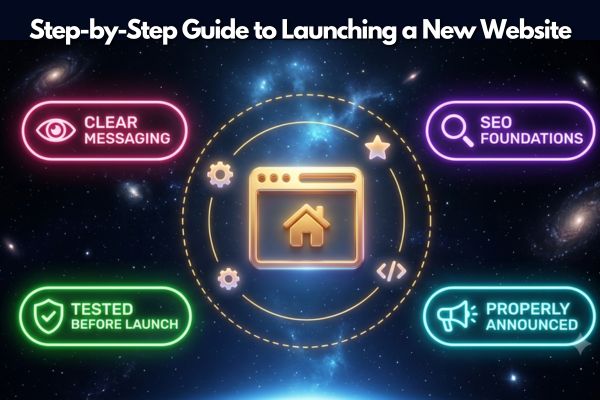
Launching a website isn’t about picking the fanciest design or the most expensive builder. It’s about doing the steps in the right order, planning your pages before you build, setting up SEO before you launch, and testing everything before you announce it.
The businesses that get this right usually aren’t doing anything complicated. They just don’t skip steps, and they treat launch day as the start of the work, not the end of it. Start with a clear plan, keep the first version simple, and improve it steadily once real visitors start showing you where the gaps actually are.
Launching Soon? Don't Let SEO Be an Afterthought
Getting your site structure, keywords, and technical setup right before launch is far easier than fixing it after. We help new websites launch with the right foundation, so you're visible from day one, not months later.
Get a Free Launch SEO Consultation →