Key Takeaways
-
1Neither Channel Is Universally Better: Organic and paid traffic solve different problems on different timelines, the right choice depends on how fast you need results and what your budget can absorb.
-
2Organic Compounds, Paid Doesn't: Organic traffic costs more upfront but trends toward near-zero cost per visit over time. Paid traffic stops the moment you stop paying.
-
3AI Overviews Are Squeezing Both Channels: Paid CTR on informational queries with AI Overviews dropped from 19.70% to 6.34%, this isn't just an organic problem anymore.
-
4The Real-World Split Is Roughly 60/40: Established businesses running both channels average a 62% organic, 21% paid, 13% email/social, 4% other traffic split.
-
5The Businesses That Grow Most Sustainably Use Both: Paid captures immediate demand and retargets warm audiences, while organic builds the long-term, owned foundation that keeps compounding.
You have a marketing budget to allocate. Someone says put it into SEO and content. Someone else says run paid ads and get results this week. You’ve heard both arguments before and you’re still not sure which one is actually right for your business.
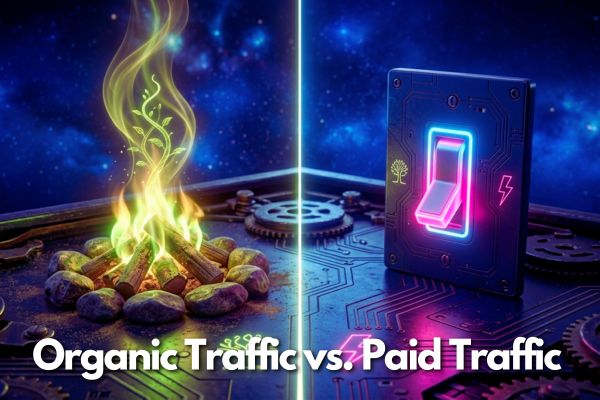
The honest answer is that the question itself is slightly wrong. Organic traffic vs paid traffic isn’t a binary choice between better and worse. It’s a choice between two fundamentally different tools that work on different timelines, produce different types of results, and carry different risk profiles.
But you still need to allocate your budget. And in 2026, with AI Overviews changing how clicks are distributed, paid search costs rising, and organic click share shifting, the decision carries more strategic weight than it ever has.
Source: Word Tracker
This guide gives you a clear, honest comparison of organic traffic and paid traffic, backed by current data, and a practical framework for deciding where your business should be investing right now.
What Organic Traffic and Paid Traffic Actually Are
Before the comparison, the definitions need to be precise, these terms get conflated in ways that muddy the strategic conversation.
Organic traffic is visitors who arrive at your site through unpaid search results. It’s earned through content quality, technical SEO, backlink authority, and making your pages more relevant and trustworthy than competing pages for the queries that matter to your business.
Paid traffic is visitors who arrive through advertisements you pay for, Google Ads, Meta ads, display ads, and other paid channels. It starts the moment your budget starts and stops the moment your budget stops.
Organic Traffic vs Paid Traffic: Side-by-Side Comparison
| Factor | Organic Traffic | Paid Traffic |
|---|---|---|
| Cost per visit over time | Decreases as content compounds | Fixed or rising as competition increases |
| Speed to first results | 3 to 9 months for meaningful volume | Hours to days after launch |
| Learning curve | Medium | Low |
| What happens when you stop | Traffic continues, often grows | Traffic stops immediately |
| Audience trust signals | Higher: editorial credibility | Lower: audiences know it's an ad |
| Targeting precision | Relies on search intent and keywords | Demographic, psychographic, behavioural |
| SEO value | Builds domain authority | Zero direct SEO impact |
| Ownership of channel | Owned: your content, your audience | Rented: platform controls costs and access |
Source: First Page Sage
The Data in 2026: What Has Actually Changed
The organic vs paid traffic landscape in 2026 is meaningfully different from two years ago. Both strategies have been affected by the rise of AI-generated search features.
Organic traffic is still the majority, but under real pressure. Organic search remains the largest single source of website traffic for most businesses. However, organic click share has been declining, ALM Corp’s analysis of Similarweb data found classic organic click share dropping significantly across multiple verticals as AI Overviews and enriched SERP features absorb clicks before they reach organic listings.
⚠️ Warning
-
AI Overviews now appear on roughly 13% to 15% of all Google searches, up from just 6.49% at the start of 2025, according to Semrush's November 2025 tracking data. That's more than double in under a year, meaning the share of queries where organic and paid CTR both take a hit is still expanding, not stabilizing.
Paid traffic is gaining click share in exactly the verticals where organic is losing it, but it’s not purely good news. ALM Corp’s analysis found that on queries where AI Overviews appear, paid click-through rate dropped from 19.70% in June 2024 to 6.34% in September 2025, a 68% decline.
For high-funnel paid search on informational queries, cost-per-acquisition has effectively risen significantly even where cost-per-click has stayed stable.
The implication: paid search remains highly effective on high-intent transactional queries where AI Overviews are less prevalent. It’s become significantly less efficient on broad informational queries where AI is absorbing attention before paid results are even considered.
Head-to-Head: The Factors That Actually Matter
Cost and ROI Over Time
This is the most important comparison, and the one most often evaluated incorrectly.
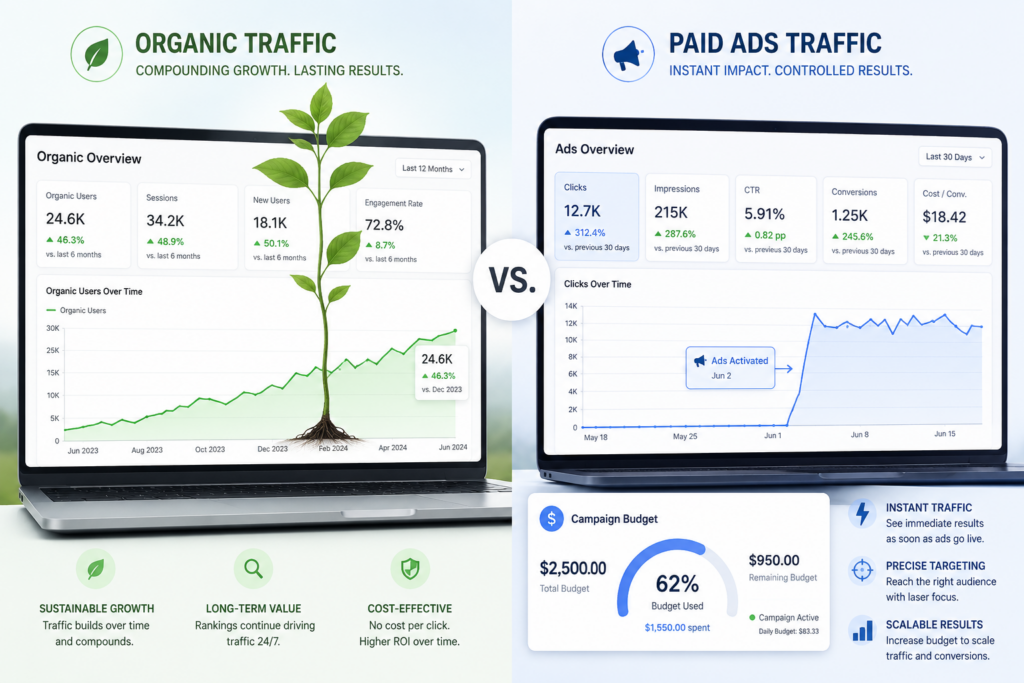
Paid traffic has a constant cost. Every click costs money. When you stop paying, the traffic stops. Organic traffic has a front-loaded cost, the investment goes into content and SEO upfront, and as that content ranks and accumulates backlinks, the marginal cost per visit trends toward zero while traffic continues.
The compounding effect in plain numbers:
- Month 1: You invest $2,000 in a content piece. It earns 50 visits.
- Month 6: The piece ranks on page 1. It earns 400 visits. Cost per visit is now $5.
- Month 12: With additional links and updates, it earns 900 visits. Cost per visit is $2.22.
- Month 24: No further investment. Still earning 900+ visits per month. Cost per visit approaches zero.
- Paid equivalent: the same $2,000/month spend buys roughly the same 900 visits, every single month, indefinitely, with no compounding.
Speed and Immediacy
This is where paid traffic wins decisively. If you need traffic tomorrow, paid advertising delivers it. Organic traffic requires patience, a new piece of content on a new domain may take three to six months to reach meaningful rankings.
Traffic Quality and Conversion Intent
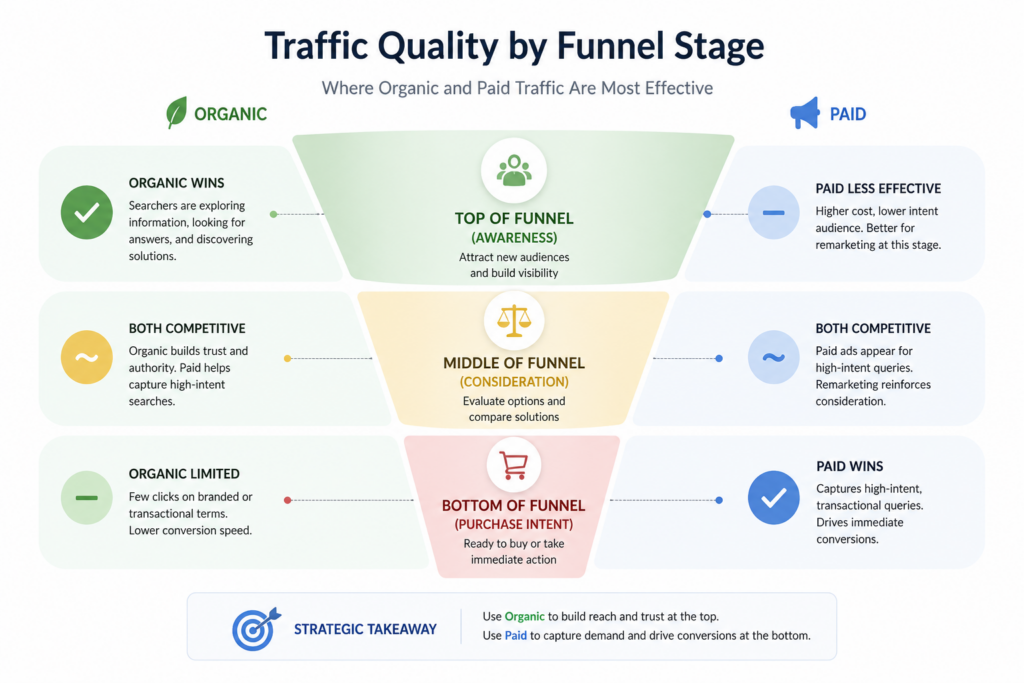
Organic search traffic tends to convert at higher rates for research-intensive purchases, since users have actively searched for information and are in research or decision mode, not interrupted.
Paid traffic converts more directly on high-intent transactional queries. A user searching “buy running shoes size 10” is ready to purchase, and a paid result offering a compelling price can capture that intent efficiently.
Audience Targeting and Control
Paid advertising gives precise control: demographic, geographic, device, interest, behaviour, and intent-based targeting, plus rapid A/B testing and retargeting of warm audiences.
Organic traffic is governed by search intent. You influence who finds your content through keyword targeting, but can’t filter by demographic characteristics the way paid advertising allows.
Brand Trust and Credibility
Content that ranks organically carries an implicit endorsement from Google, it appears because the algorithm evaluated it as relevant and authoritative. Users who find your brand organically tend to enter with higher baseline trust than users who clicked an ad.
Measurement and Tracking
This factor gets less attention than it deserves. Paid traffic is easy to track with detailed analytics directly from the advertising platform, cost, clicks, conversions, all in one dashboard.
Organic traffic requires more interpretive work, Search Console data, rank tracking, and multi-touch attribution modeling, to measure properly, since a single organic visit is often one touchpoint in a longer, less linear conversion path.
What Does an Average Traffic Split Actually Look Like?
For businesses that have actively invested in both organic and paid for one to three-plus years, First Page Sage’s client data shows an average traffic split of:
| Organic | Paid | Email and Social | Other |
|---|---|---|---|
| 62% | 21% | 13% | 4% |
⚠️ Warning
-
This split only reflects companies with an established, multi-year organic program. Businesses that have only recently begun investing in SEO should expect a lower organic percentage until content and authority have had time to compound.
When Organic Traffic Is Clearly the Right Primary Investment
Prioritise organic traffic when:
- Your customers research extensively before buying and you want to influence that research phase
- You’re building a long-term content asset that compounds in value, not a campaign that ends
- Your industry has high paid advertising costs (legal, finance, insurance CPCs regularly exceed $50 to $100), making organic significantly more cost-efficient
- You need to reduce dependence on platforms you don’t control
- Brand authority and trust are primary conversion drivers in your market
- Your budget is limited and you need maximum return over a 12 to 24-month horizon
- You have strong domain authority that makes new content rank quickly
When Paid Traffic Is Clearly the Right Primary Investment
Prioritise paid traffic when:
- You need traffic and leads within days, not months
- Your market is highly competitive organically and ranking would take 12 to 18 months of sustained investment
- You’re testing new messaging or positioning and need fast data before committing to long-form content
- Your product has high average order value and a narrow audience that precise paid targeting can reach efficiently
- You’re an early-stage business with no organic presence and can’t wait 6 months for your first organic visitors
- Your conversion funnel is short: search, see ad, click, buy, no long research phase
The Industry Factor: Where Each Performs Best
The organic vs paid traffic debate plays out differently across industries. Understanding where your business sits helps calibrate the right allocation.
| Industry | Organic Strength | Paid Strength | Recommended Primary |
|---|---|---|---|
| B2B SaaS and technology | Very high | Moderate (high CPCs, long cycles) | Organic with paid retargeting |
| eCommerce | Strong for branded/informational | Very strong for high-intent product queries | Both: organic for discovery, paid for conversion |
| Legal and professional services | Very high, trust-driven | High CPCs make organic ROI exceptional | Organic primary, paid selective |
| Local services | Strong via local SEO and GBP | Very effective for immediate leads | Both |
| Finance and insurance | High, E-E-A-T critical | Extremely high CPCs | Organic for content, paid for direct offers |
| Retail and consumer products | Moderate | Strong: product listing ads, retargeting | Paid primary, organic supplementary |
| Content and media | Very high | Low ROI | Organic dominant |
The Most Effective Approach: Using Both Together
The question “organic traffic vs paid traffic, which is better?” assumes you have to choose one. Most businesses shouldn’t.
Paid advertising can send targeted traffic to your best organic content, generating engagement signals that support organic ranking.
Organic content builds the brand authority that improves paid ad quality scores and conversion rates. Retargeting campaigns reach users who arrived via organic search but didn’t convert on their first visit, users exposed to both organic content and paid advertising convert at meaningfully higher rates than those exposed to either alone.
The Decision Framework: Which Should Your Business Prioritise Right Now?
- You need results within 90 days: Paid traffic. Organic cannot deliver at that timeline.
- You have a 12-month horizon and limited budget: Organic. Compounding returns outperform paid over 12 months for most businesses.
- You’re in a high-CPC industry (legal, finance, insurance, B2B software): Organic primary.
- You’re launching a new product or entering a new market: Paid first for immediate data and revenue, then transition toward organic.
- Your organic traffic is declining due to AI Overviews on informational queries: Shift investment toward transactional and comparison-intent content where AI Overview prevalence is lower.
- You have an established organic presence: Add paid retargeting to capture the unconverted organic audience, often the highest ROAS of any paid channel since the audience is already warm.
- You’re a brand new business with no organic presence: Start with paid for revenue while building organic assets simultaneously, not sequentially.
FAQs
Which generates more traffic: organic or paid?
Organic search generates significantly more traffic overall for most businesses. However, traffic volume isn’t the only relevant metric, paid traffic can be highly targeted and immediately available, making it more valuable for specific campaigns even at lower volume.
Does organic traffic convert better than paid traffic?
It depends on query type and funnel stage. Informational queries convert better organically, since users are self-selecting based on genuine intent. High-intent transactional queries convert just as well through paid, since it can target users already ready to purchase.
How long does organic traffic take to show results?
Meaningful organic traffic growth typically takes three to six months from consistent content investment on an established domain. New domains with low authority may take six to twelve months. Paid traffic, by contrast, can start delivering within days.
Is paid traffic worth it for small businesses?
It depends on industry and objective. In high-CPC industries like legal or finance, organic search almost always produces better ROI over any meaningful timeframe. In lower-CPC categories with short sales cycles, paid advertising can produce immediate, measurable returns.
How has AI changed the organic vs paid traffic balance?
Both channels are affected. Organic CTR has declined on informational queries, but still drives most web traffic overall. Paid CTR on those same queries dropped from 19.70% to 6.34%. Both remain most efficient on high-intent transactional queries where AI Overview coverage is lower.
What is a good split between organic and paid traffic budget?
There’s no universal answer, but a practical starting point mirrors the real-world average: roughly 60 to 70% toward organic, 30 to 40% toward paid for campaigns and retargeting. Early-stage businesses with no organic presence may reasonably invert this temporarily while organic builds.
Conclusion
Neither organic traffic nor paid traffic is universally better. They’re different tools that work on different timelines and serve different strategic purposes.
Organic traffic is the better long-term investment for most businesses, it compounds in value, reduces cost per acquisition over time, and creates an owned channel independent of ongoing spend. Its weakness is time, it requires patience that not every business situation allows.
Paid traffic is the better short-term tool, immediate results, precise targeting, measurable outcomes. Its weakness is that it creates no lasting asset, every click costs money and the traffic stops when the budget stops.
The businesses that grow most sustainably are almost always investing in both. The question isn’t which one is better, it’s how to allocate between them given where your business is right now and where it needs to be in 12 months.