
Your SEO campaign is running. Content is being published. Links are being built. Technical issues have been fixed. But here is the question that matters: how do you actually know if any of it is working?
The answer is SERP tracking. Without it, you are optimising blind. You are making decisions based on assumptions about where your pages rank, how competitors are moving, and whether your efforts are producing results.
With it, you have a clear, data-driven picture of your search visibility that makes every subsequent SEO decision faster and more accurate.
This guide covers the full case for the importance of tracking SERPs, why track SERPs consistently,, the specific reasons why it matters in 2026, and a practical step-by-step process for doing it right, including what to track, how to track it accurately, and what to do with the data once you have it.
What Is SERP Tracking?
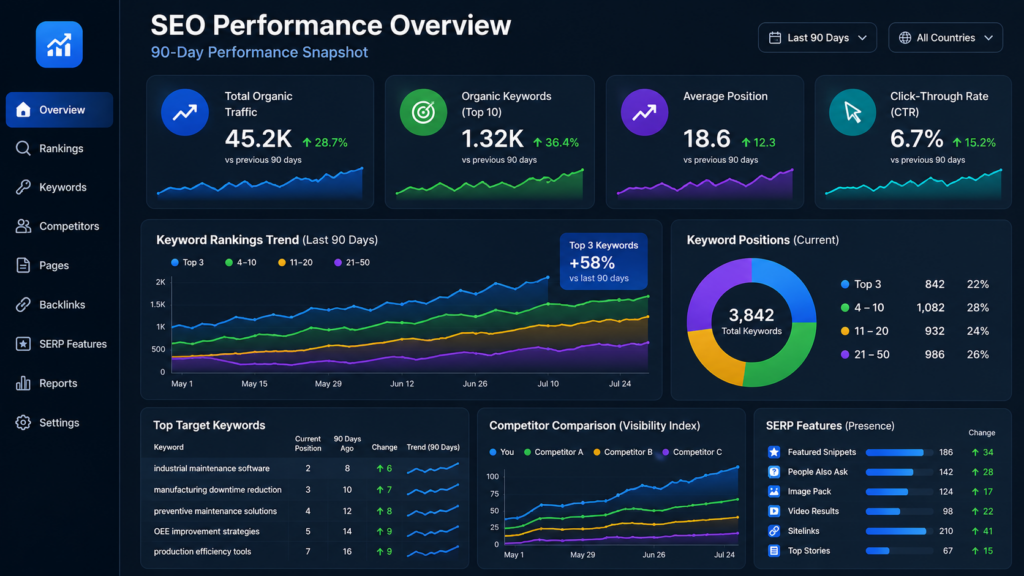
SERP position tracking, also called keyword rank tracking or rank tracking SEO, is the ongoing process of monitoring where your website ranks in search engine results pages for specific keywords over time.
It records your keyword positions, tracks how they change, identifies competitor movements, and shows you which SERP features (featured snippets, People Also Ask boxes, AI Overviews) your pages are appearing in.
The key word in that definition is “ongoing.” SERP tracking is not a one-time check. It is a continuous measurement process that turns ranking data into a live signal about the health of your SEO programme.
Done correctly, SERP tracking answers four questions that you cannot answer reliably any other way:
- Are the pages I am optimising actually improving in position?
- Are my competitors gaining or losing ground on my target keywords?
- When something changes in my rankings, what caused it?
- Which keywords are producing the traffic and conversions I care about?
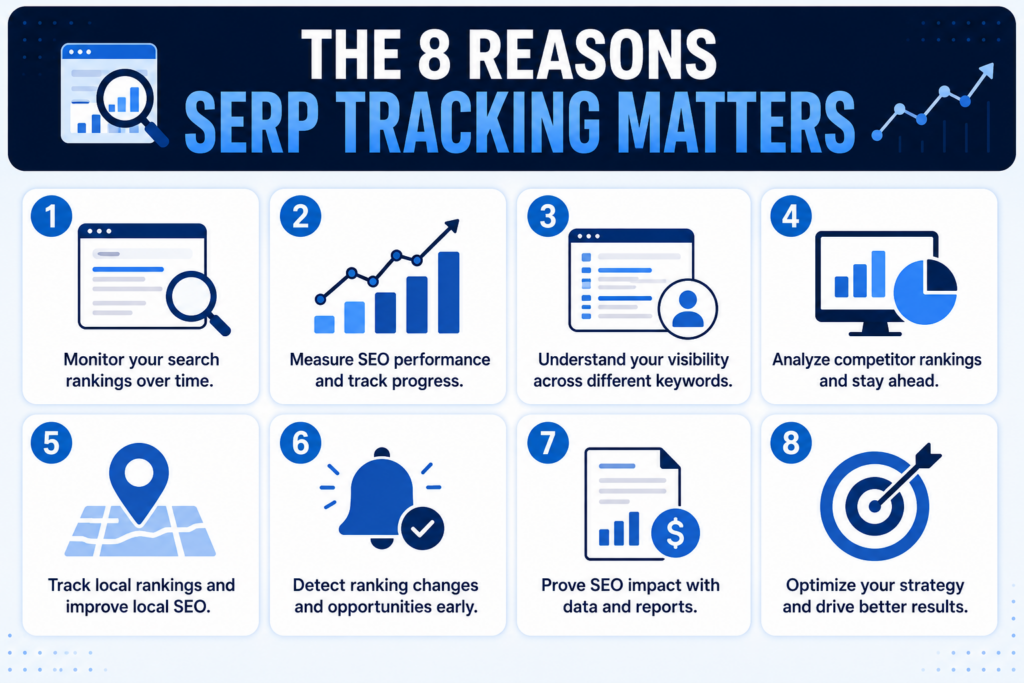
Why Tracking SERPs Matters: 8 Reasons That Directly Affect Your Business
Tracking your SERP positions is not just a reporting exercise. Every shift in your rankings has a direct impact on traffic, leads and revenue. Here are eight reasons why staying on top of your positions is one of the smartest things you can do for your business.
1. Because Ranking Position Directly Determines Your Traffic
The relationship between ranking position and organic traffic is not linear. It is steep. According to Backlinko’s 2026 CTR data, the first organic result on Google captures approximately 27.6% of all clicks. Position 2 captures 15.8%. Position 3 captures 11.0%. By position 10 you are below 2.5%.
What this means in practice: moving from position 8 to position 3 for a keyword with 1,000 monthly searches increases your expected monthly clicks from roughly 25 to 110. That is more than a fourfold increase in traffic from a single ranking improvement on a single keyword.
If you are not tracking SERP positions, you have no visibility into whether you are in position 3 or position 18. And you have no mechanism for detecting when you move between them.
Source: Backlinko
2. Because Google Updates Its Algorithm Hundreds of Times Per Year
According to SEO.com’s 2026 algorithm research, Google makes 500 to 600 algorithm updates per year. Most are minor. Some are significant core updates that can shift rankings across entire industries within days.
Without SERP tracking, a major ranking drop after an algorithm update is invisible until it shows up in your traffic data, which typically lags the ranking change by days or weeks.
By the time you notice a traffic decline in Google Analytics, you have already lost the clicks that would have come from detecting and responding to the ranking drop earlier.
With SERP tracking, a ranking shift triggers an alert immediately. You can investigate the cause, identify whether it is algorithm-related or a specific page issue, and begin addressing it before the traffic impact compounds.
3. Because Zero-Click Searches Changed What Rankings Mean
This is one of the most important and underappreciated reasons SERP tracking has become more complex and more necessary in 2026.
According to Semrush’s 2025 research, 60% of Google searches now end without a click. AI Overviews, featured snippets, People Also Ask boxes, local packs, and knowledge panels all answer user queries directly in the SERP, meaning a significant proportion of searchers get what they need without ever visiting a website.
What this means for SERP tracking is that ranking position alone is no longer the full picture. A page can rank in position one and still lose clicks if an AI Overview above it absorbs most of the query’s traffic.
Your SERP tracking needs to monitor impressions and click-through rate alongside position, so you can detect when your visibility is high but your traffic is being captured by SERP features rather than organic clicks.
4. Because Competitors Are Always Moving on Your Keywords
Every keyword you rank for is one that a competitor is also trying to rank for. When a competitor publishes a stronger piece of content, earns high-quality backlinks, or benefits from an algorithm update, their position improves. Yours may simultaneously decline without any change on your own site.
SERP tracking gives you continuous visibility into competitor movements. When a competitor jumps from position 8 to position 2 on a keyword you are targeting, that is not noise.
It is a signal that something has changed in their SEO strategy that is worth investigating. Maybe they updated their content significantly. Maybe they earned a cluster of high-authority links.
Whatever the reason, you want to know about it before it has been affecting your traffic for three months.
Competitive SERP monitoring also reveals opportunities: keywords where your competitors are losing ground that you are positioned to capture, and SERP features they are not claiming that you could target with the right content structure.
5. Because It Shows You What Content Is Working
Not all content performs equally. Some pages will rank well quickly. Others plateau at position 15 and stay there despite your best efforts.
Some will rank for keywords you never specifically targeted. Others will rank for your target keywords but attract traffic with the wrong intent.
SERP tracking at the page level, not just the keyword level, tells you which content is driving your organic visibility and which is underperforming.
Pages sitting in positions 6 to 20 with strong impressions but low clicks are your highest-priority optimisation opportunities: they have proven relevance for the query but need stronger on-page optimisation or better title and meta description writing to earn the click.
Without this data, content strategy decisions are based on instinct rather than performance evidence. With it, you can direct your content investment toward the opportunities with the highest demonstrated potential.
6. Because SERP Features Changed What Ranking Means
In 2019, ranking number one meant appearing at the top of ten blue links. In 2026, that same position might appear below an AI Overview, a featured snippet, a People Also Ask section, a local pack, and a video carousel.
The physical position of your organic result on the page may be significantly lower than your numerical ranking suggests.
Tracking SERP features for your target keywords gives you the full picture of your actual visibility. A page in position one with no SERP features above it captures far more attention than a page in position one buried beneath multiple AI-generated and enriched results.
Knowing which SERP features appear for your most important keywords tells you where to focus optimisation effort: if a featured snippet appears, optimising for it directly can capture that real estate. If an AI Overview dominates, the strategy shifts toward building the authority signals that earn citation in that answer.
According to research from Semrush, SERP features now appear in a significant majority of Google searches, with featured snippets, People Also Ask, and image packs among the most common. The search landscape your pages compete in is fundamentally different from a clean list of ten results.
7. Because It Finds Keywords, Research Alone Misses
Keyword research tells you what people might be searching for. SERP tracking tells you what they are actually searching for when they find your pages.
Google Search Console and SERP tracking tools reveal queries your pages are ranking for that you never specifically targeted.
These surprise rankings are often signals of content gaps worth developing further, related keywords worth targeting deliberately, and audience intent patterns that your existing content happens to satisfy in ways you did not design for.
Reviewing your tracked keywords alongside the actual queries driving impressions regularly surfaces new content opportunities that keyword research alone would not identify.
It also catches keyword cannibalisation issues: multiple pages competing for the same query, which dilutes the ranking potential of both.
8. Because It Makes Your SEO Reporting Credible
Whether you are reporting to a client, a business owner, or an internal stakeholder, the conversation about SEO performance needs to be grounded in data.
“We published ten blog posts this month” is an activity report. “Seven target keywords moved into the top ten, contributing an estimated 340 additional monthly organic visits” is a performance report.
SERP tracking is what makes the second version of that report possible. It connects your SEO activities to measurable ranking outcomes, which can then be connected to traffic and conversion data for a complete picture of commercial impact.
Without SERP tracking, SEO reporting defaults to activity measurement, which does not tell the people who sign off on the budget what they actually need to know.
How to Track SERPs Correctly: A Step-by-Step Process
Understanding why SERP tracking matters is half the job. The other half is doing it in a way that produces reliable, actionable data.
Here is a practical process for setting up and maintaining Google SERP tracking correctly, covering how to track SERP rankings in a way that produces reliable, actionable data.
1. Define the Right Keywords to Track
Tracking every keyword your site touches creates noise, not insight. Start by segmenting your keyword list into tiers based on commercial importance.
Tier 1 (Track Weekly):
High-intent keywords directly tied to your core business: product, service, and conversion-focused queries. These drive decisions.
Tier 2 (Track Fortnightly):
Mid-funnel informational keywords that build authority and attract leads in the research phase.
Tier 3 (Track Monthly):
Broad awareness keywords, long-tail variations, and experimental content. Lower priority for active monitoring.
Also track your top 10 to 20 competitors’ rankings for the same keyword sets. Their movements on your priority keywords are as important as your own.
2. Set Up Location-Specific and Device-Specific Tracking
SERPs are not universal. A business serving customers in Sydney will see different results than one serving customers in Melbourne for the same keyword. A mobile SERP often differs from a desktop SERP for the same query.
Configure your SERP tracking tool to pull rankings from the specific geographic locations your customers actually search from.
If your business is national, track at least three to five representative cities. If you are local, track the specific suburbs and metro areas where your customers are concentrated.
Always track both desktop and mobile rankings separately. According to StatCounter data, more than 60% of global web traffic now comes from mobile devices. Your mobile rankings may differ significantly from your desktop rankings and both matter.
3. Connect SERP Data to Google Search Console
Google Search Console provides impression, click, and average position data directly from Google’s own systems. It is the most authoritative source of search performance data available, completely free, and essential for accurate SERP tracking.
Use Search Console to:
- Identify all queries your pages are generating impressions for, including those you are not actively tracking in your rank tracking tool
- Monitor click-through rate alongside position to detect when rankings are not translating into clicks
- Spot pages with high impressions but low CTR (strong ranking, weak snippet) as optimisation priorities
- Track the impact of specific on-page changes by comparing performance before and after implementation
4. Track SERP Features, Not Just Positions
For each of your Tier 1 keywords, manually review the actual SERP every month. Note which features appear above the first organic result and what format they take.
Features to track for each priority keyword:
- AI Overview presence and what sources it cites
- Featured snippet: does one exist, who owns it, what format is it (paragraph, list, table)?
- People Also Ask questions related to your keyword
- Local pack: does it appear, are you in it if local relevance applies?
- Video results: do they appear above organic listings?
- Image pack: is it present and are your images included?
This feature mapping changes your optimisation priorities. If a featured snippet exists for a keyword and you do not own it, the highest-value optimisation for that keyword is restructuring your content to answer the query in the format Google is showing in the snippet.
5. Set Up Ranking Alerts for Significant Changes
Most SERP tracking tools allow you to configure alerts that trigger when a keyword moves by more than a defined threshold. Set alerts for:
- Any Tier 1 keyword that drops more than three positions in a single week
- Any page that drops out of the top 10 for a tracked keyword
- Any keyword where a competitor has moved into your top three
Any new competitor appearing in rankings for your priority keywordsAlerts transform SERP tracking from a reporting tool into a real-time monitoring system.
The sooner you detect a significant ranking change, the sooner you can investigate and respond before it affects traffic meaningfully.
6. Review and Act on Tracking Data on a Defined Cadence
SERP data only creates value when it drives decisions. Build a review cadence that matches your tracking frequency:
Weekly:
- Check Tier 1 keyword movements and any triggered alerts. Investigate significant changes immediately.
Monthly:
- Review full keyword portfolio performance. Identify rising and declining pages. Update content priorities based on pages in positions 6 to 20 with strong impression data.
Quarterly:
- Compare performance year-on-year rather than month-on-month to neutralise seasonal fluctuations. Assess whether your tracked keyword list still reflects your current business priorities and update it if needed.
- Year-on-year comparisons are particularly important. Month-to-month comparisons can be misleading due to seasonal search volume changes, while year-on-year comparisons give you a cleaner picture of actual organic growth.
What SERP Tracking Data Should Actually Drive
This is the part most guides skip. Data without action is just noise. Here is a practical decision framework for turning SERP tracking data into specific SEO actions.
| What Your Data Shows | What It Means | Action to Take |
|---|---|---|
| Keyword dropped 5+ positions in one week | Algorithm update, competitor improvement, or technical issue | Check Search Console for crawl errors, compare competitor content, check for recent site changes |
| High impressions, low CTR, position 1 to 3 | Title or meta description is not compelling enough to earn the click | Rewrite title tag and meta description to better match search intent |
| Keyword stuck at position 6 to 15 for 60+ days | Content relevance is proven but authority or depth is insufficient | Update and expand content, build internal links to this page, pursue external link acquisition |
| Competitor moved from position 12 to position 2 | They have made a significant change: new content, backlinks, or structured data | Audit their updated page: word count, structure, links, schema, and update your competing page |
| Impressions rising but clicks flat or falling | A SERP feature (AI Overview, featured snippet) is absorbing clicks above your listing | Optimise for the specific SERP feature appearing for that query |
| Keyword ranking for wrong page | Keyword cannibalisation between multiple pages | Consolidate content or add canonical tags to signal the preferred page |
| New competitor appearing in top 10 | A new entrant is competing for your keyword territory | Monitor their content strategy and assess whether your content needs updating to maintain position |
The Tools That Make SERP Tracking Reliable
Manual SERP checking is not reliable for ongoing tracking. Personalisation, browsing history, and location bias all affect what you see in a standard browser search. Dedicated tools eliminate these variables.
The core SEO rank tracking tools for accurate SERP monitoring:
Google Search Console (Free, Essential)
The foundation of any SERP tracking programme. Google Search Console provides direct data from Google on impressions, clicks, average position, and CTR for all queries your site appears for.
It is the most authoritative data source available and should be the starting point for every SERP tracking programme.
Third-Party Rank Tracking Tools
Where Search Console provides aggregate and historical data, dedicated rank tracking tools provide keyword-level daily tracking, competitor monitoring, SERP feature detection, and alert systems. The leading options each have different strengths:
- Ahrefs Rank Tracker: Strong historical data, competitor comparison, and SERP feature tracking. Particularly useful for tracking share of voice across keyword clusters.
- Semrush Position Tracking: Comprehensive SERP feature tracking, visibility score, and strong competitive intelligence features.
- Moz Rank Tracker: Clean interface, reliable data, and good integration with other Moz tools for a unified SEO workflow.Lorem ipsum dolor sit amet, consectetur adipiscing elit. Ut elit tellus, luctus nec ullamcorper mattis, pulvinar dapibus leo.
 Practical tip
Do not choose a rank tracking tool on features alone. Test the accuracy of its data against Google Search Console for the same keywords. If the tool’s reported positions consistently diverge significantly from your Search Console average position data, its data reliability is questionable. Use Search Console as your calibration standard.
The Biggest Mistakes in SERP Tracking
⚠️ Mistake 1: Tracking vanity keywords instead of business keywords
-
Ranking position one for a broad keyword with high volume but no commercial intent feels good but drives nothing. Track keywords that your buyers actually use when they are close to making a decision, not keywords that generate impressive-looking rankings on a report.
⚠️ Mistake 2: Checking rankings manually in your browser
-
Your browser is not a neutral observer. Google personalises results based on your search history, location, and account data. A manual search for your target keyword will almost always show you a more favourable position than your actual audience sees. Always use a dedicated tracking tool or Search Console data for reliable rankings.
⚠️ Mistake 3: Treating rank as the only metric that matters
-
With 60% of searches ending without a click, a position one ranking that sits beneath an AI Overview capturing most clicks is worth significantly less than position one in a clean SERP. Always evaluate rank alongside CTR and impression data to understand what your ranking is actually worth in traffic terms.
⚠️ Mistake 4: Comparing month-to-month without seasonal context
-
Many keywords have predictable seasonal patterns. A drop in rankings in December relative to October may be entirely seasonal, not a performance decline. Always compare year-on-year for a clean view of true organic growth, and annotate your tracking data with the dates of Google algorithm updates so you can distinguish update-related movements from strategy-driven ones.
⚠️ Mistake 5: Collecting data without acting on it
-
SERP tracking that informs weekly reports but never informs actual content or technical decisions is administrative overhead, not strategy. Every review session should end with at least one specific action triggered by the data. If your SERP tracking is not changing what you do, it is not being used correctly.
FAQs: Importance of Tracking SERPs
How often should I check my SERP rankings?
For highest priority keywords weekly tracking with automated alerts for significant changes is the right cadence. For broader portfolios monthly tracking is sufficient. Daily tracking creates more noise than insight for most businesses. The right frequency depends on market competitiveness, content volume and how quickly rankings move in your space.
Does Google Search Console replace dedicated rank tracking tools?
No, they complement each other. Google Search Console provides authoritative impression, click and position data directly from Google but lacks daily tracking, competitor monitoring and SERP feature detection. Use Search Console as your calibration standard and a dedicated rank tracking tool for keyword level daily tracking and competitive monitoring.
Why do my rankings look different when I search manually compared to my tracking tool?
Google personalises results based on your search history, location, account and device. A manual browser search shows you a personalised SERP specific to you, not what your target audience actually sees. Rank tracking tools use neutral depersonalised queries from defined locations, giving you reliable unbiased position data that is far more accurate for strategy purposes.
What metrics should I track alongside keyword position?
Beyond position, four metrics complete the picture. Click through rate, impressions, average position trend and SERP feature presence all tell you whether your ranking is actually earning traffic or being overshadowed by enriched results above it. Together they show what your ranking is genuinely worth in commercial terms.
How has AI changed the importance of SERP tracking?
AI Overviews and answer engines have made SERP tracking more important, not less. Position alone no longer tells you what your visibility is actually worth when AI-generated answers and featured snippets appear above organic listings. According to Semrush, 60% of searches end without a click in 2025. Tracking SERP features alongside position is now fundamental to understanding your real search visibility.
The Bottom Line
The importance of tracking SERPs comes down to one principle: you cannot manage what you cannot measure.
Every SEO decision, whether to update a piece of content, build links to a specific page, target a new keyword cluster, or investigate a traffic drop, should be informed by what your SERP tracking data is telling you. Without it, you are making those decisions based on assumptions that may be weeks or months out of date.
In 2026, with algorithm updates running into the hundreds per year, AI Overviews changing the click distribution of search results, and competitor movements happening faster than ever, the agencies and businesses that track their SERP performance rigorously have a structural advantage over those that do not.
Start with Google Search Console if you have not already. Add a dedicated rank tracking tool for your most important keywords. Set up alerts for significant movements. Build a review cadence that turns data into decisions. And track SERP features, not just positions, so your data reflects the search landscape your audience actually sees.