Key Takeaways
-
1Your Bio Is Read Before Your Content Is: Your author bio often gets read before a single word of your actual content does.
-
2Credibility Drives Trust and Sharing: Author credibility is one of the biggest factors in whether a reader trusts, engages with, or shares your content.
-
3A Strong Bio Is an E-E-A-T Signal: A clear, credentialed author bio is a genuine E-E-A-T signal for Google and AI search tools.
-
4Structure Matters: Credentials, Authority, Personality: A good bio leads with credentials, builds authority, then adds a personal touch.
-
5Keep It Short and in Third Person: Write in the third person, and keep it far shorter than you'd expect.
-
6One Bio Isn't Enough: You'll need more than one version, tailored to different places it appears.
Most people won’t read your entire blog post before deciding whether to trust it. But they will read your author bio.
Picture someone landing on your article from a search result, or scrolling past a guest post you wrote for an industry site. They skim the headline, maybe the first paragraph. Then their eyes drop to the small block of text under your name.
That short paragraph is doing more work than almost anything else on the page. It’s quietly answering the question every stranger asks before they invest their time: “Can I trust this person enough to keep reading?”
Most writers and brands treat their bio as an afterthought, something dashed off in the last five minutes before hitting publish. That’s a genuine missed opportunity.
A weak or generic bio can undo the hard work of a great headline, while a strong one builds instant credibility, both with your reader and with the search engines increasingly evaluating who’s actually behind your content.
This guide covers exactly how to write an author bio that builds real credibility, connects with readers, and strengthens the trust signals Google and AI search tools now look for.
We’ll also touch on how this applies if you’re writing a book, since the core principles genuinely carry over either way. Let’s get started.
What Is an Author Bio, and Why Does It Matter?
An author bio is a short, third-person paragraph that tells readers who you are, what you write, and why you’re worth reading. On a blog, you’ll typically see it at the bottom of an article, on a dedicated author page, or alongside a guest post byline.
It sounds simple. But it genuinely shapes whether someone trusts your content, keeps reading, or clicks away.
Source: Subscribe PR
That’s a genuinely significant gap, and it’s only becoming more relevant as AI-generated summaries increasingly decide what content gets seen at all.
Where Your Bio Actually Appears
Your bio shows up in more places than you might expect. Think blog post footers, dedicated author pages, guest post bylines, LinkedIn articles, and media kits.
Why Readers, Editors, and Search Engines Judge You by It
Source: Live Write Thrive
That’s a genuinely striking number. Readers care more about who you are than almost anything else about the content itself.
Your author bio is often the fastest, easiest way to establish that credibility. It’s doing more trust-building work than most content writers realise.
Why You Shouldn't Rely on a Generic Byline or Template
Content management systems often default to a generic “Admin” or “Staff Writer” byline if nobody fills one in. That’s a genuine missed opportunity.
⚠️ Warning
-
Leaving your bio as a generic default, or copying a template without personalising it, weakens both reader trust and the credibility signal your content could otherwise be sending.
Source: Twitter - Search Liaison
Author Bios and E-E-A-T: Why This Matters for SEO
Here’s the part that makes author bios genuinely strategic, not just a nice-to-have.
Google evaluates content quality partly through a framework called E-E-A-T, short for Experience, Expertise, Authoritativeness, and Trust. Your author bio is one of the clearest, most direct signals of all four.
Source: SEJ
This distinction matters. A bio won’t single-handedly boost your rankings. But content with a real, named, credentialed author consistently outperforms anonymous or generic bylines when it comes to trust signals, both for human readers and for the AI systems now summarising and citing content.
What a Strong E-E-A-T Bio Actually Includes
- A real name, not a generic brand or team name
- A professional title genuinely relevant to the topic
- Years of hands-on experience, where relevant
- A link to a fuller author page, if your site has one
- A professional headshot
- Links to verifiable external profiles, like LinkedIn
⚠️ Warning
-
Don't treat your bio purely as an SEO trick. Google's own John Mueller has noted that readers, and increasingly AI systems, can tell when a bio exists purely to game rankings rather than genuinely inform readers. Write it for humans first, and the trust signal follows naturally.
Why This Matters More for Some Content Than Others
Topics involving health, finance, legal advice, or anything with real consequences if the information is wrong face the highest bar. Google refers to these as YMYL topics, short for “Your Money or Your Life.”
If you’re writing in one of these spaces, a genuinely detailed, credentialed bio isn’t optional. It’s one of the clearest ways to demonstrate you’re a legitimate source worth trusting.
Author Schema Markup: Making Your Bio AI-Readable
Writing a genuinely credible bio is only half the job. The other half is making sure Google, Bing, and AI tools like ChatGPT and Perplexity can actually read and verify that credibility, not just a human skimming the page.
Author schema markup is a small technical addition that helps search engines confirm you’re a real, verifiable person, not just a name in text.
It works alongside your bio, not instead of it, and it’s one of the clearest ways to strengthen your E-E-A-T signals without changing a single word of your actual content.
What Is Author Schema, and Why Does It Matter?
Schema markup is structured code added to your page that explicitly tells search engines “this is a person, here’s their name, and here’s proof they’re real.”
Without it, you’re relying entirely on search engines correctly inferring who wrote something from plain text, which they don’t always get right.
With Person schema in place, you’re directly connecting your author to Google’s Knowledge Graph, the same system that powers those info panels you see on the right-hand side of search results for well-known people and brands.
For AI search tools specifically, this matters even more. Large language models rely heavily on structured, verifiable data when deciding whose content to cite or summarise.
A bio with no schema is just a paragraph of text an AI has to interpret. A bio with proper schema is a verified entity an AI can confidently reference.
The Sitewide vs Article-Level Distinction
There are two levels worth understanding here:
| Type | Where It Lives | What It Does |
|---|---|---|
| Sitewide Person schema | Your dedicated author page | Establishes you as a persistent, verifiable entity across your whole site |
| Article-level author schema | Nested inside each blog post's Article schema | Links that specific piece of content back to the verified author entity |
Ideally, you want both. The article-level schema tells Google “this post was written by this person,” and the sitewide Person schema backs that claim up with a full profile.
A Working Example
Here’s what a basic (Person) schema looks like for an author page, using JSON-LD (the format Google recommends):
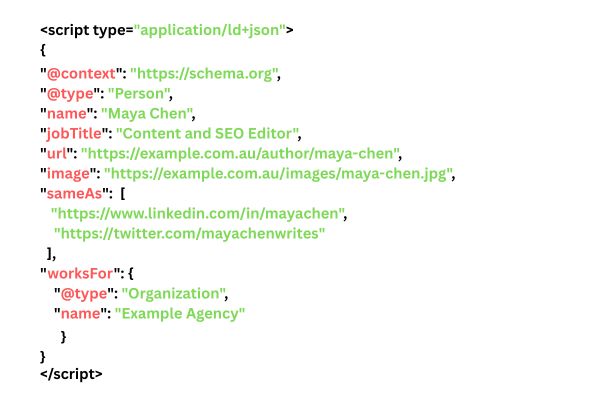
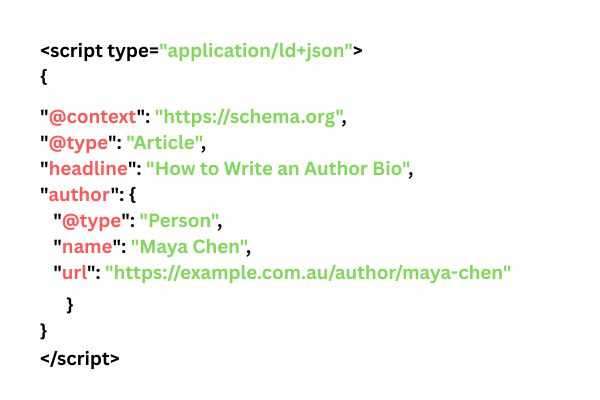
And here’s how you’d nest an author reference inside your article-level schema, so the specific post links back to that verified entity:
Why the sameAs Property Is the Secret Weapon
The sameAs field is arguably the most important part of this whole setup, and it’s the bit almost everyone skips.
It works by linking your schema to external profiles that already exist and are already trusted, like your LinkedIn, industry association listing, or Google Scholar page. This gives search engines independent verification that you’re a real person with a genuine professional history, rather than just taking your own website’s word for it.
Think of it as the digital equivalent of a reference check. Your bio says you’re an expert; your sameAs links let Google actually confirm it.
A Quick Checklist to Get This Right
- Add Person schema to every dedicated author page on your site
- Nest an author reference inside your Article schema on every blog post
- Fill out sameAs with genuine, active external profiles, not dead or half-finished ones
- Keep your name and job title consistent across every version of your schema and bio
- Test your markup using Google’s Rich Results Test before publishing
- Update your schema whenever your bio changes, so the two never fall out of sync
How to Write an Author Bio: Step-by-Step
Writing an author bio doesn’t need to feel overwhelming. Here’s a simple, three-step process to follow.
Step 1: Lead With Your Strongest Credentials
Open with who you are and what you do professionally. Think of it as your elevator pitch, compressed into a single sentence.
If you hold a genuinely relevant professional title, qualification, or notable achievement, this is where you mention it.
This opening line does a lot of heavy lifting. Readers, and increasingly search engines, often decide within seconds whether they’ll trust the rest of your content at all.
What to Do If You're New, With No Major Accolades Yet
That’s genuinely fine. Just showcase what you do have.
For example: “Jane Doe is a content strategist and former high school English teacher who writes about plain-language communication.”
This establishes professional credibility, even without a long resume behind it.
Leveraging Smaller Wins and Relevant Experience
You can also mention a guest post on a well-known industry site, relevant professional experience, or a notable endorsement.
Step 2: Further Establish Your Authority
Now double down on what makes you genuinely positioned to write about this topic.
This is where you answer the reader’s unspoken question. Why should they trust you specifically to cover this subject?
Mention your professional role, years of hands-on experience, and any genuinely relevant qualifications tied to the topic you’re writing about. This is exactly where E-E-A-T comes into play.
| What You're Writing About | What to Emphasise |
|---|---|
| Technical or B2B topics | Professional title, years of direct experience, industry credentials |
| Health, finance, or legal topics | Formal qualifications, licences, or verifiable professional standing |
| General lifestyle or opinion content | Genuine personal experience or a clear, relevant perspective |
The key here is relevance over volume. Only include what genuinely matters to the piece you’re introducing.
Resist the urge to list everything you’ve ever done. A shorter list of genuinely relevant achievements always outperforms a long, unfocused one.
Step 3: Finish With a Personal Touch
Adding a little colour makes you more relatable to readers.
This final section is often what people remember most, even after they’ve forgotten the specific credentials you mentioned earlier.
A brief personal detail, where you’re based, a hobby, or a light closing line in your natural voice, can humanise an otherwise credentials-heavy paragraph.
Think about what makes your own writing voice distinctive. If you’re known for a bit of humour, let a touch of it show here. If your tone is more measured, a quieter closing line often works better.
Author Bio Statistics
Beyond everything covered so far, a few more genuinely useful data points are worth knowing when it comes to author bios.
- In a 2026 experiment, content attributed to a high-expertise author scored an average credibility rating of 4.85, compared with just 4.47 for identical content attributed to a low-expertise author.
- A Seer Interactive case study added author bylines to 123 blog pages and measured an 11.7 percentage point increase in Googlebot crawl rates as a result.
- The same test found a 109% increase in citations through Bing Webmaster Tools once author bylines were added to those pages.
- Interestingly, once Seer accounted for sitewide trends, the true effect on AI-retrieval crawling came out to just -1.3%, essentially zero, showing bylines don’t automatically guarantee AI visibility.
- 40 to 60 words, typically 2 to 3 sentences, is a commonly recommended length for a short contributor bio or byline.
- 100 to 200 words is a commonly recommended length for a website author page, press kit, or professional profile.
- 200 to 300 words is a commonly recommended length for a full author or “About” page.
What to Include in an Author Bio
Here’s a practical checklist covering exactly what to include.
- Your name and current job, especially if it’s relevant to your writing
- Relevant education, when it genuinely supports your subject
- Professional experience, tied to your credibility or subject matter
- Notable publications or guest posts, kept to a handful for relevance
- Awards or honours, genuinely relevant to your career
- A link to your full author page and a professional headshot, genuine trust and E-E-A-T signals
- Personal details, like hobbies or hometown, used sparingly
- Social media links, particularly LinkedIn or a professional profile
- One interesting detail, if it’s authentically relevant
Not every item on this list belongs in every bio. Treat it as a menu to select from, rather than a checklist you need to tick off entirely.
What to Leave Out of Your Author Bio
Just as important as what you include is what you leave out.
1. An Exhaustive List of Achievements
Nobody needs a comprehensive list of every single thing you’ve ever done. Keep it selective, and choose only the credentials genuinely relevant to what you’re writing about right now. A bio trying to prove everything at once usually ends up proving nothing memorably.
2. Personal Opinions or Off-Topic Commentary
Save these for the actual content, not your bio. Political views, unrelated hot takes, or tangents about topics you don’t actually cover can distract from the credibility you’re trying to build, and may alienate readers for no genuine reason.
3. Irrelevant or Overly Long Personal Details
Not every hobby, life story, or personal milestone belongs here. A single, well-chosen detail does far more work than a paragraph of loosely related life history.
⚠️ Warning
-
Cramming in every personal detail dilutes your bio's impact and buries the parts that genuinely matter.
Getting the Vibe and Tone Right
Your bio’s opening sets a tone, whether you intend it to or not.
Matching Tone to Your Brand and Audience
A technical B2B blog needs a different tone to a casual lifestyle brand. Match your bio’s voice to what you’ve written, and to who’s genuinely reading it.
Letting Your Personality Show Without Overdoing It
A touch of personality helps readers connect. Just don’t let it overshadow the genuinely important credibility information.
Author Bio Best Practices
A handful of habits consistently separate strong bios from weak ones.
Write in the Third Person
Even though you’re writing it yourself, stick with “they” rather than “I.” This is standard practice, and makes it far easier to state achievements plainly without sounding like you’re bragging.
It also matches how bios typically appear elsewhere on the internet, so readers instinctively recognise the format and trust it.
Keep It Concise
Source: Elite Authors
Every word genuinely needs to earn its place. Readers skim bios quickly, often in just a few seconds, so a bloated paragraph risks losing their attention before it even makes its case. If you’re struggling to trim it down, cut entire sentences rather than shaving a word here and there.
Create Multiple Versions for Different Contexts
You’ll need more than one version, tailored to where it appears. A bio written for a dense, formal press kit rarely works well squeezed into a casual social media profile, and forcing one version to do every job usually means it does none of them particularly well.
Having these ready in advance saves genuine time. You won’t be scrambling to trim a long bio down at the last minute when a guest post or new byline comes in, and you’ll always have something polished ready to go the moment an opportunity appears.
The One-Liner (15–30 words)
Ideal for social media profiles and brief mentions, where every single word has to count. This version usually strips things back to just your role and one defining detail, nothing more.
The Standard Bio (50–200 words)
This is the version you’ll use most often, on blog post footers and guest posts. It should comfortably cover your credentials, a touch of authority, and a small personal detail without feeling rushed.
The Extended Bio (250–500+ words)
Useful for a dedicated author page, press kit, or speaker profile. This version gives you room to go deeper into your background, but resist the urge to pad it out just because you have the space.
Use the "So What?" Test
For every sentence, genuinely ask yourself: will anyone actually care about this? If not, cut it. This simple habit is often the fastest way to spot filler you’ve grown attached to but that genuinely isn’t pulling its weight.
Don't Oversell or Undersell Yourself
⚠️ Warning
-
Exaggerating your achievements damages trust just as much as downplaying genuine accomplishments does, and inflated claims are increasingly easy for both readers and AI systems to spot.
Striking the right balance takes a bit of practice. Aim for confident, factual statements rather than either false modesty or obvious embellishment, since both extremes quietly undermine the credibility you’re trying to build.
Proofread Carefully
Your bio is often one of the first things readers see. A typo here undermines credibility instantly, sometimes more than a mistake buried deep in the article itself, simply because it’s one of the shortest, most scrutinised pieces of text on the page.
Keep It Updated as Your Career Grows
Refresh your bio whenever you publish something new, change roles, or hit a genuine career milestone. An outdated bio doesn’t just look neglected, it can actively undersell expertise you’ve since gained, especially if it still references a job or project you left behind years ago.
Author Bio Template and Examples
Here’s a simple fill-in-the-blank template to get you started.
[Full name] is a [job title] with [X years] of experience in [industry/topic]. They specialise in [specific focus area]. [Relevant credential or achievement]. They live in [location] and [optional personal detail].
For example:
“Maya Chen is a Content and SEO Editor with eight years of experience writing about digital marketing for small businesses. She previously led content strategy at a Sydney-based agency and now writes about plain-language content that ranks. She lives in Melbourne with her rescue greyhound.”
Notice how this bio moves through all three steps naturally. It opens with a professional title and experience, builds authority through her past role, then closes with a genuine personal touch.
More Author Bio Examples by Context
Technical/B2B blog:
“James Whitfield is a Senior DevOps Engineer with over a decade of experience building CI/CD pipelines for fintech companies. He writes about infrastructure automation and cloud security.”
Health or wellness content:
“Dr. Amelia Reyes is a registered dietitian and clinical nutritionist based in Brisbane. She has spent twelve years helping clients build sustainable eating habits, and writes about evidence-based nutrition.”
General marketing blog:
“Tom Reilly is a content marketer and former agency copywriter who now covers SEO and content strategy for small business owners.”
Short Bio Examples
If you need something even briefer, examples like these work well for social media bios or brief mentions:
“Maya Chen writes about content strategy and SEO for small business owners.”
“James Whitfield covers cloud infrastructure and DevOps best practices.”
These short bio examples prove you don’t need dozens of words to establish who you are. A single well-chosen sentence, focused entirely on what genuinely matters, is often more effective than a longer, unfocused paragraph.
The best way to find your own version is to read author bios from writers or brands you genuinely respect. Notice what feels authentic, and what feels forced, then apply those same instincts to your own writing.
A Note on Book Author Bios
If you’re writing a bio for a novel or non-fiction book rather than a blog, the core principles here still apply, credentials first, authority second, personality last. But a few things shift.
Book bios tend to lean more heavily on personal voice and genre-relevant life experience, especially for fiction, rather than professional credentials alone.
Reader surveys also show something genuinely interesting here: bestseller status and literary prizes rank among the least influential factors in a book-buying decision, while simply feeling a personal connection to the author ranks far higher.
Source: Toner Buzz
If you’re a debut author with no major accolades, focus on what genuinely draws you to your genre instead. For example: “Jane Doe is a poet, teacher, and author of the new novel We Were Already There.”
Book bios also typically appear in fewer places, book covers, retail pages, and author websites, so you’ll usually only need a standard and an extended version, rather than the full range a content marketer might need across dozens of guest posts and platforms.
Common Author Bio Mistakes to Avoid
Even experienced writers fall into a few common traps.
- Writing it like a resume. Your bio should connect with readers, not just list achievements.
- Making it too long. Readers skim quickly, so length genuinely works against you.
- Forgetting to update it. An outdated bio undersells your current career.
- Skipping the personal touch entirely. Pure credentials without personality feel cold.
- Using a generic byline like “Staff Writer” or “Admin.” This weakens both reader trust and the credibility signal your content could otherwise be sending.
- Including irrelevant details. Every sentence should genuinely earn its place.
Watch out too for generic, forgettable phrasing. Lines like “when not writing, they enjoy coffee and long walks” tell readers nothing distinctive about you specifically.
FAQs
Does an author bio actually affect SEO or Google rankings?
Not directly, according to Google. But a clear, credentialed author bio genuinely strengthens the trust and expertise signals search engines and AI tools use to evaluate content quality, particularly for topics where accuracy matters.
How long should an author bio be?
Most standard bios run between 50 and 150 words. Shorter one-liners work for social media, while longer versions suit a dedicated author page.
Should I write my author bio in first or third person?
Third person is standard practice. It reads as more professional and makes stating your achievements feel far more natural.
What if I don't have much professional experience yet?
Focus on genuinely relevant credentials, like your current role or education, and be honest about where you’re at. A short, authentic bio beats an exaggerated one.
How often should I update my author bio?
Update it whenever you change roles, publish something significant, or reach a genuine career milestone. An outdated bio undersells you.
Do I need more than one version of my author bio?
Yes, ideally. A short one-liner suits social media, while a standard version works for blog footers and guest posts.
Is writing a bio for a book different from writing one for a blog?
The core structure is the same, credentials, authority, personality, but book bios lean more on personal voice and genre connection, while blog bios lean more on professional credentials and topic-relevant experience.
Conclusion
Your author bio isn’t a formality tucked away at the bottom of your content. It’s genuinely one of your most powerful trust-building tools, for readers and search engines alike.
Learning how to write an author bio properly comes down to three things: lead with your strongest credentials, build authority naturally, then let a little personality shine through.
Keep it concise, write it in the third person, and create versions suited to different places it’ll appear, whether that’s a blog footer, a guest post, or a dedicated author page.
Revisit and refresh it as your career grows. The bio that served you when you started won’t serve you forever.
Don’t be afraid to write several drafts either. Your first attempt rarely captures the right balance of credibility and warmth straight away, and that’s genuinely normal.
Take the time to get it right. Once you know how to write an author bio that genuinely reflects who you are, it becomes one of the highest-leverage paragraphs on your entire site, small in size, but outsized in influence over whether readers, and increasingly, search engines, choose to trust you.