

A law firm partner gets a call from a new client who found them through a blog post they published eight months ago. An accounting firm wins a six-figure retainer from a CFO who had been reading their quarterly market commentary for two years. A management consultancy is shortlisted for a major engagement because the procurement team had already seen three of their case studies before picking up the phone.
None of these outcomes came from a cold call, a trade show booth, or a paid ad. They came from content marketing for professional services, executed consistently and with genuine subject matter expertise behind it.
Professional services firms that do content marketing well do not just generate leads. They build the kind of pre-existing trust that shortens sales cycles, improves close rates, and attracts higher-calibre clients who are already convinced of your expertise before the first conversation.
This guide covers how content marketing strategy for professional services firms actually works, what makes it different from consumer or eCommerce content, and a practical framework for building a programme that generates measurable business results.

Why Content Marketing Works Differently in Professional Services
Before we get into strategy, it is worth being clear about what makes professional services content marketing distinct from other sectors. The difference matters because it changes what good content looks like and how you measure its success.
In professional services, the buyer is not purchasing a product they can evaluate, return, or try before committing. They are making a trust decision. They are selecting a firm or individual whose expertise, judgment, and professional standards they will rely on for outcomes that matter significantly: their legal case, their financial health, their business strategy, their tax position, their IT security.
That trust does not come from a catchy headline or a well-placed ad. It comes from demonstrated expertise over time. And content, specifically content that genuinely reflects deep domain knowledge, is one of the most reliable ways to build that demonstrated expertise at scale.
This is why Hinge Marketing’s research on professional services firms consistently shows that firms investing seriously in thought leadership content grow faster and attract clients at higher fee levels than those that do not. The content is not just a marketing vehicle. It is direct evidence of the quality of thinking the firm brings to client engagements.
92%
of B2B marketers include B2B content marketing as part of their strategy. Among professional services firms specifically, legal and consulting firms are increasingly using thought leadership blogs and SEO to generate inbound clients as a primary business development channel. Source: Content Marketing Institute and Digital Marketing Institute
The Unique Challenges Professional Services Firms Face With Content
Understanding the challenges is as important as understanding the opportunity, because they are specific to this sector and they require specific solutions.
The Expertise Trap
This is the core challenge of professional services marketing. The people with the most valuable knowledge to share are the busiest people in the firm. Senior partners, principals, and practice leads are the ones whose insights would resonate most with prospective clients. They are also the ones least likely to have time to write 1,500-word articles on a consistent basis.
This is the expertise trap. The content that would work best exists in the heads of people who will not write it, and the people who have time to write it do not have the depth of expertise that makes the content compelling.
Solving this requires a content process that extracts expertise from senior practitioners efficiently and transforms it into publishable content without consuming unreasonable amounts of their time. Interview-based content creation, structured briefing processes, and working with specialist content writers who understand your field are the primary ways professional services firms resolve this.
Compliance and Regulatory Constraints
Legal, financial, medical, and other regulated professional services firms operate under content constraints that most other industries do not face. Legal advice cannot be given freely in public content without the right disclaimers. Financial content must comply with FCA, ASIC, SEC, or equivalent regulatory standards depending on jurisdiction. Medical content must meet clinical accuracy standards and cannot make claims that could mislead patients.
These constraints do not make content marketing impossible. They make the compliance and accuracy layer of content production non-negotiable. Every professional services firm with content marketing aspirations needs a clear editorial governance process that includes appropriate compliance review before publication.
Long Sales Cycles and Attribution Difficulty
Professional services purchases are rarely impulsive. A procurement team selecting a management consultancy may spend six to twelve months evaluating options. A general counsel choosing external legal counsel may have read a firm’s thought leadership for two years before picking up the phone.
This long nurture cycle makes traditional content marketing attribution models unreliable. Last-click attribution will almost never credit the blog post or white paper that first built awareness and trust. Professional services firms need to measure content performance on leading indicators, brand visibility, organic traffic, time on site, and direct document downloads, rather than expecting every piece of content to produce a directly traceable conversion.
What Content Actually Works for Professional Services: By Sector
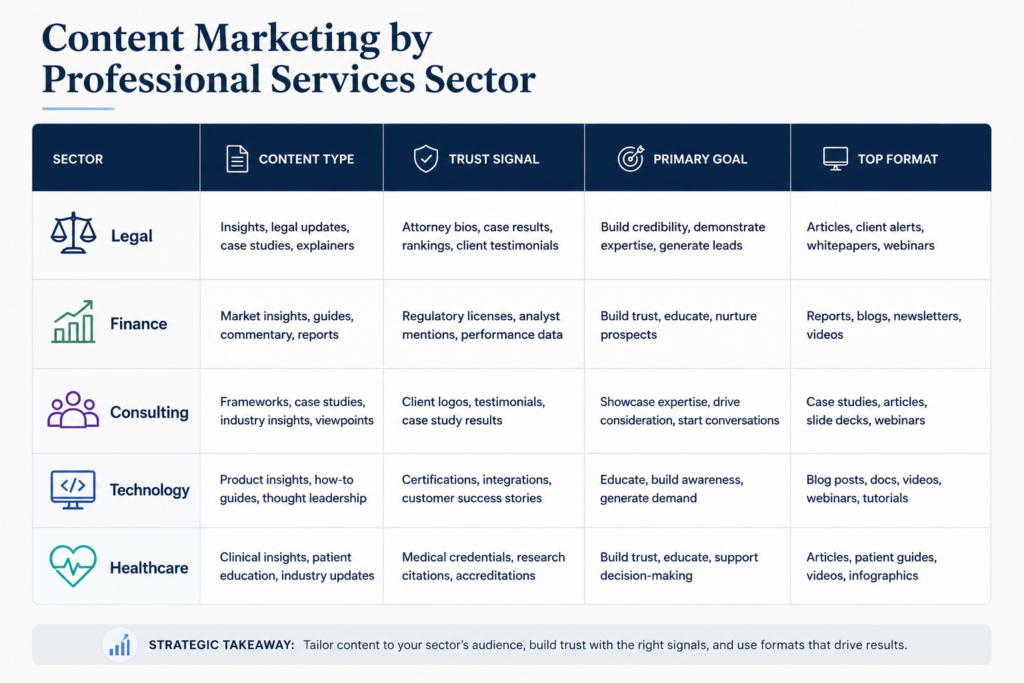
Different professional services sectors have different audience expectations, trust signals, and content preferences. Here is what works by sector.
Legal Services
Thought Leadership, Guides, and Case Studies
Legal buyers research extensively before engaging counsel. They search for guidance on specific legal scenarios, want to understand a firm’s expertise in their jurisdiction and practice area, and evaluate thought leadership quality as a proxy for the quality of advice they will receive. Content that directly addresses specific legal questions, explains complex regulatory changes in plain language, or provides practical guidance on common legal challenges builds exactly the trust that converts to mandates. Case studies showing successful outcomes in comparable situations are particularly powerful in legal marketing, subject to confidentiality constraints.
Accounting and Financial Services
Market Commentary, Tax Guides, and Compliance Content
Content marketing for accounting firms works best when clients need content that demonstrates current technical knowledge and genuine understanding of their financial situation. Market commentary published at relevant times (budget announcements, interest rate decisions, regulatory changes) positions a firm as current and proactive. Practical guides on tax planning, compliance requirements, and financial reporting changes answer the specific questions clients are searching for. Financial services firms are producing 41% more video explainers year-over-year, targeting audiences who increasingly prefer accessible explanations of complex financial topics over dense written guides.
Management and Strategy Consulting
Original Research, Frameworks, and Point-of-View Papers
Content marketing for consulting firms is built on one insight: management consulting clients buy thinking, not just delivery. Content that demonstrates the quality and originality of a firm’s thinking is the most powerful marketing asset a consultancy can have. Original research using proprietary client data (appropriately anonymised), published frameworks that clients actually use, and point-of-view papers on strategic challenges in a specific industry all position a consulting firm as a genuine thought leader rather than a commodity provider. This is the content category where professional services content most directly substitutes for expensive relationship marketing.
Technology and IT Services
Technical Guides, Implementation Content, and Case Studies
Technology services buyers often have significant technical knowledge themselves. They evaluate a firm’s content with a discerning eye, quickly distinguishing shallow marketing content from genuine technical expertise. Detailed implementation guides, architecture explanations, and documented results from complex technical projects all perform well. Content that helps a technical buyer understand how to solve a specific problem they are grappling with builds far more trust than general claims of capability.
Healthcare and Medical Services
Patient Education, Clinical Expertise, and Trust-Building Content
Healthcare content operates under the strictest accuracy and compliance requirements of any professional services category, and for good reason. Patient-facing content must be genuinely helpful, medically accurate, and written or reviewed by credentialed practitioners. Google’s E-E-A-T standards are most strictly applied in the healthcare sector, meaning that content without visible expert authorship and genuine clinical depth will not rank and will not build trust. Content that explains conditions, treatment options, and care pathways in accessible language while maintaining clinical accuracy is both ethically essential and commercially effective.
Building Your Professional Services Content Strategy: A Step-by-Step Framework
1
Define Your Audience With Specificity
Professional services content marketing fails most often at this step. “Senior executives” is not a specific enough audience. “CFOs at mid-sized manufacturing firms evaluating their first outsourced finance function” is. The more specifically you define who you are writing for, the more precisely you can address their actual questions, concerns, and decision criteria.
For each target audience segment, document their role, the specific decisions or problems they are responsible for, what they search for when they need expertise like yours, what objections or hesitations they bring to any engagement decision, and what would make them trust a firm like yours before the first meeting.
This audience mapping exercise produces content briefs that writers can actually use rather than producing generic content that addresses no one specifically.
2
Map Content to the Client Journey
Professional services clients typically move through three stages before engaging a firm: awareness (recognising they have a need), evaluation (assessing options and expertise), and decision (selecting a firm). Each stage requires different content.
Awareness-stage content:
Addresses the problems and questions your target clients have before they are actively looking for help. Blog posts answering common questions in your practice area, articles on industry trends that affect your clients, and accessible explanations of complex regulatory or technical topics all belong here. This is the content that builds organic search visibility and first establishes your firm in the minds of future clients.
Evaluation-stage content:
Helps clients understand your specific approach, expertise, and perspective. Detailed case studies, methodology papers, point-of-view articles, and original research all demonstrate the quality of your thinking in ways that differentiate you from competitors making similar claims. This is where thought leadership earns its value.
Decision-stage content:
Addresses the specific questions and concerns that arise during the selection process. Proposal templates, team biographies, credential documents, and client testimonials all support the final decision. This content is often not public-facing but is equally important to a complete content programme.
3
Build Topical Authority Through Content Clusters
Professional services firms should build deep coverage of their core practice areas rather than publishing across a wide range of loosely related topics. A firm practising
content marketing for law firms
should own the employment law content landscape, not publish occasional pieces across five different practice areas at low depth.
Content clusters work by creating a central pillar page for each core practice area or service offering, supported by a network of related articles covering specific questions, scenarios, and subtopics within that area. This structure signals topical authority to search engines and creates a genuinely comprehensive resource for clients researching in your space.
Semrush’s research on topic clusters consistently shows that sites with structured topic cluster architecture outperform those with isolated blog posts for competitive informational queries. For professional services firms trying to rank for high-value commercial search terms, this structural approach is not optional. It is the foundation of organic visibility.
4
Build E-E-A-T Into Every Content Asset
(The Key E-E-A-T Standard for Professional Services)
Experience, Expertise, Authoritativeness, and Trustworthiness are the four signals Google uses to evaluate content quality, and they are most stringently applied in professional services categories. Getting E-E-A-T right is not optional for any firm that wants its content to rank and convert.
In practice, building E-E-A-T means:
- Attributing all content to named practitioners with visible credentials and professional profiles
- Including author biography sections on every article that describe the author’s qualifications and experience
- Earning mentions and citations from authoritative industry publications, professional bodies, and media in your sector
- Ensuring all factual claims are sourced and all regulatory or legal statements include appropriate disclaimers
- Maintaining consistent, accurate information about your firm and its practitioners across all online platforms
For professional services firms, E-E-A-T is not just an SEO concern. It is a direct reflection of the professional standards clients expect from any firm they consider engaging.
5
Choose Content Formats That Match Your Audience
Not every content format works equally well for every professional services audience. Long-form written content, detailed research papers, and comprehensive guides tend to perform strongly for professional buyers who evaluate written analysis as part of their daily work. Video is growing significantly across all sectors, with 61% of B2B marketers planning to increase video investment in 2025 according to the Content Marketing Institute.
The most effective formats for most professional services firms include: long-form blog posts and guides for organic search visibility, original research and white papers for authority and lead generation, case studies for evaluation-stage credibility, newsletters for ongoing client and prospect relationship maintenance, and webinars or podcasts for audience development and thought leadership positioning.
6
Build a Consistent Publication and Distribution System
Consistency matters more than volume in professional services content marketing. A firm that publishes one genuinely excellent piece per month, promotes it properly, and maintains a high standard over two years will build significantly more authority than a firm that publishes three mediocre pieces per week and then stops when the initial enthusiasm fades.
Distribution is as important as creation. LinkedIn is the primary distribution channel for most B2B professional services content. Email newsletters maintain relationships with existing contacts and warm leads. Industry publications and media coverage extend reach to audiences your owned channels cannot access. Each piece of content should have a defined distribution plan before it is published.
7
Measure What Actually Matters for Professional Services
Standard digital marketing metrics apply, but professional services firms need to add several layer-specific measures to their reporting. Organic traffic to practice area pages tracks whether your content is building search visibility in your core service areas. Direct document downloads measure whether your thought leadership is being consumed by potential clients. Time on page and scroll depth indicate whether visitors are genuinely engaging with your expertise or bouncing.
Beyond digital metrics, track how new clients heard about the firm and specifically whether content was part of their awareness or evaluation journey. Even rough attribution data from client intake interviews is more useful for content investment decisions than digital analytics alone, because it captures the long nurture cycles that digital attribution models typically miss.
Content Types That Perform Best for Professional Services Firms
| Content Type | Best For | Journey Stage | Time to Produce |
|---|---|---|---|
| Long-form blog posts and guides | Organic search visibility, answering specific client questions | Awareness | Medium: 4 to 8 hours |
| Original research and reports | Authority building, media coverage, lead generation | Evaluation | High: weeks to months |
| Case studies | Demonstrating proven outcomes, overcoming scepticism | Evaluation to decision | Medium: 3 to 6 hours |
| White papers and point-of-view papers | Complex topic authority, premium lead capture | Evaluation | High: 8 to 20 hours |
| Email newsletters | Ongoing relationship maintenance, repeated touchpoints | All stages | Low to medium: 2 to 4 hours |
| Webinars and virtual events | Deep expertise demonstration, direct audience engagement | Awareness to evaluation | High: production plus presentation time |
| Podcast appearances or series | Thought leadership positioning, audience development | Awareness to evaluation | Medium: 2 to 4 hours per episode |
| Video explainers | Accessible explanations of complex topics, growing B2B audience | Awareness | High: scripting plus production |
| LinkedIn articles and posts | Practitioner visibility, network amplification | Awareness to evaluation | Low: 1 to 2 hours |
The Role of SEO in Professional Services Content Marketing
Organic search is one of the highest-value traffic channels available to professional services firms. When a potential client searches “employment law advice for tech companies” or “R&D tax credit consultants” or “management consultants for healthcare operators,” they are demonstrating active intent. They are not browsing. They are looking for firms exactly like yours.
Capturing that search intent requires content that is specifically written to match what those buyers are searching for, structured to rank in the competitive search landscape for those terms, and authoritative enough that Google evaluates it as a trustworthy result.
Professional services SEO content writing has several specific requirements that distinguish it from general content writing:
- Subject matter accuracy: Content that gets the substance wrong undermines the trust it is trying to build. In regulated sectors it can also create compliance risks. Accuracy is not optional.
- Practitioner attribution: Named authorship with verifiable credentials is a direct E-E-A-T signal that affects both ranking potential and client trust.
- Keyword targeting that reflects buyer language: Professional services buyers search in specific ways. Understanding the exact language your target clients use, rather than the internal jargon of your firm, is the difference between content that gets found and content that does not.
- Depth that matches search intent: A potential client searching for legal guidance on a complex employment issue is not well served by a 400-word overview. They need comprehensive, detailed content that genuinely addresses their situation.
 On SEO content for professional services
Getting the balance right between SEO optimisation and genuine subject matter depth is the hardest part of professional services content. Content optimised purely for keywords but thin on genuine expertise will not build trust. Content written purely for experts but ignoring how clients actually search will not get found. The firms that win on organic search get both right simultaneously, which requires collaboration between SEO expertise and professional subject matter knowledge.
Common Mistakes Professional Services Firms Make With Content Marketing
⚠️ Mistake 1: Writing for peers rather than clients
The most common content mistake professional services firms make is producing content that impresses other practitioners in their field rather than genuinely serving the clients they are trying to attract. A law firm’s article on a recent case decision written in legal language for a legal audience will attract lawyers, not clients. The same insight, translated into what it means for businesses in plain language, attracts clients. Know who you are writing for and write for them, not your professional community.
⚠️ Mistake 2: Publishing without a distribution plan
A brilliant white paper sitting in the resources section of a website that nobody visits is not content marketing. It is content creation without the marketing. Every significant piece of content needs a distribution plan: which LinkedIn profiles will share it, which email lists will receive it, which industry publications might cover it, and how it will be promoted beyond organic search alone.
⚠️ Mistake 3: Treating content marketing as a campaign rather than a programme
Professional services firms frequently commission a content burst, publish eight articles in one month, and then stop when the initial enthusiasm fades. Content marketing for professional services is a compounding discipline. The benefits build over 12 to 24 months of consistent publishing. Treating it as a one-off campaign produces one-off results. Building it as an ongoing programme produces compounding organic growth.
⚠️ Mistake 4: Skipping compliance and accuracy review
In regulated professional services sectors, publishing content that contains inaccurate claims, implies advice where none was given, or fails to include required disclaimers is not just a quality problem. It is a regulatory and reputational risk. Every firm in a regulated sector needs a clear editorial governance process that includes compliance review before publication, particularly for content on legal, financial, medical, or technical topics.
⚠️ Mistake 5: Measuring content by last-click attribution
Last-click attribution will almost always undervalue content marketing in professional services. A client who spent two years reading your newsletter before calling your firm will be attributed to the phone call in most CRM systems, not to the 24 newsletters they consumed. Supplement digital attribution with client intake questions about how they first became aware of your firm and what content they found helpful in their evaluation process. That data tells a truer story about content’s commercial contribution.
Producing Content at the Required Quality Level
One of the most practical challenges professional services firms face is producing content that genuinely reflects their expertise at a sustainable volume. There are three approaches that work, and most firms end up using a combination.
Practitioner-Written Content
Content written directly by senior practitioners is the most authoritative but the hardest to sustain at volume. The best model here is to build content creation into the working rhythm of key practitioners rather than treating it as an additional burden. Short interview formats, structured briefing processes, and regular scheduled writing time (even one hour per week per practitioner) can generate a meaningful volume of genuinely expert content without unsustainable demands on busy professionals.
Interview-Based Content Creation
A specialist writer interviews a subject matter expert, extracts the key insights, and writes the article in the expert’s voice and under their byline. The expert reviews and refines the final draft. This model resolves the expertise trap by separating the knowledge extraction from the writing process. It requires less practitioner time than direct writing while maintaining genuine subject matter depth in the published content.
Specialist Content Writers
Writers with genuine expertise in a specific professional services sector can produce content that demonstrates real domain understanding rather than surface-level research. A writer with a legal background, financial services experience, or technology sector expertise brings both writing skill and substantive knowledge to briefs that a generalist writer cannot match. This is particularly valuable for firms in regulated sectors where accuracy is non-negotiable, and for high-volume content programmes that cannot rely entirely on practitioner time.
The quality of the brief matters as much as the quality of the writer. A well-structured content brief that specifies the target audience, the key questions to answer, the practitioner’s perspective on the topic, and the specific expertise to demonstrate gives any writer a far better foundation than a one-line topic instruction.
How AI Is Changing Professional Services Content Marketing
AI content generation tools have entered every content marketing workflow in 2025. Siege Media’s 2025 research found that 90% of content marketers plan to use AI in their strategies. The question for professional services firms is not whether to use AI but how to use it without compromising the credibility that makes their content valuable.
The risk is specific to professional services. AI-generated content can produce fluent, well-structured text on almost any topic. What it cannot reliably produce is genuine practitioner insight, current awareness of regulatory developments, nuanced professional judgment, or the kind of authoritative voice that comes from real expertise in a field.
In professional services, AI is most useful as a productivity tool within a human-led content process. Drafting structures, generating initial research summaries, writing first drafts that practitioners review and substantially improve, and handling administrative content production tasks. It is least appropriate as a replacement for the genuine expert knowledge that makes professional services content credible and trustworthy in the first place.
The AI content risk in professional services
Google’s quality systems and professional services clients share the same red flag: content that sounds authoritative but lacks genuine domain expertise. In sectors where clients are evaluating your content as evidence of the quality of advice they will receive, AI-generated content without substantive expert review does not just underperform on SEO. It actively signals to sophisticated buyers that the firm’s content is not worth their trust.
Measuring Content Marketing Performance in Professional Services
Professional services content marketing requires a measurement framework that reflects the long, complex buying journey typical of this sector. Here are the metrics that matter most.
| Metric | What It Measures | Why It Matters |
|---|---|---|
| Organic traffic to practice area pages | Search visibility in core service areas | Indicates whether content is building the right audience |
| Keyword rankings for target queries | Competitive position on high-value searches | Shows whether content strategy is earning search real estate |
| Document downloads and gated content completions | Engagement with thought leadership | Direct signal that content is valuable enough to exchange for contact details |
| Time on page and scroll depth | Content engagement quality | Indicates whether visitors are reading, not just arriving |
| Email subscriber growth and open rates | Audience development and newsletter health | Measures whether the firm is building an owned, engaged audience |
| Inbound enquiry source attribution | Content's commercial contribution | Connects content activity to actual business development outcomes |
| Media mentions and backlinks | Authority building and third-party validation | Signals that thought leadership content is being cited and shared |
FAQs: Content Marketing for Professional Services
How long does content marketing take to show results for professional services firms?
For organic search performance, most professional services firms see meaningful movement in keyword rankings within three to six months of consistent publishing on an established domain. Measurable inbound enquiries from content typically emerge after six to twelve months as content builds topical authority and organic traffic volume grows. Thought leadership positioning, where your firm is recognised as an authority in its sector, builds over 12 to 24 months of consistent content investment. The returns compound significantly after the first 12 months as content assets accumulate, backlinks grow, and domain authority strengthens.
What is the most effective content type for professional services firms?
It depends on the sector and the stage of the buyer journey you are targeting. For organic search visibility and top-of-funnel awareness, long-form blog posts and guides addressing specific client questions consistently perform well. For evaluation-stage content that differentiates a firm from competitors, original research, case studies, and point-of-view papers are most effective. For ongoing relationship maintenance with existing contacts and warm prospects, email newsletters produce strong results. The Content Marketing Institute reports that case studies and customer success stories are among the top-performing content types for B2B professional services.
How do professional services firms handle compliance in content marketing?
Regulated professional services firms need a documented editorial governance process that includes a compliance review step before any content is published. This process should define who is responsible for compliance review in each practice area, what disclosures and disclaimers are required for different content types, how factual claims are verified and sourced, and what the escalation path is if a compliance question arises during review. The specifics vary by sector and jurisdiction, and firms should seek advice from their professional regulatory body on content marketing compliance requirements applicable to their specific circumstances.
Should professional services firms use AI to produce content?
AI tools can be genuinely useful productivity tools within a professional services content programme, particularly for first drafts, structural suggestions, research synthesis, and administrative content tasks. However, published content on professional topics should always reflect genuine practitioner knowledge and judgment, not AI-generated text passed off as expert analysis. In sectors where content quality is evaluated as a proxy for professional capability, the risks of over-relying on AI-generated content include both reputational damage with sophisticated clients and reduced search performance as AI systems become better at identifying content lacking genuine expertise.
How much should a professional services firm invest in content marketing?
Investment levels vary significantly by firm size, growth ambitions, and competitive landscape. As a general benchmark, the US Small Business Administration suggests businesses with under $5 million in revenue allocate 7 to 8% of gross revenue to marketing overall. For professional services firms prioritising content as their primary business development channel, allocating 25 to 35% of that marketing budget to content creation and distribution is a reasonable starting point. The more important question than the absolute budget is whether the investment is consistent and sustained over 12 to 24 months, because content marketing’s returns compound over time and are heavily front-loaded with effort relative to early results.
The Bottom Line
Content marketing for professional services firms is not about generating clicks or viral shares. It is about systematically building the demonstrated expertise and reputation that converts the most valuable business development asset any professional services firm has: trust.
Firms that invest consistently in high-quality, expert-led content over 12 to 24 months build organic search visibility, thought leadership positioning, and an audience of potential clients who arrive at the first conversation already believing in the firm’s expertise. That trust advantage shortens sales cycles, improves close rates, and attracts higher-calibre clients at better fee levels.
The firms that do this best are not the ones with the largest content budgets. They are the ones that are most disciplined about audience specificity, most rigorous about content quality and accuracy, and most consistent in their publishing and distribution over time.
Start with a single practice area. Define the specific audience within that area. Build a small cluster of genuinely excellent content around the questions that audience is asking. Publish consistently. Distribute properly. Measure honestly. And build from there.