Key Takeaways
-
1Branded Traffic Comes From People Who Already Know You: It's website visitors who search using your brand name, products, or services, meaning they already know you exist before they click.
-
2It Converts Far Better Than Non-Branded Traffic: Branded traffic usually converts two to five times higher than non-branded traffic, making it one of the highest-value segments on your site.
-
3A Healthy Click-Through Rate Sits Between 40% and 60%: Falling below this range often signals that competitors are stealing clicks that should rightfully be yours.
-
4Branded Traffic Depends on Your Whole Marketing Mix: It isn't just an SEO metric. PR, social media, advertising, and word of mouth all feed into how many people search for your brand directly.
-
5Competitors Can Bid on Your Brand Name: Protecting your branded SERP matters, since rivals can buy ad space above your organic listing for searches that include your own name.
-
6Local SEO Plays a Big Role for Physical Locations: Businesses with a storefront or office see branded search closely tied to local visibility, since nearby customers often search the brand name directly once they've found you.
Picture two customers searching Google right now. One types “best coffee machine for small kitchens.” The other types “Breville Barista Express.”
Both end up looking at the same product. But only one of them already trusts your brand enough to ask for it by name.
That second search is branded traffic, and it’s one of the most valuable, most overlooked signals in your entire marketing strategy.
Most businesses pour their energy into chasing new keywords and new audiences. Meanwhile, the traffic they’ve already earned, people who know their name and actively seek them out, gets treated as an afterthought.
That’s a genuine missed opportunity. Branded traffic converts higher, costs less to protect than to replace, and tells you more honestly than almost any other metric whether your brand is actually working.
In this guide, you’ll learn exactly what branded traffic is, why it deserves far more attention than it usually gets, and how to grow it deliberately rather than hoping it happens on its own. We’ll keep things simple and practical, so you can start using this straight away.
What Is Branded Traffic?
Branded traffic is the visitors who come to your website by searching for your brand name.
They might type your exact business name. Or a product you sell. Or even a misspelled version of your name.
Either way, they already know you exist. They’re not discovering you for the first time.
This is different to non-branded traffic, which comes from generic searches. Think “best running shoes” instead of “Nike shoes.”
Types of Branded Keywords
Branded keywords come in a few different shapes. Here’s a simple breakdown.
- Your brand name alone, like “Telstra” or “Bunnings”
- Your brand plus a modifier, like “Telstra plans” or “Bunnings opening hours”
- Your product names, like “iPhone 17” or “PlayStation 6”
- Your service names, like “Australia Post express delivery”
- Your trademarked terms, like specific product lines only you sell
Each type tells you something different about what your customers want.
Branded vs Non-Branded Traffic: What's the Difference?
It helps to see these two traffic types side by side rather than looking at them in isolation.
Here’s a simple comparison to walk you through it.
| Feature | Branded Traffic | Non-Branded Traffic |
|---|---|---|
| Search example | "Officeworks printer ink" | "cheap printer ink" |
| User awareness | Already knows your brand | Doesn't know your brand yet |
| Funnel stage | Usually bottom of funnel | Usually top or middle of funnel |
| Conversion rate | Higher, often 2 to 5 times more | Lower on average |
| Competition | Usually low | Usually high |
| What it measures | Brand awareness and loyalty | Content reach and visibility |
Both types of traffic matter. But they play different roles in your marketing.
Branded traffic tells you how well known you are. Non-branded traffic tells you how well you’re reaching new people.
Why Branded Traffic Matters So Much
Branded traffic isn’t just a vanity metric. It has a real impact on your bottom line.
Here’s why you should care about it.
It Converts Better Than Almost Anything Else
People searching for your brand have already made up their mind, at least partly. They’re not comparing five options anymore.
This means your branded traffic often converts far higher than other traffic sources. Some data shows it converting two to five times higher than generic organic traffic.
That’s a huge difference. It’s one of the best signals you have that your marketing is working.
It Signals Trust and Recognition
When someone searches your brand name, they’re telling Google something important. They already trust you enough to seek you out directly.
This is powerful. Trust is hard to build and easy to lose.
Source: PwC
Branded traffic captures a big share of this behaviour.
It Helps You Win More of the Search Results Page
When your branded keywords rank well, you take up more space on the results page. This pushes competitors further down.
You might also see sitelinks appear under your main listing. Or a Knowledge Panel showing facts about your business.
Both of these help you look more credible. And they leave less room for competitors to steal your traffic.
It Boosts Your Return on Paid Search Spend
Branded search ads often perform incredibly well. That’s because the person searching already wants you specifically.
Source: Dreamdata
This is one reason many businesses still bid on their own brand name in paid search, even though they already rank well organically.
It Protects You from Losing Customers to Rivals
Here’s something a lot of businesses miss. Competitors can bid on your brand name in Google Ads.
This means someone searching for you specifically might see a rival’s ad above your own listing.
⚠️ Warning
-
If you don't monitor and protect your branded search results, competitors can steal your traffic right from under you. Check your branded SERPs regularly.
Branded Traffic Statistics
The benefits above aren’t just theory. Real data across thousands of websites backs up just how disproportionately valuable branded traffic really is.
- 45.7% of all Google searches in the U.S. are for branded terms, meaning nearly half of all searches already include a specific brand name.
- The average website generates just 2.44% of its overall search traffic from branded terms, highlighting how little brand recognition most businesses have actually built.
- Top-performing websites, by comparison receive 9.74% of their search traffic from branded queries, a clear sign of stronger brand equity and recognition.
- On average, a single branded keyword brings in 18.32 visits, compared to just 2.96 visits for a typical non-branded keyword.
- Because branded search visitors already trust your brand and know exactly what they’re looking for, they convert 2x to 5x higher than generic traffic.
- A steady rise in branded search volume year over year, typically somewhere between 10% and 30%, is one of the clearest signs your brand awareness is genuinely growing, while flat or falling numbers often signal that recognition is starting to slip.
- Branded traffic showed only a weak correlation (0.274) with brand mentions in Google’s AI Overviews, ranking well below off-site signals like branded web mentions (0.664) and branded search volume (0.392).
- 59% of Americans click on search results from brands they already know, while less than a third simply click the top-ranked result regardless of who it belongs to.
- A branded conversion rate of 5% to 15% is typical, running two to five times higher than non-branded organic traffic since these visitors already have strong purchase intent.
- A healthy branded click-through rate sits between 40% and 60%, and anything below that range is often a sign competitors are capturing clicks meant for your branded SERP.
How to Identify and Analyse Your Branded Queries
Before you can grow branded traffic, you need to know exactly what counts as a branded query for your business.
Here’s a simple step-by-step process to follow.
Step 1: Define What Counts as a Branded Query
Start with your exact brand name. Then think about variations.
This includes misspellings, abbreviations, and combinations with your products or services.
For example, if your brand is “Aussie Dental Co,” you’d also track “Aussie Dental,” “AussieDentalCo,” and any common misspellings.
Step 2: Pull a Full List of Branded Queries
Head to Google Search Console. Export all the queries that already contain your brand name.
If you’re a newer business without much data yet, try tools like Ahrefs or Semrush instead. These can suggest branded variations you haven’t thought of.
Step 3: Sort Your Branded Queries by Type
Not all branded searches mean the same thing. Group them into categories to understand user intent.
- Navigational, just your brand name, like “Woolworths”
- Transactional, ready to buy, like “buy Woolworths gift card”
- Informational, seeking info, like “Woolworths opening hours”
- Mixed, combines intent, like “Woolworths delivery cost”
This helps you create the right content for each type of search.
Step 4: Track Frequency and Trends Over Time
Look at how often people search your branded terms each month. Then compare this to previous months or the same time last year.
Rising numbers usually mean your brand awareness is growing. Falling numbers might be a warning sign.
Step 5: Check Who's Ranking for Your Branded Terms
Search your own brand name in Google. See what comes up.
Is it your website? Or is it a competitor, a marketplace like Amazon, or an old review site?
If you’re not ranking well for your own name, that’s a problem worth fixing fast.
Step 6: Monitor Your Brand's Online Reputation
Search terms like “your brand reviews” or “your brand complaints.” See what shows up.
This tells you how people feel about your business. And it shows you where you might need to respond to negative feedback.
3 Ways to Check Your Branded Traffic and Queries
You don’t need expensive tools to start tracking this properly. Here are three genuinely reliable methods, from free to paid.
Option 1: Google Search Console (Custom Regex)
This is the free, most direct way to see your organic branded queries.
- Open Search Console and go to Performance > Search results.
- Select Custom (regex), then choose Matches regex.
- Enter your brand name and common variations, separated by the pipe symbol
|. For example, since our brand is “OmniSEO Agency,” you’d type:omniseo|omni seo|omniseoagency|omni seo agency|omniseo agency
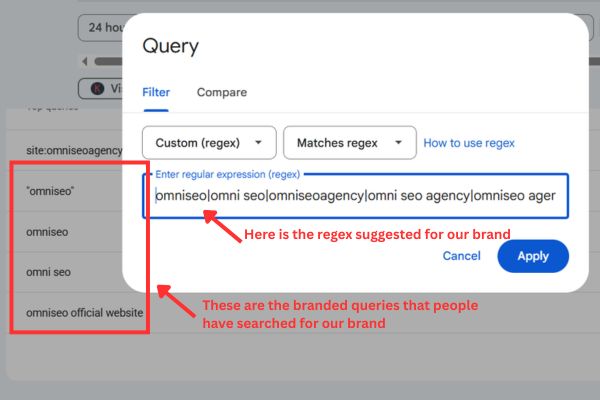
- Apply the filter. Your report now shows only branded queries, along with clicks, impressions, CTR, and average position for that segment.
To see non-branded traffic instead, repeat the same steps but choose Doesn’t match regex with the same pattern.
Option 2: Google Ads Search Terms Report
If you run paid search on your own brand name, your Google Ads account already separates this data for you.
- Open your Google Ads account and go to your branded campaign.
- Click into Search terms under the Insights and reports section.
- Review exactly what people typed to trigger your branded ads, along with clicks, cost, and conversions for each term.
This only captures paid branded traffic, not organic, but it’s a useful cross-check if you’re running branded search ads alongside your organic strategy. It also helps you spot new branded variations you hadn’t thought to track in Search Console.
Option 3: Ahrefs (Site Explorer)
If you’re already using Ahrefs for rank tracking, it offers a faster way to view this without building your own regex.
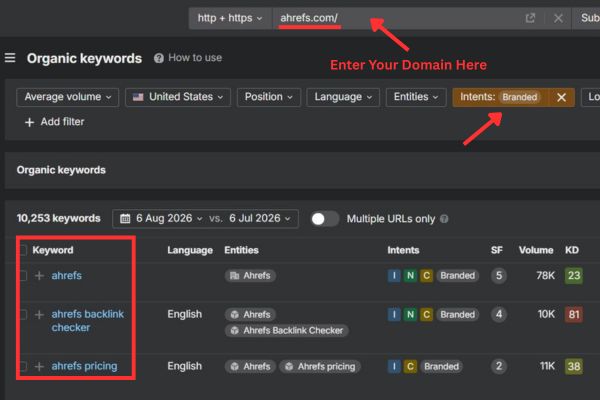
- Open Site Explorer and enter your domain.
- Go to Organic keywords, then filter by Intent or search for your brand name directly within the keyword list.
- Review branded keyword rankings, estimated traffic, and trends over time, all in one view.
This is genuinely handy for tracking branded traffic trends over months without needing to log into Search Console separately, especially if you’re already checking Ahrefs regularly for other SEO reporting.
| Method | Cost | Best For |
|---|---|---|
| Search Console (regex) | Free | Direct organic branded query data |
| Google Ads Search Terms | Free (with active campaigns) | Paid branded traffic specifically |
| Ahrefs Site Explorer | Paid subscription | Ongoing tracking alongside other SEO reporting |
How to Measure Branded Search Traffic
Once you know what counts as branded traffic, you need a way to measure it properly.
The basic formula looks like this:
Branded Traffic = Branded Impressions × Branded Click-Through Rate
In simple terms, that means how often you show up for branded searches, multiplied by how often people click through.
Here’s a breakdown of the key metrics you should track.
| Metric | Where to Find It | What It Tells You |
|---|---|---|
| Branded search clicks | Google Search Console | Total branded visitors to your site |
| Branded impressions | Google Search Console | How often people search your brand |
| Branded click-through rate | Google Search Console | How well you capture the clicks available |
| Branded vs non-branded ratio | Search Console or SEO tools | How reliant you are on brand awareness |
| Branded conversion rate | Google Analytics | How well branded visitors turn into customers |
Tracking these regularly gives you a clear picture of your brand’s health over time.
Branded Traffic Benchmarks You Can Aim For
It helps to know what “good” looks like. Here are some general benchmarks to guide you.
| Metric | Typical Benchmark | What It Means |
|---|---|---|
| Branded share of organic traffic | 10% to 30% | Healthy range for most content-driven businesses |
| Branded click-through rate | 40% to 60% | Below this may mean competitors are stealing clicks |
| Branded conversion rate | 5% to 15% | Should be much higher than non-branded traffic |
| Branded traffic growth (year on year) | 10% to 30% | Flat or falling numbers can signal brand awareness issues |
| Branded vs non-branded conversion gap | 2x to 5x | Branded visitors should convert far better |
These numbers vary by industry. But they give you a solid starting point.
How Branded Traffic Fits Into Your Bigger Marketing Picture
Branded traffic doesn’t happen in isolation. It’s the result of everything else you do to build your brand.
Think of it like a tree. Your branded traffic sits in the middle, connected to what feeds it and what it produces.
What feeds your branded traffic:
- Advertising and brand campaigns
- PR coverage and media mentions
- Word-of-mouth referrals
- Social media presence
What your branded traffic produces:
- Higher organic revenue
- Better overall conversion rates
- Stronger brand reputation
This means growing branded traffic isn’t just an SEO job. It’s connected to your whole marketing strategy.
How Much Branded vs Non-Branded Traffic Should You Have?
This is a common question, and there’s no single right answer.
It depends on your business stage, your goals, and your industry.
A newer business will likely have very little branded traffic at first. That’s normal. Nobody searches for a brand they’ve never heard of.
As your brand grows, your branded traffic should grow too. If it stays flat for a long time, that might mean your brand awareness efforts aren’t working.
On the flip side, if almost all your traffic is branded, you might be missing opportunities. You could be relying too heavily on people who already know you, and missing new customers who don’t.
⚠️ Warning
-
A business with 90% branded traffic and only 10% non-branded traffic may be leaving a lot of growth on the table. Non-branded content brings in fresh audiences.
The healthiest approach is usually a solid mix of both. Aim for enough non-branded content to keep bringing new people in, while your branded searches keep growing steadily.
Proven Strategies to Grow Your Branded Traffic
Now for the fun part. Here’s how you can actually increase your branded traffic over time.
1. Improve Your Existing Branded Pages
Look at pages already ranking for your brand terms. Make sure they’re well optimised.
Add your brand name naturally into titles and headers. Keep the content accurate and up to date.
2. Build New Content Around Branded Searches
Create pages that directly answer common branded questions. Think FAQ pages or “how to use your product” guides.
This helps you own more of the conversation around your brand.
This is exactly where dedicated SEO content services earn their keep, building out branded FAQ and product content deliberately, rather than leaving that conversation to competitors or review sites to shape instead.
3. Aim for Sitelinks in Search Results
Sitelinks are the extra links that sometimes appear under your main search listing. They take up more space and push competitors down.
You can’t force sitelinks to appear, but you can improve your odds. Use clear page titles and strong internal linking between important pages.
4. Claim and Manage Your Knowledge Panel
A Knowledge Panel is the info box that sometimes appears beside search results. It usually shows for well known brand names.
If Google has generated one for your business, claim it. This lets you keep the information accurate and adds another trust signal.
5. Actively Manage Your Online Reviews
People searching “Your Brand reviews” want honest opinions. Make sure you’re responding to both good and bad reviews.
This builds trust and shows potential customers you care about their experience.
6. Answer Common Questions in Your Content
Look at the “People Also Ask” section when you search your brand name. Add short, clear answers to these questions on your website.
This increases your chances of showing up directly in these search features.
7. Stay Active on Social Media
Regular, useful social media posts build familiarity with your brand. Over time, this leads to more people searching for you directly.
You don’t need to be everywhere. Just be consistent on the platforms your audience actually uses.
8. Build Branded Backlinks
Branded backlinks are links from other websites that include your brand name in the clickable text. These help build authority and drive referral traffic.
Look out for unlinked brand mentions too. If a site mentions your name without linking it, it’s worth reaching out and asking them to add a link.
9. Consider Defensive Paid Search Ads
Competitors can bid on your brand name in Google Ads. This means their ad might show above your organic listing.
Running your own branded search ads helps you keep control of that space, even if it costs a little extra.
10. Invest in Brand Awareness Campaigns
This includes things like podcast sponsorships, display ads, or partnerships. These build recognition that eventually turns into branded search.
11. Earn Media Coverage and PR
Getting featured in the news or industry publications introduces your brand to new audiences. Some of those people will later search for you directly.
Build relationships with journalists in your industry. Look for genuine opportunities to be newsworthy.
12. Encourage Word of Mouth
Happy customers talk. Referral programs and great experiences naturally create more branded searches.
Every recommendation is a potential new branded searcher down the track.
13. Make Your Brand Easy to Remember
A simple, easy to spell brand name helps people search for you correctly. A recognisable logo and a catchy tagline help too.
This might sound small, but it genuinely affects how often people search for you by name.
Don't Forget Local SEO for Branded Searches
If your business serves specific regions, local SEO plays a big role in your branded traffic too.
People often add a location to their branded search. Think “Aussie Dental Co Melbourne” or “Bunnings near me.”
Why Local SEO Matters for Your Brand
More people are adding location details to their searches these days. If you’re not optimised locally, competitors or directory sites can take that space instead.
For local businesses like cafes or clinics, this really matters. Being easy to find locally builds trust fast.
Practical Steps to Improve This
- Collect a list of branded queries that include location names
- Create local landing pages if you serve multiple areas
- Add your brand and location into page titles and meta descriptions
- Check how you appear in the Google Local Pack and maps results
- Keep your business name, address, and phone number consistent everywhere online
Even small inconsistencies in your business details can hurt your local rankings. It’s worth double checking regularly.
How to Segment Branded and Non-Branded Traffic in Your Reports
Keeping these two traffic types separate makes your reporting much clearer.
Most SEO platforms let you set up filters based on keywords containing your brand name. You can then exclude these to see non-branded performance on its own.
This split helps you see two things clearly. First, how much of your traffic depends on people already knowing you. Second, how well your content reaches completely new audiences.
FAQs
What is branded traffic in simple terms?
Branded traffic is anyone who visits your website by searching your brand name, product name, or service name. They already know you exist before they click.
Is branded traffic the same as direct traffic?
No. Direct traffic is when someone types your website address straight into their browser. Branded traffic comes from a search engine, using a query that contains your brand name.
What is a good branded click-through rate?
Most healthy businesses see a branded click-through rate between 40% and 60%. If yours sits lower, competitors may be capturing some of your clicks.
How do I check my branded traffic for free?
Log into Google Search Console. Filter your search queries using your brand name and any common variations or misspellings.
Should I run paid ads on my own brand name?
Many businesses do. It stops competitors from taking that ad space above your organic listing, and it often comes with a strong return on ad spend.
How much branded traffic should my website have?
There’s no single right number. Newer businesses usually have very little. As your brand grows, aim for branded traffic to make up roughly 10% to 30% of your total organic traffic.
Can non-branded content help grow branded traffic?
Yes. Non-branded content brings in new people who don’t know you yet. Over time, some of them come back later using a branded search instead.
Conclusion
Branded traffic is one of the clearest signals you have of how well your brand is doing.
It shows you who already knows and trusts you. And it usually converts far better than any other traffic source you have.
But it’s not something SEO alone can fix. It’s connected to your advertising, your PR, your reviews, and your customer experience overall.
Start by measuring where you stand today. Use Google Search Console to filter your branded queries and see your current numbers.
Then pick a few strategies from this guide and put them into action. You don’t need to do everything at once.
Small, steady improvements add up over time. A better review response here, a stronger FAQ page there, and a bit more consistency on social media.
Track your branded search volume every month. Watch how it moves as you invest in brand building activities.
Compare your numbers against the benchmarks in this guide. Use them as a rough guide, not a strict rulebook.
Every business is different. Your industry, your audience, and your growth stage all shape what a healthy number looks like for you.
Over time, a steady rise in branded traffic is one of the best signs that your business is becoming a name people know, trust, and actively search for.
That’s the real goal here. Not just more traffic, but more people who already want what you offer, showing up ready to engage.