
Key Takeaways
-
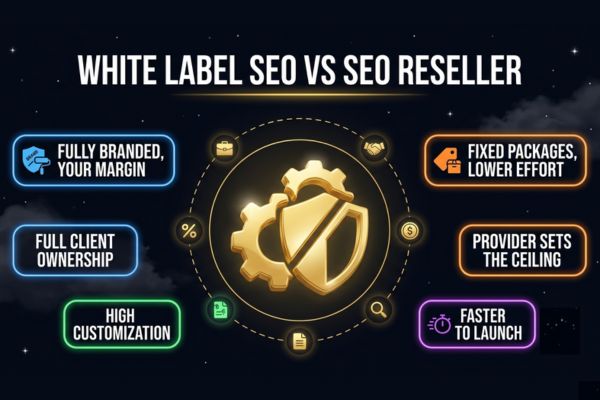
1Branding Visibility Is the Core Difference: White label SEO means the work is invisible to the client, everything they see carries your agency's brand. Reseller SEO means you're distributing someone else's pre-packaged product, sometimes with their branding still visible.
-
2The Real Divide Is the Margin Ceiling: The biggest financial difference isn't the sticker price, it's the ceiling. Reseller margins are structurally capped by the provider's wholesale rate, while white label margins scale with your own pricing and positioning.
-
3Vetting Your Partner Matters Either Way: Both models carry real risk if you skip vetting the partner. A bad partner under your brand becomes your reputation problem either way.
-
4Most Agencies Eventually Switch Models: Most agencies don't stay on one model forever. Many start with reseller programs to test demand, then migrate to white label as their client base grows.
Most agencies reach this decision from the same starting point: SEO is in demand, building an in-house team isn’t realistic right now, and the choice comes down to two outsourced models that look nearly identical on the surface.
Here’s why the difference matters. White label SEO and SEO reseller programs both solve the same delivery problem, but they diverge sharply in how much control you keep and how your margins behave over time.
Picking the wrong model in the white label SEO vs SEO reseller decision doesn’t just cost you money. It can quietly cap how big your agency is able to grow, especially once a client ever wants to leave.
Source: Cloud Campaign
Industry benchmarks put white label SEO gross margins between 45% and 65%, with the median sitting around 55%, according to recent white label SEO pricing research.
Reseller-style commission arrangements typically land much lower, often in the 10% to 25% range, since the reseller isn’t controlling pricing at all.
This guide breaks down:
- What each model actually means, in practice, not just in theory
- How they differ across branding, pricing, control, and margin
- Which model fits your agency right now, and when it’s time to switch
How White Label SEO Actually Works
White label SEO is an arrangement where a specialist provider does the actual SEO work, technical audits, content, link building, reporting, while your agency remains the only thing the client ever sees or interacts with.
The 4-step process usually looks like this:
- Your client signs up for SEO services directly with your agency
- You forward the scope of work to your white label provider
- The provider executes the strategy behind the scenes
- Deliverables, reports, and communication go back to the client fully branded as yours
What the provider actually handles:
- Technical audits and crawl/indexation fixes
- Content strategy and topical authority planning
- On-page optimization across target pages
- Off-page authority building and link acquisition
- Reporting, built to your branded template, not theirs
Source: Center Point VAS
How SEO Reseller Programs Work
An SEO reseller program is a more transactional, product-based model. The provider builds the packages, sets the pricing structure, and defines what’s included, you sell a version of their pre-made product with a markup on top.
The 4-step process usually looks like this:
- The provider offers predefined tiers (Basic, Standard, Premium)
- You resell one of these plans to your client
- The provider fulfills the work according to their fixed scope
- Reports are typically co-branded or provider-neutral, not fully yours
Key trait: This is a ready-made service, not a custom one. You’re mainly just selling someone else’s product. The provider decides the strategy, how the work is delivered, and even how much you can charge, not you.
White Label SEO vs SEO Reseller: Side-by-Side Comparison
| Factor | White Label SEO | SEO Reseller |
|---|---|---|
| Branding | Fully yours throughout | Often provider-visible or co-branded |
| Client ownership | Entirely yours | Yours, but partially mediated by the provider |
| Pricing control | You set your own rate | Capped by the provider's wholesale terms |
| Customization | High, tailored per client | Low, fixed package tiers |
| Client relationship | Fully owned | Shared or provider-facing at times |
| Scalability | High | Medium |
| Risk | Client relationship risk sits with you | Lower financial risk, but less control |
| Margin | Full margin, set by you | Commission or fixed markup |
⚠️ Warning
-
The most overlooked row in this table is client ownership. In a reseller arrangement, if the provider has any direct visibility into your client relationship, co-branded reports, their support team fielding questions, that same access can become a liability if the arrangement ever ends.
Key Differences Explained in Detail
Now that you know how each model works on its own, here’s where they actually pull apart in practice.
Ownership & Branding
In white label SEO, your client never interacts with the backend team, every touchpoint carries your identity. In reseller arrangements, branding is frequently generic or shared, which weakens the sense that your agency is the one actually delivering value.
Pricing Flexibility
White label gives you full control to set custom pricing, build packages, and charge a premium for specialized strategy. Reseller programs usually come with fixed tiers, a “10-keyword plan” or “20-backlinks package,” that you can mark up but not meaningfully restructure.
Level of Customization
White label lets you build a genuinely tailored strategy per client. Reseller models are built for volume and consistency, not customization, which can leave real gaps when a client’s needs don’t fit the provider’s predefined boxes.
Client Relationship Control
White label agencies handle onboarding, strategy calls, reporting, and renewals entirely themselves. Reseller providers sometimes communicate with clients directly, which can blur who the client actually feels loyal to.
Profit Margins
With white label SEO, you set the client price and keep everything above the wholesale rate, often 40-60% margins. With an SEO reseller program, the provider sets the ceiling and your cut is usually a 10-30% markup or fixed commission.
Source: Agency Dashboard
Switching Friction
This is the most underdiscussed difference across most comparisons. Reseller programs create low switching friction, not just for you if you want to change providers, but for your client if they want to leave you. If the infrastructure your client relies on technically belongs to someone else, your retention leverage weakens over time.
Who White Label SEO Works Best For
White label SEO tends to be the strongest fit for three types of agencies:
- Full-service digital marketing agencies already offering PPC, social, or web design, but with no in-house SEO capability. Adding SEO through a white label partner lets them offer a complete service without hiring a specialist team.
- Web design and development studios whose clients frequently ask about SEO after a launch. A white label partnership lets them serve that demand profitably without pulling developers into an unfamiliar discipline.
- PR and content agencies whose clients want a credible, real answer for why their content isn’t ranking. White label technical fulfillment gives them a genuine deliverable to point to.
The financial model is straightforward: you pay the fulfilling partner a wholesale rate, then charge your client a retail rate. The gap between the two is your margin, and unlike reseller arrangements, you’re the one who decides how wide that gap is.
Source: Demand Sage
Who SEO Reseller Programs Work Best For
Reseller SEO fits a narrower, but still legitimate, set of circumstances:
- Freelancers or solo consultants who want to offer SEO without managing any part of delivery themselves
- Non-digital businesses with a relevant audience who want to monetize that audience through referrals
- Agencies testing demand for SEO before committing to a deeper white label partnership or in-house hire
- Anyone needing to activate an SEO offering in weeks, not months
Why Agencies Choose White Label Over Reseller
- Enhances perceived value. Clients see your agency as a full-service partner, not a middleman, which supports higher fees and stronger retention.
- Builds long-term trust. Clients prefer working with a single accountable partner who owns both the strategy and the relationship.
- Scales without hiring. You add capacity instantly by shifting workload to your provider, instead of recruiting and training an in-house team.
- Generates recurring revenue. Since you control pricing and packaging, you can build predictable, subscription-style revenue and upsell into higher tiers over time.
- Strengthens market positioning. Tailored offerings let you market real niche expertise instead of competing as a generalist.
Why Agencies Choose Reseller Over White Label
- Very easy to start. Reseller programs are built to be plug-and-play, predefined packages with ready-made sales materials.
- No deep SEO expertise required. The provider owns the tactics, so you can sell and manage the relationship with only basic SEO literacy.
- Low operational involvement. Execution, quality control, and much of client communication sit with the provider, freeing your time for sales and account growth.
- Predictable workflows. Fixed deliverables and timelines make client expectations, billing, and internal processes simpler to manage.
Common Pitfalls to Avoid in Both Models
White label pitfalls:
- Choosing a partner based on price alone, poor SEO delivered under your brand damages your agency’s reputation, not the provider’s
- Not clearly understanding what’s actually included in fulfillment, vague deliverables create client complaints you can’t resolve because you don’t control the underlying work
- Skipping a clear contract covering what happens if a client is lost, or if you want to switch providers later
- Promising specific ranking positions to clients, no legitimate provider can guarantee this, and doing so under your own brand is a promise you’ll be the one breaking
Reseller pitfalls:
- Referring clients to a provider whose quality you haven’t verified, their poor performance still reflects on your recommendation
- Not fully understanding the commission structure well enough to represent the service honestly to clients
- Assuming that because you’re not delivering the work, you carry no responsibility for the outcome, if you recommended it, your reputation is still on the line
Which Model Is Right for Your Agency?
Choose White Label SEO if:
- You have active retainer clients and want SEO margin without adding headcount
- Your clients span different verticals, and fixed reseller packages would leave real gaps in delivery
- You’re positioning your agency as the expert, not the middleman
- Retention and long-term account value are how you measure growth
Choose an SEO Reseller Program if:
- You’re testing whether SEO converts within your existing client base
- Your current volume is too low to justify vetting and onboarding a full white label partner
- You need to activate an SEO offering in weeks, not months
- You’re not yet ready to manage in-depth strategy or client-facing SEO reporting
A quick, three-question way to decide:
- Do your clients need customized strategies? If no, a reseller program may be enough. If yes, keep going.
- Do you want to be actively involved in strategy and direction? If no, reseller suits you. If yes, keep going.
- Is a fully integrated, branded client experience a top priority? If yes, white label SEO is the right fit.
⚠️ Warning
-
Most agencies that start on reseller programs move off them within about 18 months, not because the model fails, but because growth eventually makes its margin ceiling impossible to ignore.
FAQs
What's the main difference between white label SEO and reseller SEO?
White label SEO means you sell services under your own brand with full control over pricing, communication, and how deliverables are presented. Reseller SEO typically means selling another company’s fixed-scope service, sometimes under their branding, in exchange for a commission.
Is white label SEO actually profitable for agencies?
Yes, when structured correctly. Agencies typically achieve gross margins of 40% to 70% by paying a wholesale fulfillment rate and charging clients a retail rate, according to 2026 industry pricing data. Profitability still depends on market pricing, partner quality, and how long you retain each client.
Do clients know when an agency is using white label SEO?
In a properly structured arrangement, no. Every report, deliverable, and communication carries the selling agency’s branding, the fulfillment partner works entirely in the background. That invisibility is the entire point of the model.
Can small agencies realistically use white label SEO?
Yes. It’s particularly valuable for small agencies that want to offer SEO without hiring a full-time specialist, letting them compete with larger competitors by accessing expertise through a partner instead of building it internally.
Is reseller SEO basically the same as affiliate marketing?
They’re similar but not identical. Affiliate marketing usually means promoting a product through content and earning commission on attributed sales. Reseller SEO often involves a more active, consultative sales role, though the underlying commission structure is comparable in many programs.
Do I need deep technical SEO knowledge to manage a white label partner?
Enough to read a ranking report and interpret core metrics, but you don’t need to execute the work yourself. Understanding what you’re reviewing keeps the partner relationship sharp and client conversations credible.
Conclusion
The white label SEO vs. SEO reseller decision isn’t about which model is objectively better. It’s about which one matches where your agency actually is right now.
Reseller programs are a legitimate way to test demand with minimal risk. White label SEO is where the real margin, control, and long-term client retention live, once you have the client base to justify it.
Most agencies eventually move from reseller to white label as they grow. The mistake isn’t choosing the “wrong” model to start, it’s staying on one your agency has already outgrown.
Not Sure Which Model Fits Your Agency?
Every agency sits at a different stage of growth. Talk to our team and we'll help you figure out which setup actually matches your client base, margins, and goals, no pressure, no generic pitch.
Book a Free Strategy Call →