
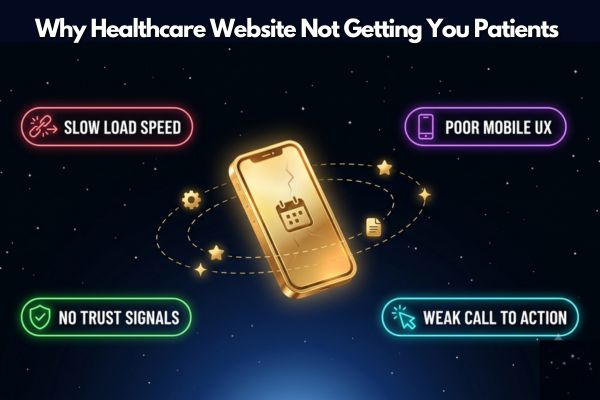
Key Takeaways
-
1Healthy Traffic, Low Bookings Means a Conversion Problem: A conversion problem looks like healthy traffic but low bookings, don't assume you need more visitors before checking this first.
-
2Most Healthcare Sites Are Leaving Bookings on the Table: The average healthcare website converts at just 3–4%, but top performers reach 8–10% or higher.
-
3Trust Signals Need a Compliant Approach in Australia: Trust signals matter enormously in healthcare, but AHPRA restricts testimonials in Australia, so compliant alternatives like credentials and star ratings matter more here.
-
4A Brochure Site and a Booking Engine Aren't the Same Thing: A brochure website describes your practice; a patient booking engine is built to convert every visitor into a booked patient.
-
5A Booking Isn't the Finish Line: Booking isn't the finish line, a no-show isn't a real conversion, follow-up systems matter just as much as the website itself.
Somewhere in your city right now, a patient is sitting on the couch, phone in hand, searching for exactly the kind of care you offer.
They find your website. They read it. Then they close the tab, and book with someone else instead.
You never see this happen. There’s no error message, no red flag in your analytics. Just a quiet, invisible moment where a real patient almost chose you, and didn’t.
Multiply that by every visitor your website gets in a month, and you start to see the actual size of the problem. This is what a healthcare website not getting you patients actually looks like from the inside, not a broken page or an obvious red flag, just a slow, invisible leak.
Here’s the strange part: your website might be doing everything “right.” Good rankings. Steady traffic. A clean, professional design.
And your phone still isn’t ringing the way it should.
If that sounds familiar, the problem isn’t what you think it is. It’s not your marketing. It’s not your rankings. It’s something quieter, and far more fixable, than either of those.
Why Isn't Your Traffic Turning Into Customers?
Most practices assume the fix is “more traffic.” So they spend more on ads. They chase more keywords.
But here’s the thing: more visitors to a broken website just means more people leaving without booking. (Before spending more on ads, it’s worth checking whether your healthcare SEO services foundation is actually converting the traffic you have.)
Source: LanderLab
That gap between average and top performers isn’t luck. It’s a website that’s actually built to convert, not just built to look nice.
So what separates the two? That’s exactly what the rest of this guide is going to show you, starting with a two-minute way to check which problem you actually have.
Traffic Problem or Conversion Problem? A Quick Way to Tell
Here’s a simple way to check which one you actually have.
Look at your website analytics for the last 30 days. Find two numbers:
- How many people visited your site
- How many of them called, booked, or filled out a form
If your visitor number is healthy but your bookings are low, that’s a conversion problem.
If both numbers are low, you likely have a traffic problem first.
Most practices assume it’s traffic. Most of the time, it’s actually conversion.
Once you know that, the real question becomes: fixed compared to what? What does a website that actually converts even look like? That’s worth seeing clearly before we get into everything that might be going wrong on yours.
What a Website That Actually Books Patients Looks Like
Before we get into what’s broken, let’s look at what “working” actually looks like. A website that books patients usually has five things in place.
Clear, Visible Calls to Action
A call to action is just a button or line of text telling the visitor what to do next. “Book Now.” “Call Today.” “Get a Free Consultation.”
Every page should have one. Not buried at the bottom. Not hidden behind three clicks.
Fast, Speed-Optimized Pages
If your website takes too long to load, people leave before they even see what you actually offer, and once they’re gone, they rarely come back to give it a second chance.
Mobile-First Experience
Most people search for a doctor or dentist on their phone, not a laptop.
If your site is hard to read, hard to tap, or hard to navigate on mobile, you’re losing patients before they even get to your services page.
Strong Trust Signals
Trust signals are anything that makes a stranger feel safe choosing you. Reviews. Photos of your real team. Clear credentials.
Healthcare is a high-trust decision. People aren’t buying a T-shirt. They’re choosing who takes care of their health.
A Clear Value Proposition
In one sentence, can a visitor tell what makes your practice different? If not, they’ll assume you’re the same as every other option and pick based on price or whoever’s first on Google.
Five things. That’s the whole standard. Now here’s where it actually breaks down, and there are more ways for this to go wrong than most practices expect.
9 Reasons Your Website Isn't Converting Visitors Into Patients
Now that you know what “good” looks like, here’s where most websites actually fall short, often in ways that aren’t obvious until you know exactly what to look for.
1. Attracting the Wrong Traffic
Ranking for the wrong keywords brings the wrong visitors. Someone researching “symptoms of gum disease” isn’t ready to book. Someone searching “emergency dentist near me” is.
If your content only attracts browsers, not bookers, your conversion rate will always look low, even if your website itself is fine.
Here’s a real example. A practice ranks well for “what causes tooth sensitivity,” a genuinely helpful article. But that same practice has no content targeting “tooth sensitivity treatment near me,” the version of the search someone types once they’re ready to act.
The traffic looks healthy in Google Analytics. The bookings never show up. The fix isn’t more content, it’s the right content, matched to what stage of the search journey the visitor is actually in. (This is exactly the kind of keyword-intent mapping our dental SEO services are built around.)
2. Weak or Confusing Calls to Action
“Learn More” tells a visitor nothing. “Book Your Free Consultation” tells them exactly what happens next.
Weak CTAs are often a symptom of a bigger habit: writing website copy to sound professional, rather than to move someone toward a decision.
A visitor reading a page about dental implants doesn’t need “Contact Us” at the bottom. They need “Book Your Implant Consultation,” placed right after the section that answers their biggest hesitation, usually cost or pain.
3. Slow Website Speed
Source: Lucky Orange
Common causes worth checking: large, uncompressed images, videos embedded directly on the page instead of hosted elsewhere and linked in, outdated plugins, and cheap hosting that can’t handle traffic spikes.
None of these are exotic problems. Most are fixable within a single afternoon by a competent developer, once someone actually identifies them.
4. Poor Mobile Optimization
Source: Steel Advertising
If a visitor has to pinch, zoom, or scroll sideways to read your site, they’re gone within seconds.
That means for most practices, mobile isn’t a secondary experience, it’s the primary one. A site that was designed on a desktop screen and simply “shrinks” on mobile usually fails visitors in small, cumulative ways: tiny tap targets, forms that are painful to fill out with a thumb, phone numbers that aren’t clickable.
5. Lack of Trust Signals
No reviews. No real photos. No clear credentials. To a stranger, that reads as “unproven,” even if you’re actually excellent.
This is especially costly in healthcare, where the decision carries more weight than almost any other online purchase.
A visitor comparing three practices will often default to whichever one feels most credible in the first ten seconds, long before they read a single word of your actual service descriptions.
6. No Clear Value Proposition
If every competitor’s website says the same thing, patients have no reason to pick you over them.
Most dental and medical websites genuinely do sound identical: “compassionate care,” “state-of-the-art technology,” “patient-centered approach.” None of that differentiates anything, because every competitor’s site says it too.
A real value proposition answers one specific question: why this practice, instead of the other five open right now within a ten-minute drive?
7. No Tracking or Data Insights
If you don’t track where visitors drop off, you’re guessing at fixes instead of actually solving the problem.
Most practices only look at one number: total visitors. But the far more useful numbers are hiding underneath that: which page has the highest exit rate, how far someone scrolls before leaving, and whether they ever reach your booking form at all.
Without this, “improving the website” becomes a guessing game, redesigning things that were never actually broken, while the real leak goes untouched.
8. No Follow-Up System
A visitor who almost booked but didn’t isn’t a lost cause; they’re a warm lead. Without a follow-up system, most practices simply let them disappear.
Source: 2025 Healthcare Marketing Benchmarks
That gap is rarely a marketing problem. It’s usually a process problem: a form submission that sits in an inbox for two days, or a missed call that’s never returned. Fixing the website brings the visitor to the door. Fixing follow-up is what actually gets them through it.
9. No Specialty-Specific Landing Pages
A general “Services” page can’t properly speak to a cosmetic patient, an emergency patient, and a routine-care patient all at once. Each one needs their own path.
Think about how differently these three people are searching: someone Googling “tooth pain won’t stop” at 11pm, someone comparing veneers providers over several weeks, and a parent looking for a gentle pediatric dentist for their toddler.
One generic page, with one generic message, can’t speak to all three at the same time. Each one drops off looking for a page that actually understood what they needed.
Of all nine of these, one of them is quietly more complicated than it looks, especially if you’re running a practice in Australia. It’s worth its own section.
Why Trust Signals Are Harder to Build in Healthcare
Trust matters more in healthcare than almost any other industry. People are choosing who looks after their health, not picking a restaurant for dinner.
Source: Get Dear Doc
But here’s the catch for Australian practices specifically: AHPRA, the body that regulates healthcare advertising in Australia, restricts the use of patient testimonials about clinical services.
That means the exact tactic that works so well in other markets can get an Australian practice in regulatory trouble if it’s not handled correctly.
The fix isn’t to skip trust-building altogether. It’s to lean on the trust signals that are still fully compliant:
- Clear provider credentials and qualifications
- Real photos of your team and practice
- Star ratings displayed through your Google Business Profile (rather than quoted testimonials)
- Clear, transparent information about services and pricing
All nine of these problems usually trace back to one root cause, and it’s bigger than any single fix on this list. Here’s the actual distinction that matters.
Brochure Website vs. Patient Booking Engine
Most healthcare websites were built to describe the practice. Hours, services, a photo of the building.
That’s a brochure. It informs people. It doesn’t move them to act.
A patient booking engine is different. Every page is built around one question: what does this visitor need to do right now to become a patient?
| Factor | Brochure Website | Patient Booking Engine |
|---|---|---|
| Purpose | Describe the practice | Convert visitors into booked patients |
| CTAs | Few or none | Clear, on every page |
| Content focus | Services and hours | Patient questions and next steps |
| Mobile experience | Often an afterthought | Built mobile-first |
| Tracking | Rarely set up | Tracks every drop-off point |
If your site looks more like the left column, that’s the real reason it isn’t converting, not your pricing, not your services, not even how many patients are searching for you. The website itself is quietly turning people away before they ever pick up the phone.
What a Real Conversion Audit Checks
A proper audit isn’t a vague “review.” It’s a specific checklist, and each item on it should produce an actual number, not just an opinion:
- Page speed score on both desktop and mobile, using a real tool, not a guess
- Mobile usability, tested on an actual phone, not just a browser resize
- Number and placement of CTAs on every key page, counted, not assumed
- Trust signals present, reviews, credentials, real photos, checked page by page
- Booking friction, literally counting how many clicks or fields stand between a visitor and a completed booking
- Tracking setup, confirming you can actually see where visitors drop off, not just how many arrived
If you’ve never had this checked, there’s a good chance one or more of these is quietly costing you patients right now.
Most practices are surprised to learn it’s rarely just one big problem, it’s usually two or three small ones compounding on top of each other.
Booking Isn't the Finish Line
Here’s something most conversion advice misses entirely: a booked appointment that turns into a no-show isn’t really a conversion either.
This matters because it changes how you should actually measure success. A website redesign that increases form submissions but doesn’t reduce no-shows hasn’t really solved the underlying problem, it’s just moved it one step further down the funnel.
We go deeper on reducing no-shows and mapping the full patient experience in our guides on increasing patient volume and patient journey mapping.
The New Front Door: Are You Visible in AI Search?
Even a perfectly converting website fails if patients never find it in the first place.
More and more people are asking tools like ChatGPT and Google’s AI Overviews questions like “best dentist near me” or “what does a root canal cost,” instead of typing a normal Google search.
This changes what “getting found” actually means. It’s no longer just about ranking on a results page a person scrolls through themselves. It’s about whether an AI system reads your content, trusts it enough to summarize, and mentions your practice by name in its answer.
If your website and content aren’t structured for these tools to read and trust, clear headings, direct answers, genuine expertise, you’re invisible in a growing share of searches, no matter how good your conversion rate is once someone lands on your site.
This is a newer, less understood problem than page speed or mobile design, which is exactly why so few practices have addressed it yet.
How We Turn Your Website Into a Patient Booking Engine
We start with a full conversion audit, checking:
- Page speed on both desktop and mobile, measured with real tools, not guesswork, since a one-second delay can cost you up to 20% of bookings
- Mobile usability, tested on an actual phone, covering tap targets, form fields, and whether your number is even clickable
- Calls to action, counting how many exist on each page, where they sit, and whether they actually tell a visitor what to do next
- Trust signals, reviews, credentials, and real team photos, checked page by page, and built around AHPRA-compliant alternatives where testimonials aren’t allowed
- Tracking setup, confirming you can see exactly where visitors drop off, not just how many arrive
Then we:
- Fix what’s broken, the quick wins, compressed images, corrected tap targets, clearer CTAs, so nothing keeps leaking bookings while the bigger work is underway
- Rebuild what needs rebuilding, from single generic service pages into specialty-specific landing pages that actually speak to the person searching
- Set up the tracking to prove it’s working, so you can see the audit’s fixes turning into real bookings, not just a better-looking site
FAQs
Why is my healthcare website getting traffic but no bookings?
This usually means a conversion problem, not a traffic problem. Common causes include slow load times, weak calls to action, poor mobile experience, or a lack of trust signals.
What is a patient booking engine?
It’s a website built specifically to move visitors toward booking an appointment, rather than simply describing the practice like a digital brochure.
How can I improve my healthcare website's conversion rate?
Start with a proper audit checking page speed, mobile usability, CTA placement, trust signals, and tracking, then fix whichever of these is weakest first.
Do I need more traffic to grow my practice?
Not necessarily. Check your visitor-to-booking ratio first. If traffic is healthy but bookings are low, fixing conversion usually gets faster, cheaper results than buying more traffic.
What does a website conversion audit include?
A real audit checks page speed, mobile usability, the number and placement of calls to action, trust signals, booking friction, and whether you have proper tracking in place.
Why are trust signals so important on a healthcare website?
People are choosing who manages their health, a decision with far higher stakes than most online purchases. Trust signals like reviews, credentials, and real photos directly influence that decision.
How does a follow-up system increase bookings?
Many visitors who almost book don’t finish the process the first time. A follow-up system, like a reminder email or text, brings a meaningful share of them back to complete the booking.
Does website conversion matter more than SEO rankings?
They work together, not against each other. Ranking well brings visitors to your site, but if the site doesn’t convert them, that ranking effort is wasted. Fixing conversion first often makes your existing traffic far more valuable before you spend more on getting additional visitors.
Conclusion
Your website doesn’t need more traffic to fix this. It needs to actually convert the traffic it’s already getting.
That’s the real takeaway here: most practices chase rankings and ad spend when the leak is somewhere much simpler, a slow-loading page, a buried call to action, a mobile experience that quietly frustrates every visitor who tries to book from their phone.
None of these are exotic problems. All of them are fixable, usually faster and cheaper than the next marketing campaign you were about to fund.
The nine reasons above rarely show up alone. They compound, one weak CTA plus one slow page plus zero follow-up adds up to a patient who almost chose you, and didn’t.
The good news is that the reverse is also true: fix two or three of these, and the traffic you already have starts converting at a noticeably higher rate, without spending a single extra dollar on getting people to your site.
Start with the two-minute check from earlier in this guide. Look at your visitor count and your booking count side by side.
If the gap between them is wider than it should be, you don’t have a traffic problem. You have a website that’s ready to work harder for you, as soon as someone actually fixes what’s quietly holding it back.
Stop Losing Patients You've Already Won
Every visitor who leaves without booking isn't a lost cause, they're a fixable problem. Fix the conversion gap, and the traffic you already have starts working a lot harder for you.
Get a Free Conversion Audit →