
Key Takeaways
-
1Engagement Drives Revenue: A one-point rise in digital engagement score leads to a one-point rise in patient charges collected.
-
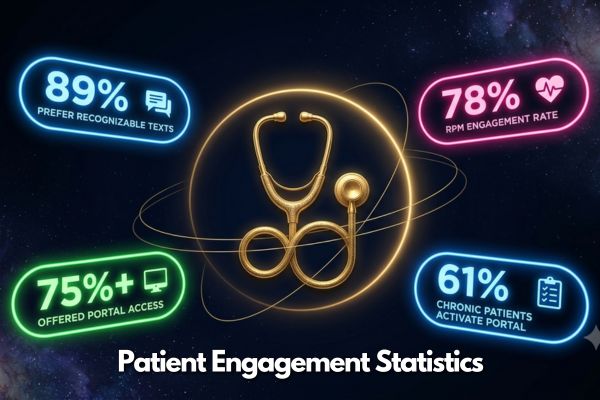
2Recognizable Numbers Win: 89% of patients engage more with texts from familiar 10-digit numbers, boosting attendance and payments.
-
3Chronic Patients Lead Digital Adoption: 61% activate patient portals, and RPM engagement tops 78% in complex care programs.
-
4Most Practices Still Have a Gap: Fewer than half of hospitals have fully implemented advanced engagement tools, leaving room to lead.
Patient engagement is rapidly becoming central to how clinics, group practices, and health systems drive better outcomes and financial success.
As digital tools, remote care, and data-driven strategies continue to expand in clinical use, 2026 represents a pivotal year in patient engagement trends: providers are now measuring engagement not as a soft concept but as a core performance indicator tied to revenue, adherence, and care quality.
In this blog, we’ll walk through the most important patient engagement data insights and metrics you need to know to shape strategy in the year ahead.
From how patients prefer to be contacted to how digital engagement improves financial performance, these patient engagement statistics and research findings offer a clear roadmap of what’s working, and what’s still a gap, in healthcare.
These same digital-first patient behaviors also shape how patients search for and choose a provider in the first place, which is where healthcare-focused SEO strategy becomes just as important as the engagement tools covered below.
What Is Patient Engagement?
Patient engagement refers to the active involvement of patients in their own healthcare decisions, treatment plans, and day-to-day interactions with providers.
It covers everything from how patients access their medical records to how they communicate with their care team, schedule appointments, and follow through on treatment instructions.
In practice, patient engagement shows up through tools and behaviors like:
- Logging into a patient portal to view test results or clinical notes
- Responding to text or email reminders about upcoming appointments
- Using remote monitoring devices to track chronic conditions
- Messaging providers directly through secure digital channels
- Completing pre-visit forms or post-visit instructions online
The more engaged a patient is across these touchpoints, the more likely they are to attend appointments, follow care plans, and pay bills on time, which is exactly why healthcare providers increasingly track engagement as a measurable performance indicator rather than a soft, qualitative concept.
10 Must-Know Patient Engagement Statistics in Healthcare for 2026
These are the 10 most critical, up-to-date patient engagement numbers in healthcare that should guide strategy and priorities for clinics, group practices, and healthcare networks this year.
1. Digital Engagement Directly Improves Collections
One leading measure of patient engagement metrics shows that for every one-point increase in digital engagement, there is a corresponding one-point increase in the share of total patient charges paid within a year.
This means practices scoring higher on digital engagement (like portal use, online scheduling, and digital payments) tend to collect more patient-responsibility revenue.
What it means: More robust digital engagement leads to improved patient responsibility payment performance, a powerful patient engagement study finding that ties engagement tools directly to revenue improvement.
2. Patients Prefer Recognizable, Text-Based Outreach
Communication matters. According to a recent patient engagement survey statistic, 89% of patients are more likely to engage with messages from a recognizable 10-digit phone number rather than anonymous or short-code SMS.
Beyond just engagement, these familiar numbers were tied to higher patient actions: 66% were more likely to attend appointments, 58% more likely to complete pre- or post-visit instructions, and 41% more likely to pay bills on time.
Operational implications: Text-based outreach that patients trust improves attendance, adherence, and revenue, highlighting the importance of patient engagement data insights into how patients prefer to interact.
3. The Patient Engagement Solutions Market Is Booming
The global patient engagement solutions market, technology designed to support engagement through portals, messaging, education, and remote care, is on a strong growth trajectory.
Forecasts suggest that from a base market size of roughly $27.7 billion in 2025, the segment will grow at around an 18.6% CAGR through 2035, driven largely by increasing demand for digital, telehealth, and patient-centric care tools.
Insight: This rapid growth in the patient engagement solutions market confirms that digital engagement technologies are not a fad. They are a long-term strategic investment and a key part of patient engagement trends in healthcare.
4. Patient Portal Access Is Now Mainstream and Growing
Patient portals, secure digital platforms where patients can view records, schedule appointments, and communicate with providers, have moved from “nice to have” to a baseline expectation.
In 2024, more than three-quarters of individuals in the U.S. were offered online access to their medical records via a portal or insurer, and portal use has risen steadily.
Among patients with chronic conditions, portal use is even more prevalent, often serving as the hub of digital patient engagement. This signals a shift in patient engagement trends: patients expect convenience, transparency, and access to their health information anytime, anywhere.
5. Hospitals Offer Robust Patient-Facing Capabilities Beyond Portals
Hospital systems, often early adopters of digital engagement technologies, continue to expand patient-facing capabilities. Recent data shows:
- 95% of hospitals let patients view clinical notes online
- 92% provide secure provider messaging
- 81% support access via mobile apps
- Around 70% use FHIR-based apps that allow interoperable access to health data
Benchmark for practices: These systems set expectations for outpatient clinics and group practices, showing that robust portal access, messaging, and app-based tools are rapidly becoming standard elements in patient engagement research.
6. IT-Enabled Engagement Is Growing but Not Fully Mature
Across the healthcare ecosystem, the inpatient advanced engagement capabilities rose from 56% in 2021 to 69% in 2024; outpatient capabilities increased from 49% to 64%. Fewer than half of hospitals had all advanced capabilities fully implemented by 2024.
Insight: While growth in patient engagement technology is strong, many providers still have significant room for innovation. This highlights the potential for further advancements in leveraging digital tools to deepen patient involvement.
7. Portal Use Is Highest Among Patients With Complex Health Needs
Research into patient engagement rates statistics shows that patients with chronic conditions, such as diabetes, cardiovascular disease, and cancer, are more likely to activate and use patient portals than healthier individuals.
In a large observational study, 61% of adults with at least one chronic condition activated their patient portal, and 54% logged in at least once annually.
Patients with chronic conditions, such as diabetes, cardiovascular disease, and cancer, showed even higher usage. High utilizers, especially those with conditions requiring ongoing monitoring or management, made greater use of digital tools.
What this means: Digital engagement tools are especially useful for high-risk patients, a key patient engagement data insight that clinics can use to prioritize interventions and tailor educational efforts.
8. Portal Messaging Volumes Are Surging with Workflow Implications
As more patients access digital portals, message volumes are increasing rapidly. Recent surveys show that 70% of medical groups reported increased portal message volume, with only 1% seeing decreases.
In some cases, policy changes that tied portal threads to billable e-visits led to an 8.8% decrease in billable threads, underscoring how financial incentives affect engagement patterns.
Insight: Practices must plan staffing and workflow around asynchronous communication, part of evolving patient engagement trends that require operational attention.
9. RPM Engagement Often Exceeds 75% and Shows Positive Outcomes
Remote Patient Monitoring (RPM) is one of the most engaging digital modalities, especially for patients with chronic disease or complex care needs.
In some large RPM programs, engagement rates exceed 78%, and participants were linked to improvements in outcomes such as reduced emergency department visits and lower readmission rates.
Additionally, RPM adoption contributes to a growing market expected to reach tens of billions of dollars in coming years, further evidence that tech-enabled engagement is reshaping care delivery.
10. Wearables, Telemedicine, and Digital Health Tools Continuously Shape Engagement
Digital tools beyond portals, including wearable devices and telemedicine, play a growing role in patient engagement. Wearable tech usage has been associated with engagement increases of around 20%, particularly among patients managing chronic conditions like diabetes and hypertension.
Meanwhile, telehealth is estimated to have contributed to a 15% reduction in non-urgent emergency department visits in recent years, an indicator of how digital care channels can redirect care and deepen engagement.
Insight: Integrating wearables and virtual care into engagement strategies expands the touchpoints where patients interact with providers and creates new metrics that matter in patient engagement research and strategy.
Why This Matters for Local Search & Patient Acquisition
Here’s the part these statistics don’t cover directly, but that matters just as much for practice growth.
Patients who expect portal access, text reminders, and app-based care are the same patients researching providers online before ever booking an appointment.
The digital-first behavior driving these engagement numbers is the exact same behavior driving how patients find a new provider in the first place.
A few direct connections worth understanding:
- Patients who expect digital convenience from their existing provider also expect to find that provider easily online. If your website, Google Business Profile, or local search presence doesn’t reflect the same digital-first standard, you lose prospective patients before they ever reach your portal.
- Online reviews are now part of the “engagement” a patient evaluates before choosing you. A practice with strong digital tools but a thin or outdated online reputation still loses the first impression that determines whether a patient calls at all.
- Search visibility compounds the same trust signals covered above. Practices that show up prominently in local search results for their specialty and location are effectively converting the same digital-first patient expectations these statistics describe, just earlier in the patient journey, before the first appointment is even booked.
- The engagement maturity gap described in Stat 6 also exists in search visibility. Just as many practices haven’t fully implemented advanced engagement tools, most haven’t fully optimized their local SEO either. Closing both gaps together compounds the advantage.
In short, the statistics above measure what happens once a patient is in your system. OmniSEO’s healthcare SEO services are built to solve the step before that: making sure enough of the right patients find and choose your practice in the first place.
What These Patient Engagement Numbers Mean for Your Strategy
Taken together, these numbers offer several clear patient engagement data insights for clinics and practices in 2026:
- Digital touchpoints drive outcomes: From revenue collection to appointment adherence and communication quality, digital engagement tools have measurable clinical and financial impacts.
- Patients increasingly expect digital access: Portals, secure messaging, and app access are not nice extras; they are expected parts of care delivery and key patient engagement metrics to track.
- There is still a maturity gap: Adoption is growing, but many providers have incomplete engagement toolsets, creating opportunity for strategic investment and improvement.
- Track the right metrics: Measure portal activation rates, SMS opt-ins, RPM adherence, digital payment completion, and secure messaging volumes, these metrics matter in 2026 and beyond.
FAQs
What patient engagement metrics should clinics track in 2026?
Focus on portal activation rate, SMS/email opt-in rate, appointment adherence, RPM engagement, digital payment completion, and portal message volume. Together, these give a clear picture of engagement depth and where to invest next.
How does digital patient engagement affect revenue collection?
Research shows a direct correlation: for every one-point rise in a practice’s digital engagement score, patient-responsibility collections rise by roughly the same margin. Digital engagement is a measurable revenue lever, not just a care quality investment.
Which patients engage most with digital healthcare tools?
Patients with chronic conditions engage far more than healthier populations. 61% activate their patient portal, and RPM engagement often exceeds 78% in complex care programs. Digital investment pays off most when targeted at high-acuity patients.
What are the biggest patient engagement trends for small clinics in 2026?
Portal access becoming standard, recognizable-number SMS outperforming anonymous outreach, rising message volumes needing better workflows, RPM driving strong chronic-care engagement, and the maturity gap creating a real differentiation opportunity.
Conclusion
The latest patient engagement numbers in healthcare show that engagement is no longer an ambiguous concept: it is central to financial performance, clinical outcomes, and patient experience.
As digital tools mature and patient expectations rise, providers that prioritize engagement strategy and begin tracking actionable patient engagement metrics will be better positioned to enhance outcomes and differentiate care.
Start by auditing your existing engagement tools and data, determine which of the key stats above are most relevant to your patient population, and then design a simple 12-month engagement roadmap.
Focusing on a small set of high-impact engagement measures, such as portal utilization, text engagement rates, and RPM adherence, can unlock notable gains in both care quality and operational performance in 2026 and beyond.
Great at Patient Engagement? Make Sure Patients Can Find You First.
Digital-first patients expect the same convenience when searching for a provider as they do once they're your patient. OmniSEO Agency helps healthcare practices turn that expectation into stronger search visibility, so more of the right patients find you first.
Talk to Our Healthcare SEO Team Today