

Most manufacturers built their business on word-of-mouth, trade shows, and a sales team that knew the industry inside out. That model worked for decades.
But the buyers those sales teams once reached by phone are now doing twelve online searches before they ever engage with a supplier. They are reading technical blogs, watching process videos, downloading spec sheets, and forming strong opinions about which manufacturers understand their problems before they speak to anyone.
By the time a purchasing manager or engineer finally reaches out, they have already decided which two or three suppliers are worth their time. If your manufacturing company is not producing content that shows up in that research phase, you are not on that shortlist.
This is the case for content marketing for manufacturers and for content marketing for manufacturing companies of every size. Not as a replacement for your sales team or your trade show presence, but as the system that ensures you are visible, credible, and trusted in the digital research phase that now precedes almost every significant B2B purchase decision.
Why Content Marketing Is Different for Manufacturers
Before we get into content strategy for manufacturers and tactics, it is worth being clear about what makes content marketing manufacturing distinct from other B2B sectors. The differences are real and they affect everything from what you write to who you write it for.
The Buying Committee Is Technical
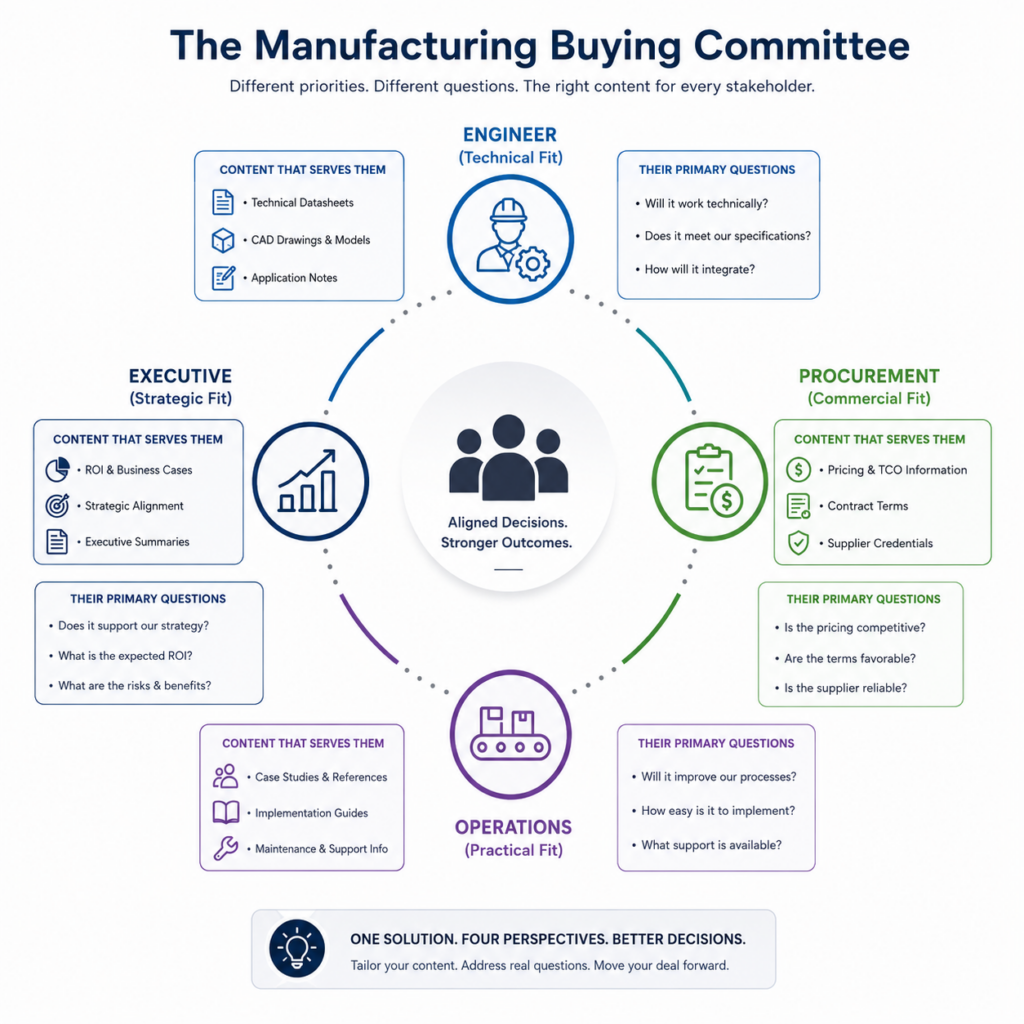
Manufacturing purchases are rarely made by a single decision-maker. A typical B2B manufacturing sale involves engineers evaluating technical specifications, procurement managers assessing costs and reliability, operations managers considering implementation and maintenance, and executives approving capital expenditure.
Each of these stakeholders consumes content differently and needs different information. Engineers want specifications, tolerances, material data, and process details. Procurement wants pricing structures, lead times, quality certifications, and supplier reliability evidence. Executives want ROI data, case studies with measurable outcomes, and risk mitigation evidence.
Manufacturing content marketing that addresses only one of these audiences leaves the rest of the buying committee uninformed and creates friction in the purchase process. Your content programme needs to serve each stakeholder type at the level of detail they require.
The Sales Cycle Is Long
Industrial and manufacturing sales cycles routinely span six to eighteen months. A procurement committee evaluating capital equipment may conduct extensive research, request multiple proposals, run technical trials, and consult references before making a decision. During that entire period, content is either working for you or against you.
Content that answers the questions buyers are asking at each stage of that process keeps your firm present in their consideration during months when no sales activity is occurring. Content that does not exist leaves the field to competitors who are publishing.
The Research Phase Starts Online
According to WebFX’s manufacturing marketing research, 84% of people searching for services in the manufacturing industry say they use the internet as their starting point when finding a company, components, or services. A separate study by Think with Google found that B2B researchers average 12 online searches before engaging with a specific brand’s website.
That research phase is where content marketing operates. The manufacturers whose content answers the questions buyers are asking during those twelve searches earn the awareness, credibility, and consideration that converts to conversations.
57%
of industrial buyers make purchase decisions before ever interacting directly with a manufacturing company. And 40% of B2B buyers consume three to five pieces of content before reaching out to a salesperson. Source: WebFX Manufacturing Marketing Statistics
Understanding Your Manufacturing Buyer: The Stakeholders Your Content Must Serve
Effective manufacturing content marketing starts with a precise understanding of who you are writing for. Here are the four primary stakeholders in most industrial buying decisions and what content serves each one.
Stakeholder 1
The Engineer: Evaluating Technical Fit
Engineers are often the first person to engage with your content and frequently the most influential voice in the buying process. They are looking for technical evidence that your product or capability meets their specifications. They want exact performance data, material certifications, tolerance ranges, process capabilities, and integration requirements.
Content that serves engineers includes: detailed technical specification sheets, how-it-works explanations of manufacturing processes, material or component technical guides, troubleshooting articles that demonstrate process expertise, and case studies with specific technical outcomes rather than general claims of success.
Engineers will quickly dismiss content that is vague, imprecise, or makes claims without supporting data. Technical accuracy is the non-negotiable standard for this audience.
Stakeholder 2
The Procurement Manager: Evaluating Commercial Fit
Procurement managers are focused on costs, lead times, quality consistency, supplier reliability, and risk. They are not primarily evaluating technical specifications , that is the engineer’s job. They are evaluating whether your company is a reliable commercial partner.
Content that serves procurement managers includes: information about your quality certifications and standards (ISO, AS9100, IATF, and others relevant to your sector), lead time and capacity information, supplier reliability evidence, minimum order quantities and pricing structures where commercially appropriate, and references or case studies from comparable clients.
Stakeholder 3
The Operations Manager: Evaluating Practical Fit
Operations managers are thinking about implementation. How difficult is installation? What ongoing maintenance is required? What training does your product or service require? What happens when something goes wrong?
Content that serves operations managers includes: implementation guides and installation documentation, maintenance schedules and service information, training resources, after-sales support processes, and case studies that describe the implementation experience, not just the outcome.
Stakeholder 4
The Executive: Evaluating Strategic and Financial Fit
Executives are making the final approval decision. They are less interested in technical specifications than in the business case: what is the ROI, what is the risk, how does this fit the company’s strategic direction, and why this supplier rather than an established alternative.
Content that serves executives includes: ROI calculators or frameworks, case studies with quantified business outcomes (cost savings, throughput improvements, quality gains), thought leadership content positioning your company as an industry expert, and information that addresses risk and reliability concerns at a business level.
The Content Types That Work Best for Manufacturing Companies
Not all content formats serve manufacturing buyers equally well. The following are the formats with the strongest track record in manufacturing content marketing, based on what the data and the buying behaviour of industrial audiences shows.
Content Type 1
Technical Blog Posts and Application Guides
The foundation of manufacturing content marketing is written technical content that answers the specific questions your target buyers are searching for. This is the content that builds organic search visibility and gets your company found during the research phase.
Effective technical content marketing for industrial buyers is not a restatement of your product catalogue. It is genuinely useful information: how to select the right material for a specific application, how to troubleshoot a common manufacturing challenge, what tolerances are achievable with different processes, how to read a technical certification, what questions to ask when evaluating suppliers in your category.
This content works because it demonstrates expertise rather than just claiming it. When an engineer finds a detailed, technically accurate article on your website that helps them solve a problem they are working on, they form an impression of your company’s capabilities that a generic “about us” page could never achieve.
Content Type 2
Case Studies With Quantified Outcomes
Case studies are the most directly persuasive content type in manufacturing marketing, and the most underproduced. According to WebFX manufacturing research citing CMI data, 85% of manufacturers say they are doing content marketing, but the quality and specificity of case studies across the industry is consistently weak.
A manufacturing case study that says “we helped Client X improve efficiency” is almost useless. A case study that says “we helped a Tier 2 automotive supplier reduce their scrap rate from 4.2% to 0.8% over six months through the implementation of our precision tooling process, resulting in annual savings of $340,000” is highly compelling to any buyer in a comparable situation.
The specificity is what creates trust. Vague claims are easy to make. Specific, documented outcomes with named (or appropriately described) clients are evidence. Treat your case study programme as one of your most important content investments and build it systematically across your key application areas.
Content Type 3
Video: Process Demonstrations and How-To Content
Manufacturing is a visual discipline. The quality of your equipment, the precision of your processes, the cleanliness and organisation of your facility: none of these are adequately conveyed by text alone. Video gives potential clients a window into your operation that builds trust and confidence in ways that written content cannot replicate.
Content Marketing Institute data on manufacturing marketers found that 52% say videos provided the best results in the last twelve months, and 53% specifically identified how-to videos and product explainers as their highest-performing video format. This makes sense for manufacturing: buyers want to see how your process works, not just read about it.
Effective manufacturing video content includes: factory or facility tours, process demonstrations showing specific capabilities in operation, product application videos showing your components in use, quality control process demonstrations, and technical how-to content that helps engineers understand how to specify or use your products correctly.
Content Type 4
White Papers and Technical Guides
For complex technical topics where a buyer needs in-depth guidance before making a decision, white papers and comprehensive technical guides are highly effective. They serve dual purposes: generating leads through gated downloads (where an interested buyer provides their contact details in exchange for access), and establishing deep technical credibility that differentiates your company from competitors.
Effective manufacturing white paper topics include: comparative guides to different manufacturing processes for a specific application, material selection guides for particular environments or performance requirements, design for manufacturability guides that help your clients’ engineers produce better designs from the start, and industry trend or technology outlook papers that demonstrate your forward-thinking perspective on your sector.
White papers are also the content format most likely to be shared within a buying committee, passed from the engineer who found it to the procurement manager and the executive making the final decision. A single well-written white paper can simultaneously serve multiple stakeholders in the same purchase process.
Content Type 5
Webinars and Online Technical Presentations
Webinars became mainstream in manufacturing marketing and have stayed there. Industry research shows that nearly 70% of all manufacturing workers attended at least one webinar in a recent year, while trade show attendance has declined. For manufacturers trying to reach technical audiences with in-depth expertise demonstration, webinars offer the engagement depth of an in-person presentation at a fraction of the cost and with a permanent recording that continues generating leads after the live event.
High-performing manufacturing webinar topics include: technical training on how to specify or use your products, industry regulatory changes and their implications, case studies presented in depth with Q&A, design review sessions, and material or process selection guidance for specific applications.
Content Type 6
Email Newsletters for Long Cycle Nurture
Given the six to eighteen month sales cycles typical in industrial manufacturing, email newsletters are one of the most practical tools for maintaining presence with potential buyers who are not yet ready to purchase. A buyer who subscribes to your technical newsletter in February and engages consistently with your content may initiate a conversation in August, at which point they already have a strong sense of your expertise and capabilities.
Manufacturing email newsletters work best when they deliver genuinely useful technical content rather than promotional messages. Industry news analysis, tips and guidance from your engineering team, new case study announcements, and product application ideas all perform better than promotional offers in a technical B2B audience context.
Building Your Manufacturing Content Marketing Strategy: Step by Step
1
Define Your Target Applications and Buyer Personas
Manufacturing companies often serve multiple industries and applications. The most effective content marketing programmes focus on specific applications where the company has particular strength rather than trying to produce generic content for every possible customer type.
Start by identifying your two or three highest-value application areas. Then define the specific buyer personas within each: what are they responsible for, what are they trying to achieve, what technical questions do they have, and what would give them confidence that your company is the right supplier? This specificity makes every subsequent content decision easier and more effective.
2
Map Content to the Industrial Buying Journey
Manufacturing buying journeys have distinct phases and each requires different content. A framework that works well for industrial content mapping is awareness, consideration, and decision.
Awareness content
reaches buyers who are beginning to research a problem or application area. It includes technical blog posts answering common questions, industry trend articles, and introductory guides to processes or materials. This is primarily organic search content that gets found when buyers are doing their initial twelve-search research phase.
Consideration content
serves buyers who are actively evaluating options. It includes detailed technical guides, comparative process information, capability statements, quality certification documentation, and webinars that demonstrate your expertise in depth. This is the content that differentiates you from competitors who offer similar baseline capabilities. Decision content supports buyers who are near the final selection. It includes case studies with specific outcomes, references and testimonials, detailed proposal support materials, and clear documentation of your quality systems, lead times, and commercial terms. This is the content that resolves the final objections and gives a buying committee confidence to select your company.
According to Aberdeen Group research, there is a 73% higher average conversion rate for marketers who align content to stages of the buyer’s journey versus those who produce content without journey mapping. For industrial sales cycles that span many months, this alignment is particularly important.
3
Build
Manufacturing SEO Content
Into Your Strategy From the Start
Manufacturing buyers search with technical specificity that most generic SEO strategies miss. They search for “CNC machining tolerances for aerospace aluminium” not “CNC machining.” They search for “IATF 16949 certified casting supplier UK” not “metal casting.” They search for “injection moulding for medical device components FDA compliance” not “injection moulding.”
This specificity means manufacturing content marketing has a significant long-tail SEO opportunity. Highly specific technical search terms face much less competition than broad industry terms, and the intent behind them is much higher. A buyer searching for a very specific technical term is likely close to a purchase decision.
Build your keyword research around the specific applications, materials, processes, certifications, and industries you serve. Create content that precisely matches the language your buyers use when they are searching, not the language your internal teams use when talking about your products.
4
Extract Your Engineering Team’s Expertise Systematically
The most valuable manufacturing content is locked inside the heads of your engineering and operations team. They know the technical nuances, the common mistakes clients make in their specifications, the questions they get asked most frequently, and the problems they have solved in ways competitors have not.
The challenge is extracting that expertise efficiently without consuming too much of their time. Structured interview formats work well: a marketing team member or specialist content writer interviews an engineer for thirty to forty-five minutes, asks specific questions about a technical topic, and produces a draft article or guide that the engineer then reviews and approves.
This model separates the expertise extraction from the writing, which is the right division of labour. Engineers are world-class at their technical domain. Content writers who understand manufacturing are world-class at turning that expertise into clear, well-structured, SEO-optimised content. Combining both produces content that neither could produce as effectively alone.
5
Build Topical Authority Through Content Clusters
Rather than publishing occasional articles across a wide range of unrelated topics, the most effective
industrial content marketing
strategy builds deep coverage of specific application and process areas. If your core business is precision CNC machining for aerospace components, own that content territory completely before expanding.
A topical cluster for a CNC machining manufacturer might include: a central pillar page on aerospace CNC machining capabilities, supported by individual articles on specific materials (titanium, aluminium alloys, high-temperature superalloys), specific processes (5-axis machining, wire EDM, surface finishing), quality and certification topics (AS9100, first article inspection, material traceability), and application guides for specific component types.
This cluster structure serves two purposes simultaneously. It signals topical authority to search engines, which improves ranking potential for competitive terms. And it serves the actual information needs of technical buyers who want comprehensive coverage of a topic, not isolated pieces of information.
6
Align Content With Your Sales Team’s Process
One of the most common failures in manufacturing content marketing is producing content that marketing considers useful but that the sales team never references. The most effective content programmes create direct alignment between the questions the sales team hears most frequently and the content the marketing team produces.
Run a regular session with your sales team: what questions do buyers ask most in initial conversations? What objections do they encounter most frequently? What information do buyers ask for that the team does not currently have good materials to share? Each answer is a content brief.
Sales-aligned content serves double duty: it contributes to organic search visibility and awareness, and it becomes a sales enablement resource that your team can share directly with prospects during the evaluation phase. The white paper that ranks on Google and gets shared by your sales team to every qualified prospect is significantly more valuable than content that only does one job.
7
Publish Consistently and Distribute Properly
Manufacturing companies are notorious for producing a burst of content, publishing it, and then stopping when the next quarter’s priorities crowd out the content programme.
This approach produces none of the compounding benefits that make content marketing valuable.
A realistic
manufacturing marketing strategy
for content includes a sustainable publishing cadence for most manufacturing companies is two to four pieces of substantive content per month. This might include one long-form technical blog post, one case study update or new case study, one email newsletter issue, and one piece of social content (a short video, a LinkedIn article, or a process highlight).
Distribution matters as much as creation. LinkedIn is the primary distribution channel for most B2B manufacturing content: your company page, your senior team members’ personal profiles, and relevant industry groups all extend the reach of published content to audiences your website alone cannot access. Email to your existing contact database, sharing with industry media, and direct distribution to prospects through your sales team all multiply the value of content you have already invested in creating.
The Manufacturing Content Marketing Matrix: What to Create and When
| Content Type | Buyer Stage | Primary Stakeholder | Primary Goal |
|---|---|---|---|
| Technical blog posts and application guides | Awareness | Engineer | Organic search visibility and first awareness |
| Process overview videos | Awareness to consideration | Engineer, Operations | Capability demonstration, trust building |
| White papers and technical guides | Consideration | Engineer, Procurement | Lead generation, authority building |
| Webinars and technical presentations | Consideration | Engineer, Operations | Deep expertise demonstration |
| Detailed case studies | Consideration to decision | All stakeholders | Proof of outcomes, objection handling |
| Quality and certification documentation | Consideration to decision | Procurement, Executive | Risk reduction and supplier validation |
| ROI calculators and business case tools | Decision | Executive, Procurement | Financial justification support |
| Email newsletters | All stages | All stakeholders | Long-cycle relationship maintenance |
| LinkedIn articles and posts | Awareness to consideration | All stakeholders | Thought leadership and network reach |
SEO for Manufacturing Content: How to Get Found by Industrial Buyers
Search engine optimisation for manufacturing content requires a different approach from general B2B SEO because the search queries industrial buyers use are often highly specific and technical.
Target Long-Tail Technical Keywords
General terms like “precision machining” or “contract manufacturing” have high search volume and very high competition. Specific technical terms like “PTFE-coated stainless steel springs for food processing” or “investment casting tolerances for hydraulic valve bodies” have lower search volume but dramatically higher buyer intent and far less competition.
For manufacturing companies, the long-tail technical keyword opportunity is vast and largely unexploited by competitors who are trying to rank for generic industry terms. Every specific application, material, process, certification, industry, and component type you serve is a potential keyword cluster.
Create Capability and Application Pages That Rank
Beyond blog content, your website’s core service and capability pages are critical SEO assets. A dedicated page for each manufacturing process you offer, each material or component type you work with, and each industry sector you serve gives search engines clear, specific content to index and rank for the searches relevant to those capabilities.
These pages should be substantive: not a two-paragraph description of a process but a comprehensive, technically detailed page that includes specifications, applications, tolerances, relevant certifications, typical use cases, and links to related case studies. Pages that demonstrate genuine depth of expertise on a specific capability rank significantly better than thin capability descriptions.
Build E-E-A-T Through Technical Authorship
Google’s E-E-A-T standards (Experience, Expertise, Authoritativeness, Trustworthiness) are directly relevant to manufacturing content. Content attributed to named engineers with visible credentials, with specific technical claims backed by data and certifications, and published by companies with verifiable industry credentials, ranks and converts better than anonymous generic content.
Ensure that your technical blog posts and guides are attributed to named members of your engineering or technical team. Include brief author profiles that describe their qualifications and experience. This builds both SEO authority and the trust that technical buyers need before they will engage with a new supplier.
💡 Quick win for manufacturing SEO
If your company holds specific quality certifications (ISO 9001, AS9100, IATF 16949, ISO 13485, NADCAP, or others), create dedicated pages for each certification explaining what it means, what it requires, and why it matters for buyers in the relevant industries. These pages attract highly specific searches from procurement professionals who are specifically seeking certified suppliers, and they face very little competition from generic content.
Common Mistakes Manufacturing Companies Make With Content Marketing
 Mistake 1: Writing for your own team rather than your buyers
The most common manufacturing content mistake is writing in the internal language of your engineering and production team rather than the language your buyers use. Your team calls it “high-pressure die casting.” Your buyers might search for “HPDC aluminium automotive components” or “metal casting for structural automotive parts.” Understanding the exact search language your buyers use rather than your internal terminology is the difference between content that gets found and content that sits unread.
Mistake 2: Producing vague capability content without specifics
Manufacturing websites are full of vague capability statements: “state-of-the-art equipment,” “precision manufacturing,” “quality-focused production.” These claims differentiate you from nobody because every competitor makes the same claims. The specific capabilities that actually matter to buyers (the exact tolerances you hold, the specific certifications you maintain, the documented outcomes from comparable projects) require specificity and evidence to communicate convincingly.
Mistake 3: Neglecting the visual opportunity
Manufacturing is a visual discipline and most manufacturing websites are visually underpowered. If your facility is modern, organised, and well-equipped, show it. If your processes are precise, film them. If your components are high-quality, photograph them in the applications they serve. Buyers evaluating a potential manufacturing partner want to see your operation, not just read about it. Video and photography are not optional extras for manufacturing content marketing. They are core credibility tools.
Mistake 4: Treating content marketing as separate from sales
Manufacturing content marketing that operates independently of the sales function misses its highest-value use case. The content your engineers produce should be immediately usable by your sales team in prospect conversations. Every white paper, every case study, and every technical guide is also a sales enablement tool. Build the connection between content production and sales usage from the start, and ensure that new content is systematically shared with your sales team alongside its digital distribution.
Mistake 5: Stopping too early
Manufacturing companies frequently abandon content programmes before they produce meaningful results. Organic search visibility for technical manufacturing terms typically takes three to six months of consistent publishing to develop meaningfully. Thought leadership positioning takes longer. The compounding return on content investment in manufacturing is real but it requires patience that many manufacturers, accustomed to the faster feedback loops of direct sales activity, find difficult to sustain. Set realistic expectations at the start and commit to a twelve-month minimum before evaluating programme effectiveness.
Measuring Manufacturing Content Marketing: The Metrics That Matter
| Metric | What It Meas | Manufacturing-Specific Context |
|---|---|---|
| Organic traffic to capability and application pages | Search visibility for target industrial queries | Are buyers finding your specific capabilities during their research phase? |
| Keyword rankings for technical search terms | Competitive position on high-intent searches | Tracking position for specific process, material, and application terms |
| White paper and technical guide downloads | Engagement with detailed technical content | High-quality leads who invest time in your expertise deserve follow-up |
| Webinar registrations and attendance rates | Interest in live expertise demonstration | Attendees are often far along the evaluation journey |
| Case study page views and time on page | Interest in proof of outcomes | Case study engagement often precedes initial contact |
| Email newsletter metrics | Audience development and relationship health | Consistent engagement over months correlates with eventual purchase intent |
| Inbound enquiry source | Commercial contribution of content | Ask every new prospect how they found you and what content they read |
| Content-influenced pipeline | Revenue attributable to content touchpoints | Track which closed deals involved content consumption prior to first contact |
The attribution challenge in manufacturing
A buyer who reads your white paper in January, subscribes to your newsletter in February, watches your process video in April, and calls your sales team in June will often be recorded as a phone enquiry in your CRM with no credit to the content that built the relationship over five months. Add a simple intake question to your initial enquiry process: “How did you hear about us, and did you read any of our technical content before reaching out?” The answers will tell a truer story about content’s commercial contribution than digital analytics alone can capture.
FAQs: Content Marketing for Manufacturers
How long does content marketing take to work for manufacturing companies?
For organic search performance, most manufacturers see meaningful keyword movement within three to six months of consistent publishing on an established domain. Inbound enquiries directly attributable to content typically emerge after six to twelve months as organic visibility builds and content accumulates. Full compounding returns, where your content programme is generating a consistent flow of qualified inbound leads, typically requires twelve to twenty-four months of sustained investment. The timeline is longer than most manufacturers expect and shorter than most wait before abandoning the effort.
What content performs best for manufacturing B2B buyers?
Based on industry data, case studies with specific quantified outcomes and technical how-to video content consistently produce the highest engagement and commercial impact for manufacturing buyers. Content Marketing Institute data shows that 52% of manufacturing marketers say video provides their best content results, with how-to and process videos performing best. Case studies that document specific measurable improvements (scrap rate reduction, throughput increase, cost savings) are the most influential content at the decision stage of the buying journey.
Should manufacturing companies gate their technical content?
Gating (requiring an email address to access content) is most appropriate for high-value technical resources like white papers, comprehensive guides, and detailed comparison documents. It is generally counterproductive for blog content, product documentation, and general capability information, which should be freely accessible to support the search and research phase of the buyer journey. A practical rule: gate content that a buyer would consider worth exchanging their contact details for, and make everything else freely accessible. Gating too aggressively reduces organic reach and frustrates buyers who are still in early research mode.
How do we produce technical content without consuming too much of our engineers’ time?
The interview-based content model works well for most manufacturing companies. A specialist content writer, ideally one with industrial or manufacturing sector knowledge, interviews your engineers for thirty to forty-five minutes on a specific technical topic. The writer produces a draft that the engineer reviews and refines. This model requires thirty to sixty minutes of engineering time per piece rather than the three to four hours it would take an engineer to write the same content from scratch. The writer brings the writing and SEO expertise; the engineer brings the technical accuracy and insight. Combined, they produce content neither could produce as effectively alone.
Which social media platform works best for manufacturing content distribution?
LinkedIn is the primary platform for B2B manufacturing content distribution. It is where procurement managers, engineers, operations directors, and executives in the manufacturing sector are most active professionally. Company pages, individual posts from your senior engineering and commercial team, and LinkedIn newsletters all extend the reach of your content to relevant industrial audiences. YouTube is increasingly important for video content, as it functions as both a social platform and a search engine for technical how-to and process content. Industry-specific platforms, trade publication social channels, and relevant LinkedIn groups also provide distribution opportunities to highly targeted manufacturing audiences.
The Bottom Line
Content marketing for manufacturers is not a soft or peripheral activity. It is the system that ensures your company is visible and credible in the online research phase that now precedes the majority of significant industrial purchase decisions.
The manufacturing companies winning new business from content marketing are not producing more content than their competitors. They are producing better content. More technically specific, more precisely targeted at the questions their buyers are actually asking, and more consistent in their publishing and distribution over time.
The engineering expertise that makes your company valuable to clients is also the foundation of effective manufacturing content marketing. The technical knowledge that your team carries about processes, materials, applications, and problem-solving is genuinely valuable to buyers who are trying to make good decisions. Getting that knowledge out of your team’s heads and into content that buyers can find during their research is the fundamental task of manufacturing content marketing.
Start with one application area. Define the buyer personas within it. Map the questions they ask at each stage of their journey. Produce technically accurate content that answers those questions. Publish consistently. And build from there over the twelve months it takes for content to produce the compounding results that make the investment worthwhile.