
You have a marketing budget and you are deciding where to put it.
Someone suggests native advertising. Someone else says you should be investing in content marketing. Both sound reasonable. Both promise results. And if you search for a clear comparison, most of what you find is written by companies that sell one or the other, which means the comparison is rarely honest.
This guide is written from a different position. We are not a native advertising platform or a paid media agency. We are a content firm. So we have a stake in this comparison too, and we will be upfront about that.
But that also means we can tell you clearly when native advertising vs content marketing comes down to a genuine strategic choice, when one is clearly better for a specific situation, and when the most honest answer is that you need both.
By the end of this guide you will know exactly what each approach does, what it costs, what results it actually produces, and how to decide which one your business should be prioritising right now.
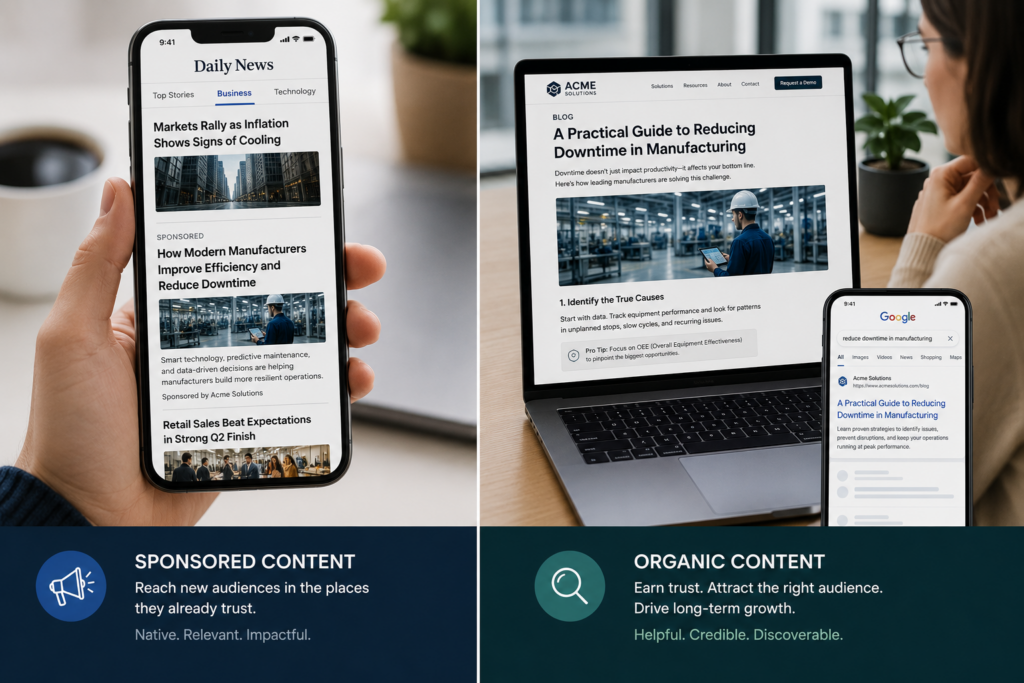
The Short Answer: What Each One Actually Is
Before the native advertising vs content marketing difference comparison, the definitions. These two terms get used loosely enough that it is worth being precise.
| Factor | Native Advertising | Content Marketing |
|---|---|---|
| What it is | Paid content that blends into the platform where it appears | Owned content published on channels your business controls |
| Where it lives | Third-party platforms: news sites, social feeds, recommendation networks | Your website, blog, email list, YouTube channel, social profiles |
| How it is distributed | You pay for placement and reach | Earned through SEO, organic social, and audience building |
| Speed of results | Fast: visibility starts when the budget starts | Slower: builds momentum over months |
| What happens when you stop | Visibility stops immediately | Content continues working long after it is published |
| Primary goal | Immediate reach and brand awareness at scale | Long-term trust, authority, and organic traffic |
| Budget model | Pay per click, impression, or placement | Investment in creation that builds compounding value |
The single most important distinction is in the last column on the right side: when you stop. Native advertising stops working the moment you stop paying for it. Content marketing keeps working, keeps ranking, and keeps attracting visitors long after the original investment was made. That difference shapes everything about when to use each one.
What Native Advertising Actually Does for Your Business
Native Advertising
Paid content that blends into the platform, designed to reach new audiences immediately
What is native advertising exactly? It is a specific type of paid media where your content matches the look, feel, and format of the platform it appears on. A sponsored article in a news publication that reads like editorial content. An in-feed post on LinkedIn or Facebook that looks like organic content from a brand someone follows. A promoted listing in a search engine results page that mirrors the organic results around it.
The key word is “blends.” Native ads are designed not to look like traditional display advertising. They do not have the banner format, the aggressive sales tone, or the visual interruption of a standard ad. They look like content. That is intentional, and it is what makes them more effective than traditional display advertising in several measurable ways.
According to research cited by eMarketer, native ads generate up to 18% higher purchase intent than traditional banner ads. They also have significantly higher click-through rates because they match the user’s existing content consumption behaviour rather than interrupting it.
Native advertising examples and common formats:
- Sponsored articles or editorial content on news and media sites
- In-feed sponsored posts on Facebook, Instagram, LinkedIn, TikTok, and X
- Promoted search listings on Google and Bing
- Content recommendation widgets (Taboola, Outbrain) at the bottom of articles
- Sponsored newsletter inclusions in third-party email publications
- Promoted listings on marketplace platforms
When native advertising is the right choice for your business
- You are launching a new product, service, or brand and need immediate reach to audiences who do not know you yet
- You have a time-sensitive campaign with a defined window: a seasonal promotion, event, or offer with a deadline
- You want to test messaging or positioning quickly with real audience data before committing to a long-term content strategy
- You have budget for paid distribution and need predictable, measurable reach within a specific timeframe
- Your organic presence is still early and you need traffic while your content marketing programme builds
- You are targeting a very specific audience that your own channels cannot currently reach organically
18%
higher purchase intent from native ads compared to traditional banner advertising, with significantly higher click-through rates across formats. Native ads also produce 9% higher brand affinity than standard display formats. Source: Sharethrough Native Advertising Research
What Native Advertising Costs
Native advertising pricing depends on the platform, format, and targeting. Here are realistic ranges based on current market rates:
- Social media native ads (Facebook, Instagram, LinkedIn): $0.50 to $5.00+ per click depending on audience and industry. LinkedIn is typically the most expensive, often $5 to $15 per click for B2B audiences.
- Content recommendation networks (Taboola, Outbrain): $0.10 to $1.50 per click, with minimum daily budgets of $10 to $100 depending on the platform.
- Sponsored editorial placements: $500 to $50,000+ depending on the publication’s audience size and authority.
- Promoted search listings: $1 to $50+ per click depending on keyword competitiveness and industry.
⚠️ The cost trap most businesses fall into
Native advertising costs are ongoing. Every click, every impression, every placement requires continuous budget. Businesses that rely entirely on native advertising for traffic and visibility are building on rented ground. The moment the budget stops, the visibility stops. This is manageable as part of a balanced strategy but dangerous as the only strategy.
What Content Marketing Actually Does for Your Business
Content Marketing
Owned content that builds compounding value, trust, and organic visibility over time
What is content marketing in practical terms? It is the practice of creating and publishing valuable content on channels your business controls, primarily your website, blog, email list, and social profiles, with the goal of attracting, educating, and building lasting relationships with your target audience.
The defining characteristic of content marketing is that you own the channel and the content. A blog post you publish today can still be generating organic search traffic and leads two years from now. An email list you build through your content programme is an asset you own outright, independent of any platform’s algorithm or pricing decisions.
Content marketing is how businesses build topical authority, which is the signal to both search engines and potential customers that you genuinely know your subject. Google’s helpful content guidelines are built around rewarding content that demonstrates real expertise, experience, and trustworthiness. Every piece of high-quality content your business publishes contributes to that reputation and compounds over time.
Content marketing examples and common formats:
- Blog posts and long-form articles optimised for search
- Guides, whitepapers, and in-depth resources
- Case studies and client success stories
- Email newsletters and nurture sequences
- Videos published on your YouTube channel or website
- Podcasts and audio content
- Social media content on your owned profiles
- Webinars and educational events
When content marketing is the right choice for your business
- You want to build sustainable organic traffic that does not depend on ongoing ad spend
- Your customers research extensively before buying and you want to be present throughout that research process
- You are building long-term brand authority and want to be seen as a trusted expert in your industry
- Your target audience uses search to find solutions to problems your business solves
- You want to generate leads without paying for every single one individually
- You are building an asset that grows in value over time rather than a campaign that ends
The compounding effect of content marketing explained
A native ad runs for 30 days and generates 500 clicks. When the budget ends, so do the clicks. A well-optimised blog post published in month one might generate 50 visits in its first month, 200 in month three, 800 in month six, and continue growing as it earns backlinks and builds authority. The initial investment is the same or lower, but the return compounds indefinitely. This is why content marketing is described as an asset, not an expense.
What Content Marketing Costs
- Freelance content writer (per blog post): $150 to $1,500 depending on length, research depth, and niche expertise
- Content marketing agency (monthly retainer): $2,000 to $15,000+ per month covering strategy, writing, SEO optimisation, and reporting
- In-house content hire (fully loaded): $60,000 to $100,000+ per year for a mid-level content marketer including tools and overhead
- SEO tools required: $100 to $500 per month for keyword research, rank tracking, and analytics
According to Siege Media’s content marketing benchmarks, businesses spending $6,000 or more per month on content marketing typically see meaningful organic traffic growth within six to nine months, with compounding returns beyond that.
The Core Difference: Rented Reach vs Owned Authority
Here is the mental model that makes the content marketing vs native advertising decision clearer for any business.
Native advertising benefits centre on speed and targeting. Native advertising gives you rented reach. You pay to appear in front of audiences on platforms someone else owns. The reach is real, the results can be significant, but you are always a tenant. If the platform changes its pricing, changes its algorithm, or becomes less relevant to your audience, your investment does not transfer.
Content marketing builds owned authority. Every piece of content you publish on your own site is an asset you own. Every email subscriber you earn is a direct relationship that no platform can take away. Every backlink your content earns strengthens your domain in ways that accumulate over time.
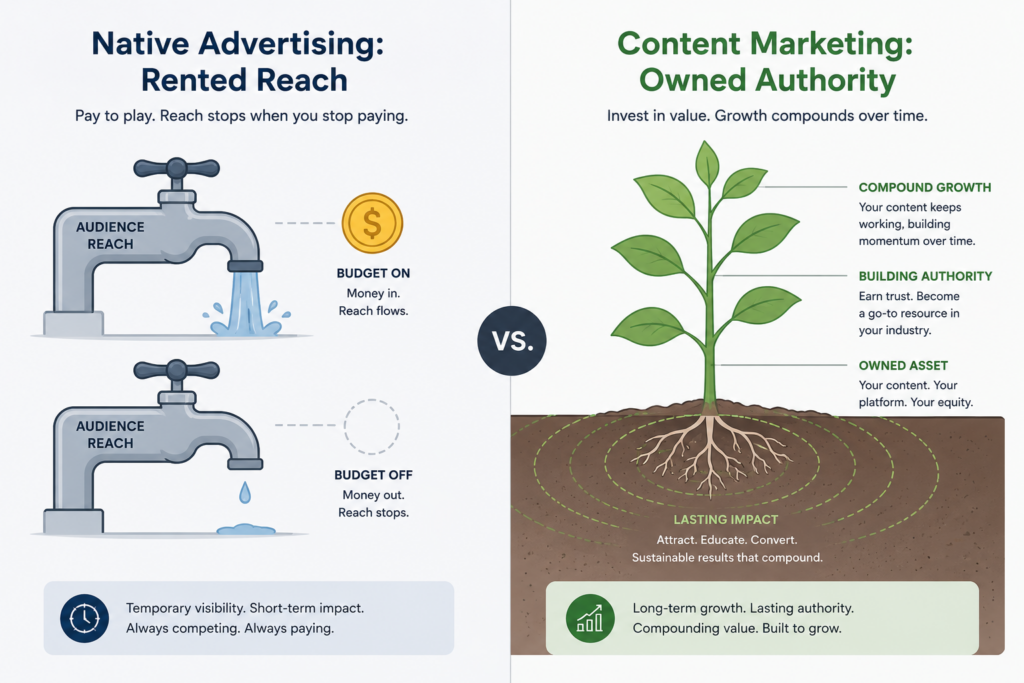
Neither model is better in absolute terms. They serve different strategic purposes and different business timelines. The mistake businesses make is choosing one entirely and missing what the other provides.
Head-to-Head: Where Each One Wins
| Factor | Native Advertising | Content Marketing |
|---|---|---|
| Speed to results | Wins: visibility within days | Slower: meaningful results in 3 to 9 months |
| Long-term ROI | Limited: stops when budget stops | Wins: compounds and grows over time |
| Audience targeting precision | Wins: demographic and psychographic targeting available | Relies on search intent and organic discovery |
| Trust and credibility | Lower: audiences are aware it is sponsored | Wins: editorial content builds genuine authority |
| Scalability without budget increase | Limited: more reach requires more spend | Wins: content continues generating results at no additional cost |
| Measurability | Wins: clicks, impressions, CPM, CPC easily tracked | Harder to attribute directly to revenue short-term |
| SEO impact | None: paid placement does not improve organic rankings | Wins: directly builds organic search visibility |
| Audience ownership | None: platform owns the audience relationship | Wins: email subscribers and organic audiences are owned |
| New brand awareness | Wins: reaches people who have never heard of you | Slower: relies on people finding you through search or referral |
| Cost predictability | Wins: CPM and CPC models are predictable | Variable: depends on content quality and competitive landscape |
The Business Stage Question: Where Are You Right Now?
One of the most practical ways to make this decision is to consider where your business is in its growth journey. The right balance between native advertising and content marketing shifts significantly depending on your stage.
Early-Stage Businesses and New Brands
When to use native advertising: if you have no organic presence, no domain authority, and no existing audience, content marketing alone will be slow and frustrating in the early months. Nobody is searching for your brand because they do not know it exists. Nobody is linking to your content because you have not established credibility yet.
For new businesses, a combination typically works best. Native advertising builds initial awareness and brings the first wave of traffic while your content programme is being established. The content marketing investment begins building the foundation of organic authority that will reduce your dependence on paid distribution over time.
Established Businesses With Existing Presence
If your business has an established domain, existing organic traffic, and a content programme already generating leads, the ROI case for content marketing is strong and well-evidenced. Your domain authority means new content ranks faster. Your existing audience amplifies new pieces. The compounding effect is already in motion.
Native advertising at this stage is most useful for specific campaign objectives: launching a new service, entering a new market, or accelerating a time-sensitive promotion, rather than as the primary engine of audience growth.
Competitive Markets With High Content Saturation
In markets where content on your key topics is already dense and highly competitive, the time and investment required to rank organically is substantial. Native advertising can generate results in those markets more reliably in the short term while a differentiated, high-quality content strategy builds the authority needed to compete organically over time.
The Practical Decision Framework
Which one is right for your business right now?
- You need results within 30 to 90 days: Native advertising. Content marketing cannot deliver meaningful results in that window. Use native to cover the short term while building content for the long term.
- You have a defined campaign with a deadline: Native advertising. Promotions, product launches, events, and seasonal campaigns need paid distribution to perform within their window.
- You are building for 12 months and beyond: Content marketing. If your goal is sustainable organic traffic and brand authority, there is no substitute. Every month you delay starting compounds the advantage your competitors who started earlier have over you.
- Your audience researches before buying: Content marketing. If your customers spend time comparing options, reading reviews, and educating themselves before making a decision, being present in that research phase with genuinely useful content is where decisions are influenced.
- You want to reach a brand new audience fast: Native advertising. Your own channels can only reach people who already know you. Native gets you in front of new audiences immediately.
- You want to own your marketing channel: Content marketing. An email list, a high-authority blog, and a strong organic search presence are assets you own. A native advertising audience is rented from the platform.
- Your budget is limited and you must choose one: Start with content marketing. The compounding return makes it more efficient over time. If you have any additional budget for paid amplification, use native advertising to promote your best content pieces rather than running standalone campaigns.
How Native Advertising and Content Marketing Work Best Together
The most effective approach for most businesses is not a choice between the two. It is a strategy that uses both in the roles they are genuinely best suited for.
Here is how the combination works in practice.
Your content marketing programme creates genuinely valuable, well-researched pieces on topics your audience cares about. These build organic authority over time and generate compounding traffic. Your native advertising programme promotes your best-performing content pieces to audiences outside your current reach, accelerating the early distribution of content that would otherwise take months to build an audience organically.
The result is that your native advertising spend goes further because it is amplifying content that is already demonstrably valuable, not just pushing paid placements that disappear when the budget runs out. And your content marketing programme builds faster because the paid distribution generates early signals of engagement that support organic ranking.
The most efficient use of a limited budget
If you have to choose, invest in content creation first. A piece of high-quality, well-optimised content will generate returns for years. Then allocate a smaller portion of your budget to native distribution of that content to accelerate its early reach. This is a better investment than spending the full budget on native placements that disappear when the money runs out.
The Transparency Question: What Businesses Often Miss
There is one aspect of native advertising that is worth addressing directly because it affects how your audience perceives your brand.
Native advertising is required by the FTC (Federal Trade Commission) and equivalent bodies in other countries to be clearly labelled as sponsored or paid content. The “blending in” quality of native advertising operates within those disclosure requirements. Audiences who read the label know they are looking at paid content, even if it reads like editorial.
This matters for trust. Research consistently shows that consumers are more sceptical of paid content than editorial content, even when the quality is identical. Content marketing, because it lives on your own channels and is not paid placement, does not carry that scepticism. It is simply your brand’s voice on your brand’s platform.
For businesses in industries where trust is the primary commercial asset, such as professional services, healthcare, finance, and legal, this distinction matters more than in impulse-purchase consumer categories. The more your customer needs to trust you before buying, the more valuable genuine content authority is relative to paid native placement.
FAQs:
What is the main difference between native advertising and content marketing?
Native advertising is paid content placed on third-party platforms that blends into the surrounding content. Content marketing is owned content published on channels your business controls. Native advertising provides immediate paid reach that stops when budget stops. Content marketing builds compounding organic authority and audience relationships that continue generating value indefinitely. One is rented reach. The other is owned authority.
Which has a better ROI: native advertising or content marketing?
It depends entirely on your timeframe and goals. Native advertising typically produces better short-term, measurable ROI on campaign-specific objectives. Content marketing produces better long-term ROI because the assets compound in value over time. HubSpot’s research consistently shows that businesses with active content programmes generate significantly more inbound leads at lower cost per lead than those relying primarily on paid distribution. But that advantage takes time to materialise.
Is native advertising the same as sponsored content?
They are closely related but not identical. Sponsored content is a specific type of native advertising where a brand pays a publisher to create or host content that is labelled as sponsored. Native advertising is the broader category that includes sponsored content alongside in-feed social ads, promoted search listings, and content recommendation placements. All sponsored content is native advertising, but not all native advertising is sponsored content.
How long does content marketing take to show results?
Meaningful organic traffic growth from content marketing typically takes three to six months for early movement and six to twelve months for consistent, compounding results. Highly competitive keyword spaces can take longer. This timeline is one of the most common reasons businesses give up on content marketing too early. The returns come, but they require patience and consistent investment. Businesses that stick with it for twelve months or more almost universally report that it becomes their most cost-efficient acquisition channel.
Can I use both native advertising and content marketing at the same time?
Not only can you, this is usually the most effective approach. Native advertising handles immediate reach and time-sensitive campaigns. Content marketing builds the long-term foundation of organic authority and owned audience. The best use of native advertising for a business that also does content marketing is to use paid distribution to amplify your best content pieces, getting them in front of larger audiences faster than organic alone would allow. This makes both investments work harder.
Does native advertising help with SEO?
Directly, no. Paid placements do not improve your organic search rankings. Indirectly, it depends. If your native advertising drives traffic to high-quality content on your site and that traffic engages genuinely with the content, those engagement signals can support your organic performance. If native advertising generates backlinks from publications hosting your sponsored content, those links can have direct SEO value. But native advertising should not be treated as an SEO strategy. It is a reach and distribution tool.
The Bottom Line
Native advertising and content marketing are not competitors. They are different tools for different jobs at different stages of your marketing programme.
Native advertising is fast, targetable, and immediate. It reaches new audiences, drives traffic on demand, and produces measurable results within defined campaigns. But it is rented, ongoing in cost, and leaves no lasting asset when the budget ends.
Content marketing is slow to start, requires consistent investment, and takes patience to see full results. But it builds something you own: a body of content that ranks, attracts, and converts indefinitely. An audience that knows and trusts your brand. Authority that compounds with every piece you add.
For most businesses the question is not which one to choose. It is how to allocate between them given your current stage, your goals, and your timeline. The businesses that grow most sustainably are almost always doing both, with native advertising providing short-term reach while content marketing builds the long-term foundation that reduces their dependence on paid distribution over time.