

Copywriting vs Copy Editing vs Content Writing: Which One You Need?
You need help with your business content. Maybe it is the website copy that never quite sounds right. Maybe it is a blog strategy that is not bringing in traffic. Maybe you have written something and it needs work before it goes out.
So you go looking for help and you run into three different terms: copywriting, content writing, and copy editing. Every freelancer and agency uses them differently. Some treat them as the same thing. Some use them interchangeably. Some use all three in their service list without explaining what they actually mean.
The result is that businesses end up hiring the wrong kind of help, briefing it incorrectly, and wondering why the output did not solve the problem.
This guide on copywriting vs copyediting vs content writing cuts through that. It explains what each service actually does for your business, what you get when you hire it, where the boundaries are, and most importantly how to figure out which one your specific content problem actually needs.
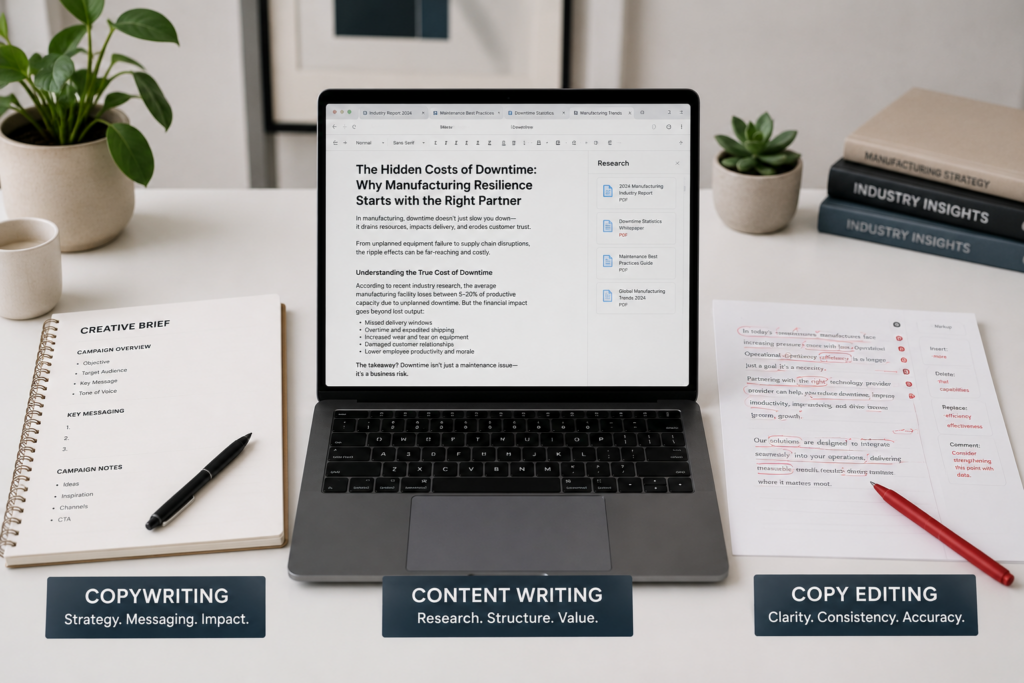
The Short Answer First
Before we go deeper, here is the clearest one-line version of each:
| Service | What It Does for Your Business | You Start With | You End Up With |
|---|---|---|---|
| Copywriting | Creates persuasive content designed to prompt a specific action | A brief and a goal | Original content that converts |
| Content writing | Creates educational or informational content that builds trust and visibility | A topic, audience, and strategy | Original content that attracts and informs |
| Copy editing | Improves existing content to make it cleaner, clearer, and more consistent | An existing draft | A polished, publication-ready version |
The most important word in that table is the starting point column. Copywriting and content writing both start from nothing. Copy editing starts from something that already exists. That single distinction explains most of the confusion.
What Copywriting Does for Your Business
Copywriting
Persuasive writing designed to get your audience to do something specific
Copywriting is what you need when you want your audience to take a defined action. Buy. Click. Sign up. Call. Request a quote. The copywriter’s job is to create content that moves a specific reader from where they are now to where you want them to go.
What is copywriting in practical terms? Think about the writing on your homepage. The headline that either grabs a visitor or loses them in the first three seconds. The button text that either earns a click or gets ignored. The email subject line that either gets opened or goes straight to the trash. The ad that either stops someone scrolling or disappears into the feed.
All of that is copywriting. Its purpose is action, not education. Its measure of success is what the reader does after reading it, not what they learned.
What your business gets from a copywriter:
- Website copy: homepages, landing pages, about pages, service pages
- Ad copy for Google, Meta, LinkedIn, and other paid channels
- Email marketing sequences: welcome series, nurture campaigns, promotional emails
- Sales pages and conversion-focused landing pages
- Product descriptions and eCommerce copy
- Brand messaging and taglines
- Video and podcast scripts
- Social media content written with commercial intent
When your business needs a copywriter
- Your website is getting traffic but visitors are not converting into enquiries or sales
- You are launching a new product, service, or campaign and need compelling content built from scratch
- Your current website copy sounds generic, off-brand, or like it was written without a clear audience in mind
- Your email open rates or click rates are low despite a reasonable list size
- Your ad spend is not generating the return it should and the messaging may be the problem
- You are rebranding and need your entire messaging repositioned
What Content Writing Does for Your Business
Content Writing
Educational or informational writing designed to attract, inform, and build long-term trust
Content writing is what you need when your goal is to bring people to you, establish your expertise, and build the kind of trust that eventually leads to commercial relationships. It operates over a longer timeframe than copywriting and works differently.
What is content writing in practical terms? Where copywriting pushes toward an immediate action, content writing pulls people toward you by giving them something genuinely useful. A blog post that answers a question your ideal customer is searching for. A guide that helps them understand a problem your business solves. A case study that shows how a business like theirs got results working with you.
Content writing is the engine behind organic search performance. According to Semrush, businesses that publish blog posts consistently generate significantly more organic traffic than those that do not. That traffic compounds over time because well-written content keeps ranking and attracting visitors long after it was published.
What your business gets from a content writer:
- Blog posts and articles written for SEO and audience education
- Long-form guides, whitepapers, and ebooks
- Case studies and client success stories
- Newsletter content and editorial email writing
- Social media content designed to inform or engage rather than directly sell
- FAQ pages and knowledge base articles
- Industry thought leadership content
When your business needs a content writer
- Your website has little or no organic search traffic and you want to build it
- You know what topics your audience cares about but do not have the time or team to write about them consistently
- You want to establish your business as a credible authority in your industry
- Your competitors are ranking for searches your ideal clients are making and you are not
- You have a content strategy but nobody to execute it
- You want to nurture leads with genuinely useful information over time rather than push them toward an immediate sale
55%
of marketers say improving content quality is the most effective content marketing tactic, ranking ahead of every other tactic including SEO, social media, and paid promotion. Source: HubSpot State of Marketing Report
What Copy Editing Does for Your Business
Copy Editing
The professional review process that makes your existing content clean, consistent, and credible
Copy editing is what you need when content already exists and it needs to be better before it goes out. The copy editor does not create. They improve. They take your draft, whether written by you, a copywriter, or a content writer, and make it more accurate, cleaner, more consistent, and more aligned with your intended standard before it reaches your audience.
What is copy editing in practical terms? A lot of businesses skip this step. They write something or receive a draft, read it once, decide it seems fine, and publish it. The result is content that is good enough but not quite right. Inconsistent terminology. Sentences that are technically correct but harder to follow than they need to be. A tone that drifts slightly from paragraph to paragraph. Small errors that individually are minor but collectively signal a lack of care.
Your audience does not always notice these things consciously. But they feel them. Content that has been properly copy edited reads more smoothly, communicates more clearly, and leaves a better impression of the brand behind it than content that has not.
Copy editing is not the same as proofreading
Proofreading is the final sweep before publication that catches typos, missing punctuation, and formatting inconsistencies. Copy editing is more substantive and happens earlier. A copy editor looks at clarity, flow, consistency, tone, and structure. They might rewrite a confusing sentence, flag a factual claim that needs checking, or identify where the logic of an argument breaks down. Proofreading polishes the surface. Copy editing improves the substance.
What your business gets from a copy editor:
- Errors in grammar, punctuation, and spelling corrected
- Sentences and paragraphs restructured for improved clarity and flow
- Consistent terminology and brand voice applied throughout
- Adherence to your style guide or a recognised style standard
- Factual claims flagged for verification
- Logical gaps or inconsistencies in the content identified
- Content formatted consistently with correct heading hierarchy and structure
When your business needs a copy editor
- You are producing content at volume and need a quality control layer before anything goes live
- Your existing content is inconsistent in tone, terminology, or style across different pieces
- You are in a regulated industry where accuracy and precision are non-negotiable (healthcare, legal, finance)
- You have a style guide and need someone to enforce it consistently across all content
- Your copywriter or content writer produces strong drafts that consistently need polishing before they are client-ready
- You are preparing a major piece of content such as a brand guide, annual report, or comprehensive resource for publication
The Biggest Difference: Goal, Not Just Process
Here is the clearest way to think about all three services together.
The question every business owner asks when comparing a copy editor vs copywriter is: which one do I actually need? Every piece of content your business publishes has a job. The question is: what job does this piece need to do?
- If the job is to get someone to take a specific action (buy, click, call, sign up) you need copywriting.
- If the job is to attract, educate, and build trust with people who do not know you yet, you need content writing.
- If the job is to make sure existing content does its job as well as it possibly can, you need copy editing.
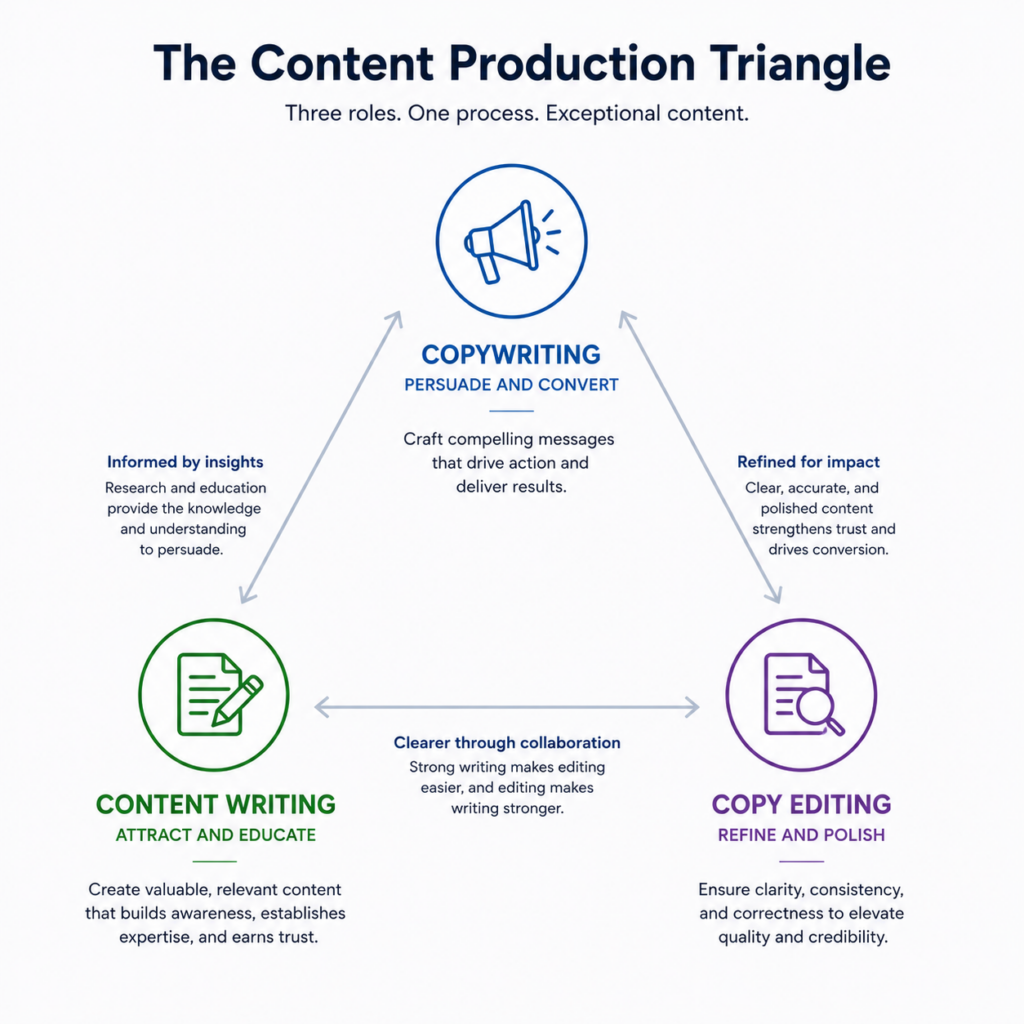
Copywriting and content writing are about creation. Copy editing is about refinement. Both creation and refinement are necessary for content that performs at a professional standard. Most businesses that are unhappy with their content results are either missing one of the creation disciplines or skipping the refinement stage entirely.
Where the Boundaries Blur
In practice, the lines between these three services are not always perfectly clean. Here is where the overlap shows up most often and what it means for hiring decisions.
Copywriting vs Content Writing
A blog post written primarily to rank in search and attract traffic is content writing. A blog post written primarily to move a reader toward requesting a demo is closer to copywriting. In practice, most effective long-form content does both: it educates and it converts. The primary intent determines which skill set should lead.
When you brief a writer, be clear about the primary goal. “Rank for this keyword and build authority” is a content writing brief. “Rank for this keyword and convert readers into enquiries” is a brief that requires both content writing skill and copywriting intent. Knowing the difference helps you find the right person and evaluate the output correctly.
Content Writing vs Copy Editing
Some content writers offer light editing as part of their service. This covers basic self-editing and consistency checks but is not the same as professional copy editing by a specialist. If your content is high-stakes, brand-defining, or highly visible, a separate copy editing pass from a dedicated editor will produce a materially better result than self-editing by the writer.
When One Person Does All Three
Some writing professionals offer all three services. For small projects or early-stage businesses, this can be practical. But there is an important limitation: editing your own copy is cognitively difficult. When you write a piece of content, your brain knows what you intended to say. When you then review it, it tends to see the intended version rather than what is actually on the page. This is why professional publishing operations, from major media outlets to large brand content teams, always route content through a separate editorial review regardless of how experienced the writer is.
 The most common mistake businesses make
Hiring a copy editor to fix a strategic problem. If your website is not converting, the issue is almost never grammar or consistency. It is strategy: the wrong message for the wrong audience with the wrong call to action. A copy editor will make your current ineffective content error-free. A copywriter will replace it with something that actually works. Diagnose the problem before you decide which type of help to hire.
What Each Service Typically Costs
Understanding typical rates helps you budget realistically and spot when pricing signals a quality concern. These figures reflect current freelance market rates based on data from the Editorial Freelancers Association and industry surveys.
Copywriting
Freelance hourly: $50 to $200+
Landing page: $500 to $3,000+
Email sequence (5 emails): $500 to $2,500
Website (5 to 8 pages): $2,000 to $8,000+
Specialist copywriters (direct response, SaaS, finance) command significantly higher rates.
Content Writing
Freelance hourly: $30 to $120
Blog post (1,000 words): $150 to $600
Long-form guide (2,500+ words): $400 to $1,500
Monthly retainer (4 posts): $800 to $3,000+
Niche expertise (healthcare, legal, technical) increases rates significantly.
Copy Editing
Freelance hourly: $30 to $80
Per word: $0.02 to $0.05
Blog post edit: $50 to $200
Monthly retainer: $500 to $2,000+
Specialist editors (medical, legal, technical) charge $75 to $150+ per hour.
A note on very low rates: copywriters offering full website copy for $100 or content writers charging $10 per blog post are almost always producing template-level or AI-generated work that will need significant rework before it does anything useful for your business. The cost of fixing poor content often exceeds the cost of commissioning good content from the start.
The Practical Decision Guide: Which One Does Your Project Need?
Ask yourself these questions to identify what you actually need
- Does the content exist yet? If no, you need a copywriter or content writer, not an editor.
- What is the primary goal of this content? If it is to get an immediate action (buy, click, call), you need copywriting. If it is to build trust and attract traffic over time, you need content writing.
- Is the content underperforming? If it is getting traffic but not converting, that is usually a copywriting problem. If it is not getting traffic, that is usually a content strategy or content quality problem. Either way, editing is not the fix.
- Does the content exist but feel rough or inconsistent? If the structure and message are right but the execution needs polishing, you need copy editing.
- Are you producing content at volume? If you are publishing regularly, you need both content writing and copy editing as separate steps in your workflow. Quality at volume requires a production process, not just a single writer.
- Are you in a regulated or high-stakes industry? Healthcare, legal, financial, and technical content needs both strong writing and a separate editorial review before publication. The cost of a mistake is too high to skip either step.
How These Three Services Work Together
The most effective content programmes do not choose between these services. They use all three in sequence.
A copywriter creates the homepage, landing pages, and conversion-focused content. A content writer builds the blog, resource library, and educational content that drives organic traffic and nurtures leads. A copy editor reviews everything before it goes live to ensure quality, consistency, and accuracy across every piece.
That sequence, creation then refinement, is how professional content programmes at any serious company operate. The businesses whose content consistently reads well, ranks well, and converts well are almost always following some version of this workflow, whether they have named it or not.
A practical workflow for small businesses and growing teams
When to hire a copywriter
first: if budget is limited, prioritise in this order. First, invest in copywriting for your highest-value pages: homepage, main service pages, and any active landing pages. These are the pages that directly affect whether visitors become customers. Second, invest in content writing for SEO-driven blog and resource content. This builds organic traffic over time. Third, add copy editing as a quality layer once your content volume justifies it. Even a monthly editorial review of your published content catches accumulated inconsistencies before they compound.
FAQs: Copywriting vs Copy Editing vs Content Writing
What is the difference between copywriting and content writing?
Copywriting is designed to get an immediate response or action: a purchase, a click, a sign-up. It is short to medium-form, persuasion-focused, and measured by conversion. Content writing is designed to educate, inform, or build trust over time. It is typically longer-form, value-focused, and measured by traffic, engagement, and authority. Both create original content from scratch. The primary intent is what separates them.
Is copy editing the same as proofreading?
No, and the difference matters practically. Proofreading is the final check for surface errors immediately before publication: typos, missing punctuation, formatting inconsistencies. Copy editing is more substantive and happens earlier in the process. It addresses clarity, flow, logical consistency, tone, and adherence to style guidelines. If you only proofread, you catch the typos but miss the structural and clarity issues that affect how your audience receives the content.
My website is not converting. Do I need a copywriter or a copy editor?
Almost certainly a copywriter. Conversion problems are almost never caused by grammar errors or inconsistent punctuation. They are caused by messaging that does not connect with the audience, calls to action that are unclear or unconvincing, or a page structure that does not guide the visitor toward a decision. A copy editor will make your current non-converting copy error-free. A copywriter will replace it with copy that actually works. The two problems require different solutions.
Can one writer do all three: copywriting, content writing, and copy editing?
Technically yes. Practically, there are limits. Most strong copywriters are average content writers and most strong content writers are average copywriters, because the skills lean in different directions. And editing your own work is always cognitively limited because you are too close to what you intended to write to catch all the gaps in what you actually wrote. For high-stakes or high-volume content, using the right specialist for each role consistently produces better results than relying on one generalist for everything.
How do I brief a copywriter vs a content writer?
A copywriter needs to understand your audience, the specific action you want them to take, the objections or hesitations they might have, and the channel where the content will live. A content writer needs to understand the topic, the search intent behind it, the audience’s knowledge level, and what you want them to understand or feel by the end of the piece. Both need to understand your brand voice. The clearest signal of which briefing to use is this: if you are measuring success by what the reader does, brief a copywriter. If you are measuring success by what the reader learns or how long they stay, brief a content writer.
Do I need all three for my business?
For most businesses with an active digital presence, yes, eventually. You need copywriting for your conversion-critical pages and campaigns. You need content writing to build organic visibility and audience trust over time. And you need copy editing to ensure consistent quality across everything you publish. The order in which you invest depends on where the biggest gap is in your current content programme. Most businesses start with copywriting for their core pages and add content writing and copy editing as their content programme matures.
The Bottom Line
Copywriting, content writing, and copy editing are three distinct services that serve different purposes in your business content programme. Hiring the wrong one for the wrong problem wastes budget and leaves the actual issue unsolved.
Copywriting creates persuasive content that drives action. Content writing creates educational content that builds visibility and trust. Copy editing refines existing content to the standard it needs to reach before your audience sees it.
The most effective content programmes use all three. But knowing which problem you are actually trying to solve right now tells you exactly where to start.