
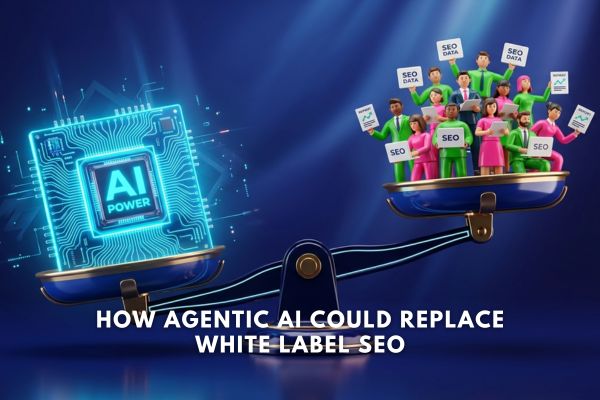
Let’s start with a story because it is going to hit close to home for a lot of agency owners.
A small business SEO agency in Australia lost four retainer clients in 90 days. Not to a competitor. To ChatGPT. His clients fired up an agentic AI tool, produced 200 blog posts over a weekend, and decided they no longer needed to pay a monthly retainer.
Three months later, two of them quietly came back asking him to fix the mess. The other two are still out there, publishing content that ranks for nothing and gets cited by no one.
That gap, between what agentic AI promises in a demo and what it actually delivers in the real world, is the most important conversation happening in digital marketing right now.
If you are an agency owner, a freelancer, or a business that relies on white label SEO services, you need to understand how agentic AI could replace white label SEO and what that means for you. Not to panic. Not to fire your SEO team on Monday morning. But to make smarter decisions about where you put your money and your trust going forward.
What is White Label SEO and Why Does It Exist?
Before we talk about what might replace it, let us make sure we are all on the same page about what white label SEO actually is.
A white label SEO agency handles fulfillment tasks like link building, technical SEO, local SEO, reporting, content, or SEO audits on behalf of other agencies.
With white labeling, the fulfillment provider stays invisible to the client while the reselling agency takes the credit.
In plain terms: Agency A sells SEO services to a business. Agency A does not actually do the SEO work. They pay Agency B to do it behind the scenes. The client never knows Agency B exists. Agency A keeps a margin and looks like the expert.
It is a model that has worked well for years. It lets smaller agencies offer a full menu of services without hiring a full team. It lets freelancers scale beyond what they could personally deliver. It keeps overhead low and client relationships intact.
The tasks that typically get white labeled include:
- Keyword research and strategy
- On-page optimization
- Technical SEO audits and fixes
- Content writing and blog posts
- Link building and outreach
- Local SEO and citation building
- Monthly reporting and dashboards
All of it, done by a team you never see, packaged under your brand and sent to your client like you did it yourself.
It is not a broken model. It has helped thousands of agencies grow. But agentic AI is now capable of doing almost every single one of those tasks. And it does them faster, cheaper, and in some cases better than a human team working on a standardized process.
What is Agentic AI and Why is it Different from Regular AI?
You have probably heard of ChatGPT. You have maybe used it to write an email or brainstorm ideas. That is generative AI. You give it a prompt and it gives you an output. You are still doing the thinking. The AI is just producing the text.
While generative AI tools such as OpenAI’s ChatGPT, Anthropic’s Claude and Canva’s Magic Studio produce results based on exact prompts, agentic AI completes tasks based on context clues.
Agentic AI is a completely different thing. You give it a goal, not a prompt. And then it figures out how to achieve that goal on its own.
Agentic AI refers to autonomous artificial intelligence systems that can plan, decide and perform goal-directed action with minimal human help.
Unlike purely generative AI models that require explicit instructions from users, agentic systems operate proactively through continuous perception-reasoning-action loops that enable them to analyze, plan, execute and refine tasks dynamically.
Here is a simple way to think about it. Regular AI is like asking a very smart intern to write you one blog post right now.
Agentic AI is like hiring a full-time employee, telling them your content goals for the quarter, and watching them research, write, optimize, publish, and report back to you without you doing anything in between.
According to Gartner, by 2028, 33% of enterprise software applications will include agentic AI, up from less than 1% in 2024, enabling 15% of day-to-day work decisions to be made autonomously.
That is not a distant future prediction. That is three years away. And a lot of it is already happening right now in SEO specifically.
What Can Agentic AI Actually Do in SEO Today?
This is where things get real. Let us look at the specific white label SEO tasks that agentic AI can already perform in 2025 and 2026.
1. Content Creation at Scale
Agents can produce 500 location pages or product comparison pages with unique data, fact-check against source databases, and publish via API.
That is not a blog post. That is an entire content operation. Location pages, service pages, comparison content, FAQs, all generated, checked, and published without a human touching each one individually. For agencies doing white label content writing, this is the most direct threat.
2. Technical SEO Audits and Fixes
Agents can detect 404s, crawl issues, duplicate content, and auto-suggest or auto-implement fixes. Technical SEO audits are one of the most time-intensive parts of any white label SEO package.
An agent can now crawl a site, identify every issue, prioritize them by impact, and in some cases fix them automatically. What used to take a human team days now takes an agent hours.
3. Keyword Research and Strategy
LLM-powered keyword clusterers can group intent and recommend full content hierarchies.
Keyword research used to require a specialist who understood both data and search intent. AI agents now combine both. They pull data, group keywords by intent, identify gaps, and map out an entire content strategy automatically.
4. Link Building Outreach
Autonomous agents can scrape sites for link opportunities and send templated yet personalized cold outreach.
Link outreach is one of the most expensive and labor-intensive white label SEO services. Agents are now doing the prospecting, the personalization, and the sending. The quality is still a fair debate, but the speed and volume are not.
5. Reporting and Analytics
AI agents autonomously plan, execute, and iterate on content strategy, researching keywords, writing drafts, optimizing for search, publishing to your CMS, and recovering rankings when they drop.
Reporting dashboards, performance summaries, and rank tracking updates that used to require a human to compile and format are now being generated automatically by agents that pull directly from Google Search Console, Ahrefs, and SEMrush.
So Is Agentic AI Going to Kill White Label SEO?
Here is the honest answer. Kind of. But not completely. And the nuance matters a lot.
The thing most agencies miss is that agentic systems are not replacing one task. They are collapsing the gaps between tasks, which is where most agency hours and margin actually live.
That is the key insight most competitors writing about this topic are missing. It is not that AI is going to do keyword research instead of humans.
It is that AI is going to do keyword research, turn it into a content brief, write the content, optimize it, publish it, and report on its performance, all in one connected workflow that previously required five different people and five different tools.
The white label SEO model works because agencies are paid for the labor and expertise required to connect all those dots.
When an agent can connect them automatically, the labor cost disappears. And with it, a big part of the reason agencies pay a white label provider in the first place.
What once required a team and ten or more SaaS products can now be done by one person and a handful of intelligent agents working behind the scenes.
Where Agentic AI Still Falls Short
Before you cancel your white label SEO contract, here is the other side of the story that most articles are not telling you clearly enough.
Brand Voice Drifts at Scale
A single agent run can match your voice. Five hundred pages produced over six months will drift. Without an editorial human at the gate, you end up with a site that reads like the programmatic content Google demoted in the March 2024 helpful content update, and is still demoting in 2026.
AI agents are good at producing content. They are not good at consistently sounding like a specific brand over time. The longer an agent runs without human oversight, the more the content starts to sound like everyone else.
Strategic Judgment Still Requires Humans
Should you go after this keyword cluster or that one? Is this competitor a real threat or a flash in the pan? Should you sunset this product line in your content? Agents will give you confident answers. They will sometimes be confidently wrong.
Agentic AI is excellent at execution. It is not excellent at judgment. Knowing which keywords to go after, which content to retire, and which opportunities actually matter for a specific business at a specific stage, that still requires a human who understands the bigger picture.
Governance is Lagging Behind Adoption
Only one in five companies has a mature governance model for autonomous AI agents even as agentic AI usage is poised to rise sharply.
Most businesses and agencies adopting agentic AI are doing it faster than they are building the guardrails around it. That gap is dangerous.
AI agents that are not properly governed can publish incorrect information, create duplicate content, chase the wrong keywords, or produce output that actively hurts a site’s rankings.
Relationships and Trust Cannot Be Automated
The white label SEO model has always been about more than task completion. It is about a client trusting that someone understands their business.
That trust, the phone call that reassures a nervous client, the strategic recommendation that comes from knowing a client’s industry inside out, that is not something an agent delivers.
The Future of White Label SEO in an Agentic AI World
White label SEO is not going to disappear overnight. But the model is going to change significantly over the next two to three years, and the change is already underway.
The white label providers that survive will be the ones that incorporate agentic AI into their own fulfillment workflows, not to replace humans entirely, but to dramatically increase the speed and scale at which humans can work. The ones who do not adopt will find it increasingly hard to compete on price.
SEO is now interpreted by language models, scaled by autonomous agents, and validated by factual integrity, not manual checklists.
For agencies, the opportunity is in repositioning. Stop selling SEO as a service and start selling SEO strategy, oversight, and results. Use agentic AI tools to handle the execution.
Use your human judgment to handle the decisions. That combination is genuinely hard to replicate and genuinely valuable to clients.
For businesses, the opportunity is in asking better questions. Not just who is doing the work, but whether the work is being done with a real understanding of your business or just a standardized process with your logo on the report.
Conclusion
Agentic AI is not replacing white label SEO tomorrow. But it is already doing the tasks that white label SEO has traditionally been paid to do. The gap between what AI can execute and what a human strategist can think is the only defensible space left in the market.
The agencies and providers who understand that difference and build around it will be the ones still growing in 2027. The ones who keep selling the same standardized fulfillment packages without evolving will find that their clients eventually figure out they can get the same thing from an agent for a fraction of the price.
The question is not whether agentic AI will change white label SEO. It already has. The question is whether you are going to be on the right side of that change when it fully hits.
FAQs
Is agentic AI already being used in SEO right now?
Yes. As of 2025 and 2026 agentic AI is already being used for technical SEO audits, content production at scale, keyword clustering, link outreach and automated reporting. It is not a future concept. Agencies and businesses are actively using it in their workflows right now.
Can agentic AI fully replace a white label SEO provider?
Not entirely. Agentic AI can replace the repetitive, process-driven tasks white label SEO providers fulfill but strategic judgment, brand-specific thinking and client relationships still need humans. Fulfillment is at risk. Strategy is not.
Which white label SEO tasks are most at risk from agentic AI?
The tasks most at risk are the standardized and process-driven ones. Content writing, technical audits, keyword research, basic link outreach and monthly reporting are all being automated by agentic AI tools right now.
Will agentic AI make white label SEO cheaper for agencies?
Yes. As agentic AI handles more of the fulfillment work, the cost of producing SEO deliverables will drop significantly. White label SEO providers that do not adopt agentic AI into their own workflows will struggle to compete on price against those that do.
How does agentic AI affect content quality in SEO?
Agentic AI produces content fast but quality degrades without human oversight. Brand voice drifts, relevance slips and content starts resembling the generic programmatic pages Google has been demoting since its 2024 helpful content update. Human oversight remains essential at scale.